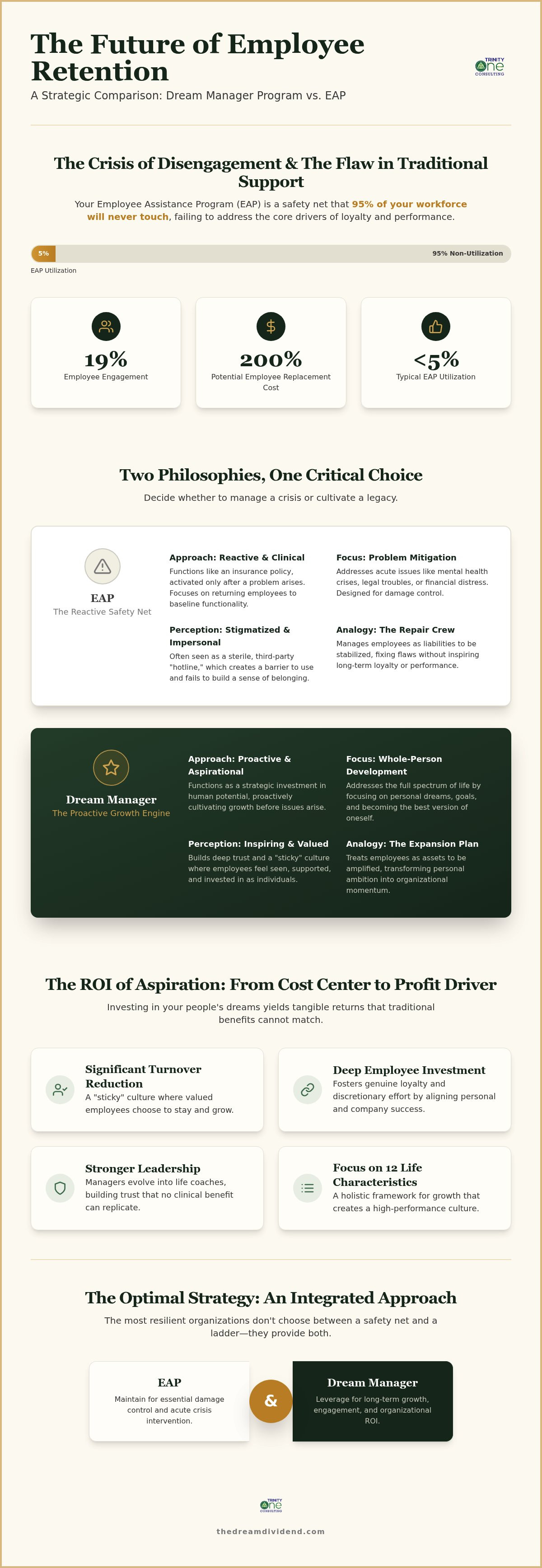
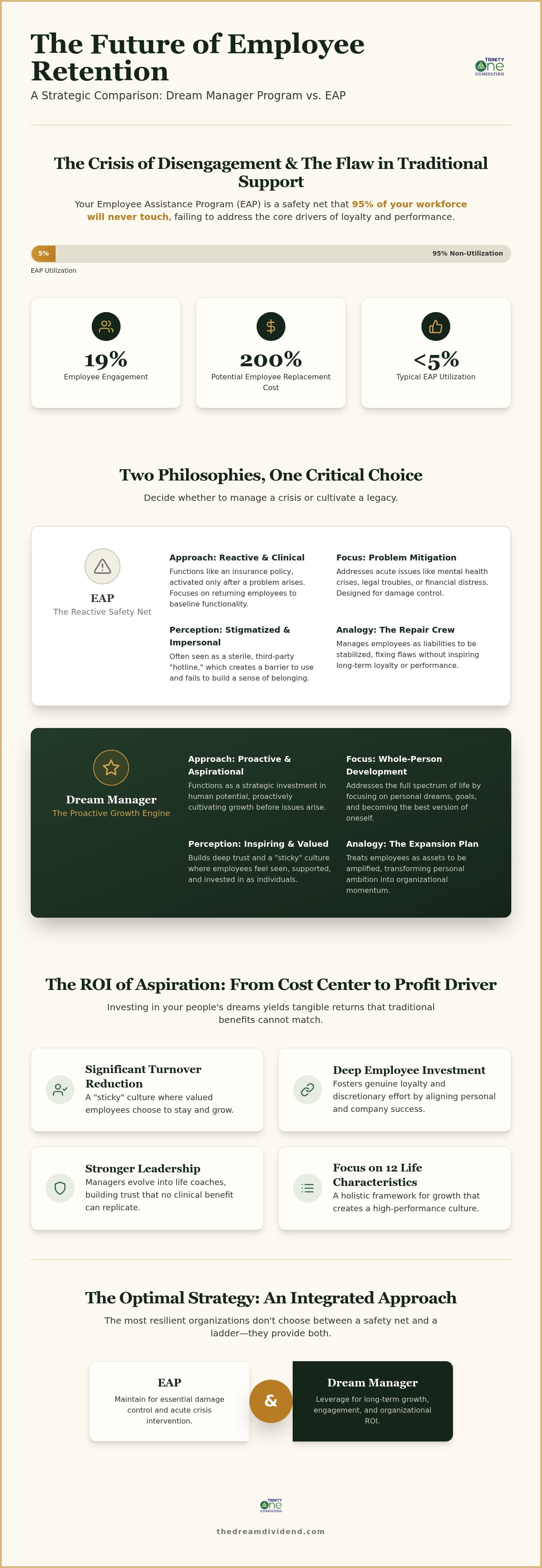
If you think your Employee Assistance Program is the cornerstone of your retention strategy, you're likely subsidizing a safety net that 95% of your workforce will never touch. With industry utilization rates often stuck below 5%, these traditional programs function as reactive insurance policies rather than proactive growth engines. It's a sterile approach to a human problem, and it fails to address the reality that replacing a single employee can cost up to 200% of their annual salary. When you compare the dream manager program vs eap, you aren't just choosing between two benefits; you're deciding whether to manage a crisis or cultivate a legacy.
We understand the pressure to provide support while maintaining a lean bottom line. You want a workforce that feels seen, valued, and energized, yet the typical corporate culture often feels devoid of purpose. This article reveals how the Dream Manager framework transforms personal aspirations into tangible organizational dividends. We'll explore how addressing the 12 Life Characteristics creates a culture of deep investment, reduces recruitment costs, and builds a foundation where your people's success becomes the fuel for your company's future.
Key Takeaways
- Identify the "inspiration gap" within your organization to move beyond reactive safety nets toward a proactive investment in human potential.
- Evaluate the strategic differences of a dream manager program vs eap to transition from clinical crisis management to a framework built on personal aspiration.
- Utilize tools like the DreamCompass to map employee goals, fostering a "sticky" culture that significantly reduces turnover and recruitment expenses.
- Shift your perspective on employee well-being from a traditional cost center to a profit driver by focusing on the 12 Life Characteristics.
- Learn to integrate a hybrid approach that maintains EAPs for essential damage control while leveraging Dream Management to cultivate long-term organizational ROI.
Table of Contents
- The Crisis of Disengagement: Why Traditional EAPs Fall Short in 2026
- Defining the Frameworks: EAP vs. The Dream Manager Program
- The ROI of Aspiration: Comparing Engagement and Retention Metrics
- Strategic Integration: Can Dream Management and EAPs Coexist?
- Cultivating the Dream Dividend: Your Path to a High-Performance Culture
The Crisis of Disengagement: Why Traditional EAPs Fall Short in 2026
The modern corporate landscape is facing a profound paradox. While benefit packages have never been more robust or expensive, employee engagement has plummeted to just 19% as of June 2026. Organizations are pouring capital into resources that remain largely untouched, creating a structural weakness in their cultural architecture. This disconnect highlights the fundamental tension in the dream manager program vs eap debate. Traditional benefits are designed to catch employees when they fall, but they offer no incentive for them to climb. They function as a safety net that's often invisible until a crisis occurs, leaving the vast majority of the workforce feeling overlooked and uninspired.
The statistical reality is jarring. Despite the depth of employee burnout reported in 2026, where 86% of workers view well-being as equal to salary, EAP utilization rates frequently hover below 5%. This gap exists because clinical benefits are often perceived as sterile, cold, and detached from the daily human experience. When the only support offered is a toll-free number for "damage control," employees don't feel a sense of belonging. They feel like a liability being managed. This is why "quiet quitting" persists even in firms with comprehensive traditional packages. You can provide a safety net without ever providing a reason to stay.
The Limits of Reactive Management
Most organizations rely on an Employee Assistance Program (EAP) as their primary defense against turnover. These programs focus almost exclusively on problem mitigation, such as mental health crises, legal issues, or acute financial stress. While these are necessary services, they are inherently reactive. They exist for the crash, for the breakdown, and for the aftermath. Furthermore, the stigma of the "hotline" remains a significant barrier. Many employees hesitate to use these resources, fearing that seeking help signals a lack of professional competence. Solving a problem is not the same as creating a motivated employee. You can fix a structural flaw in a building without ever making it a place where people want to live. In the same way, you can manage a crisis without ever inspiring loyalty or high performance.
The Shift Toward Whole-Person Development
Visionary leaders are moving beyond reactive management and toward the concept of Becoming the Best Version of Yourself. This philosophy recognizes that an employee's personal growth is a vital, strategic asset that compounds over time. It requires a fundamental shift where the role of the manager evolves into that of a life coach who navigates the complexities of human aspiration. When you invest in the individual's dreams, you build a foundation of trust that no clinical benefit can replicate. It's about seeing the person, understanding their trajectory, and aligning their personal success with the company's mission. A Dream Manager is a proactive growth partner who transforms personal ambition into long-term organizational momentum.
Defining the Frameworks: EAP vs. The Dream Manager Program
To choose the right path for your organization, you must first understand the structural differences between these two methodologies. They represent entirely different philosophies of human management. One views the employee as a variable to be stabilized; the other views them as an asset to be amplified. When evaluating the dream manager program vs eap, you are looking at the difference between a repair crew and an expansion plan. If your goal is simply to maintain the status quo, a traditional benefit might suffice. However, if you seek to build an organization that thrives on innovation and loyalty, you need a framework that addresses the human spirit.
What is an Employee Assistance Program (EAP)?
An EAP is a clinical, typically outsourced resource designed to provide short term intervention for personal or professional problems. According to the official definition of an EAP, these programs are intended to help employees deal with issues like substance abuse, emotional distress, or financial difficulties that might adversely affect job performance. The primary goal is a return to baseline functionality. Because these services are usually provided by third party vendors, they often feel disconnected from the company's unique culture and values. They are essential for crisis management, yet they are inherently limited by their reactive nature. They solve the immediate problem, but they do not ignite the long term passion required for true organizational excellence.
What is the Dream Manager Program?
The Dream Manager Program, based on the visionary work of Matthew Kelly, operates on a completely different frequency. It is an internal, strategic framework that focuses on helping employees identify and achieve their personal dreams. This approach recognizes that when an individual is actively pursuing their best life, they bring a higher level of energy, commitment, and creativity to their professional role. By utilizing the DreamCompass tool, organizations can map the aspirations of their people and provide the structured coaching necessary to turn those dreams into reality. This isn't just about "feeling good" at work; it's about a systematic investment in the people who drive your success.
The program utilizes the 12 Life Characteristics as a blueprint for human excellence, covering everything from physical health and financial literacy to emotional maturity and spiritual growth. It is a holistic approach to development that yields compounding dividends for the organization. As you explore these frameworks, you might find it helpful to listen to The Dream Dividend Podcast for deeper insights into how visionary leaders are implementing these strategies. The ultimate objective is to help every member of your team in Becoming the Best Version of Yourself. When the company helps the employee win at life, the employee helps the company win in the marketplace.
The ROI of Aspiration: Comparing Engagement and Retention Metrics
Every financial decision in a modern business requires a clear vision of its yield. Traditional EAPs are historically categorized as overhead; they are a necessary expense to mitigate the risks of human fragility. However, viewing the dream manager program vs eap through a purely fiscal lens reveals a transformative opportunity. While the EAP acts as a static cost center, the Dream Manager Program functions as a dynamic investment in human capital that compounds over time. It's the difference between paying for a safety net and investing in a launchpad.
When an employee realizes that their professional home is the very vehicle helping them achieve their personal dreams, turnover rates plummet. This is the "Dream Dividend." It's the measurable return you receive when you move beyond sterile benefits toward a culture of aspiration. Top-tier talent in 2026 no longer chooses employers based on a list of clinical resources. They seek organizations where their potential is mapped, nurtured, and realized. By shifting your focus from managing problems to managing potential, you create an environment that attracts high performers and keeps them anchored to your mission.
Retention through Personal Growth
A "sticky" culture isn't built on free snacks or basic insurance; it's built on a shared trajectory. When an employee's personal goals are inextricably linked to their professional success, the desire to seek opportunities elsewhere vanishes. By utilizing the 12 Life Characteristics as a framework, leaders can systematically reduce the stressors that lead to burnout and attrition. By empowering leaders with a Certified Dream Manager designation, you signal a profound commitment to your team's future, weaving their personal success into the very fabric of the company's long-term vision. This structural alignment ensures that as the individual grows, the organization expands alongside them.
Engagement as a Competitive Advantage
There is a vast difference between an employee who is simply "problem-free" and one who is truly inspired. An EAP may help a worker return to a baseline of functionality after a crisis, but it does nothing to ignite the creative fire required for high performance. In contrast, the Certified Dream Manager program equips mid-level management with the tools to act as strategic mentors rather than just taskmasters. This shift in management style transforms the daily grind into a mission-driven pursuit. You can see how leadership development podcasts are currently reframing these engagement metrics as the ultimate competitive advantage in a crowded marketplace. When your people win, your bottom line reflects their victory through increased loyalty, productivity, and innovation.
Strategic Integration: Can Dream Management and EAPs Coexist?
The most effective organizational architectures aren't built on a single pillar but on a balanced ecosystem of support. Many leaders mistakenly believe that choosing a dream manager program vs eap requires dismantling their existing benefits. This is a strategic error. In reality, these two frameworks function best when integrated as a "both/and" strategy. Think of your EAP as the fire extinguisher and the Dream Manager Program as the architectural plan for expansion. You need the former for emergencies, but you rely on the latter for sustainable growth and structural integrity.
Integrating these systems requires a methodical, four step approach to ensure a high return on value:
- Step 1: Audit the Inspiration Gap. Analyze your current benefit utilization. If your EAP engagement remains stagnant while turnover continues to rise, you have identified a gap where employees feel supported in crisis but uninspired in their daily roles.
- Step 2: Train Internal Catalysts. Empower your leadership team through the Certified Dream Manager program. This turns managers into mentors who can navigate the delicate balance between professional expectations and personal aspirations.
- Step 3: Deploy the DreamCompass Tool. Use this diagnostic framework to begin intentional conversations about what your people actually want to achieve. This shifts the internal dialogue from "What can you do for the company?" to "How can the company help you become the best version of yourself?"
- Step 4: Align with the 12 Life Characteristics. Ensure your organizational goals reflect a holistic commitment to well-being, from financial literacy to physical vitality. This alignment creates a culture that top tier talent finds impossible to leave.
The Hand-off: When to use EAP vs. Dream Management
Clarity is the foundation of a successful support ecosystem. It's vital to define the boundaries between clinical intervention and aspirational coaching. An EAP is the appropriate resource for clinical therapy, substance abuse intervention, or acute legal crises. Conversely, a Dream Manager focuses on the future, helping employees build the life they've always imagined. A trained Dream Manager possesses the discernment to identify when an employee's challenges move beyond coaching and require a professional referral to the EAP. This seamless hand-off ensures the "Whole Person" is cared for without blurring the lines of professional expertise.
Building the Dream-Driven Infrastructure
Creating this culture isn't an overnight event; it's a 90 day journey toward re-engagement. Leadership must be the first to adopt this visionary mindset. Resources like The Dream Dividend Podcast provide a strategic guide for leading with purpose and help your team absorb the underlying philosophy before implementation. As you refine your strategy, you may also want to explore top employee engagement podcasts to stay informed on the latest cultural trends. To begin architecting this transformation for your own organization, connect with a Dream Management Consultant today.
Cultivating the Dream Dividend: Your Path to a High-Performance Culture
The decision to choose a dream manager program vs eap is ultimately a decision about the trajectory of your leadership legacy. You can choose to manage the symptoms of a sterile culture, or you can choose to architect an environment where those symptoms never take root. By shifting your focus from managing problems to managing potential, you create a culture where engagement isn't a metric to be tracked but a byproduct of personal fulfillment. In the competitive landscape of 2026, the organizations that will dominate their markets are those that treat human aspiration as their most valuable strategic asset. Kevin Patrick and the team at The Dream Dividend serve as the seasoned architects for this transformation, providing the structural foundation needed to turn abstract dreams into concrete organizational results.
Moving from curiosity to implementation is a strategic pivot that requires both vision and pragmatism. It involves a commitment to long term value over immediate, superficial fixes. When you begin to view your workforce as a portfolio of untapped potential, the ROI of your human capital begins to compound. This transformation doesn't just happen; it is designed, built, and nurtured through intentional leadership and a proven framework that bridges the gap between where your people are and where they want to be.
The Best Version of Your Organization
There is an inseparable link between the personal dreams of your employees and the ultimate destiny of your company. When you invest in the souls of your team, you build a legacy that transcends quarterly earnings and annual reports. A leader who champions the aspirations of their people creates a culture of mutual investment, deep loyalty, and relentless innovation. This is the path to achieving the best version of your organization. To begin architecting this future for your executive team, you can book a keynote or consulting session to align your leadership with this visionary framework. It's time to move beyond damage control and start building a culture that attracts and retains the world's finest talent.
Becoming a Certified Dream Manager
Bringing the Floyd Consulting methodology into your specific business environment requires a fundamental shift in management philosophy. By becoming a Certified Dream Manager, you or your leaders gain the skills to integrate the DreamCompass tool into everyday operations, turning every performance review into a meaningful conversation about growth. This certification provides the blueprint for navigating the 12 Life Characteristics within a professional context, ensuring that your team is constantly Becoming the Best Version of Yourself. Utilizing these tools allows you to move from a reactive stance to a proactive strategy of human development. The Dream Dividend is no longer just a competitive advantage; it's a strategic necessity for any organization that refuses to settle for the status quo of disengagement.
Architecting Your Strategic Legacy
The choice between a dream manager program vs eap is the difference between maintaining a safety net and building a launchpad. While traditional programs provide essential damage control for the few in crisis, a dream-driven culture engages the entire workforce hungry for purpose. By aligning personal aspirations with professional missions, you move beyond sterile benefits toward a culture that attracts, retains, and inspires top-tier talent. This isn't just a cultural shift; it's a strategic investment that yields compounding returns in loyalty, innovation, and performance.
The path forward requires a seasoned guide who understands the structural foundations of human excellence. Led by Certified Dream Manager Kevin Patrick, our approach utilizes the proven Matthew Kelly framework and the customizable DreamCompass tool to map your organization's unique trajectory. You have the opportunity to transform your workplace into a hub of growth where every individual is empowered to become the best version of themselves. Unlock your team's potential with Dream Management Consulting and start building the future your organization deserves. Your people are ready to climb; it's time to give them the fuel.
Frequently Asked Questions
Is the Dream Manager Program a replacement for a traditional EAP?
No, the Dream Manager Program is not a replacement for a traditional EAP; it is a strategic expansion of your human support architecture. While EAPs provide clinical intervention for acute crises, this program focuses on proactive growth and personal aspiration. Utilizing a dream manager program vs eap approach allows you to maintain a necessary safety net while simultaneously building a culture of high performance.
How much time does the Dream Manager Program require from employees?
Participation typically requires one hour of focused coaching per month, though the impact of that hour compounds throughout the entire workweek. This time is an investment in the employee's clarity and energy rather than a distraction from their duties. When people have a clear path toward their personal dreams, they work with a renewed sense of urgency and focus during their professional hours.
Can a manager really act as a life coach without crossing professional boundaries?
Managers can effectively act as life coaches when they are equipped with the proper framework and clear professional boundaries. A Certified Dream Manager focuses on helping employees achieve their personal aspirations rather than providing clinical therapy. If a conversation shifts into deep psychological or legal territory, the manager is trained to refer the employee back to the EAP for specialized care.
What is the typical ROI seen after implementing a Dream Manager framework?
The ROI of this framework is primarily seen through drastically reduced turnover rates and lower recruitment expenses. By creating a sticky culture where personal success is tied to professional performance, organizations avoid the high cost of replacing staff, which can reach 200% of an annual salary. This Dream Dividend manifests as a more loyal, creative, and resilient workforce that drives long term profitability.
How do the 12 Life Characteristics differ from standard HR performance metrics?
Standard HR metrics focus on task completion and technical KPIs, whereas the 12 Life Characteristics measure the holistic foundation of the human person. These characteristics cover areas like financial literacy, physical vitality, and emotional maturity. By addressing the whole person, you solve the underlying issues that often lead to poor performance on traditional HR metrics, creating a more stable organizational structure.
Is the Dream Manager Program suitable for small businesses or just large corporations?
This framework is highly scalable and is just as effective for small businesses as it is for large global corporations. In smaller teams, the impact is often more immediate because the cultural shift is more visible and personal. Whether you have 10 employees or 10,000, the fundamental human need for aspiration and growth remains the same across all organizational structures.
What happens if an employee's dream is to leave the company?
If an employee's dream involves leaving the company, it's a strategic advantage for the organization to know sooner rather than later. This transparency allows for a graceful transition and professional succession planning rather than a sudden, disruptive resignation. Interestingly, many employees find that when a company helps them achieve a dream, their loyalty increases and they often choose to stay longer than they originally planned.
How does the DreamCompass tool actually track progress?
The DreamCompass tool provides a structured methodology for mapping aspirations and tracking the incremental steps toward achieving them. It allows both the employee and the manager to visualize progress across different life areas, ensuring that goals don't remain abstract ideas. This tool turns vague desires into a navigable roadmap, providing the accountability and clarity needed for sustainable personal and professional growth.