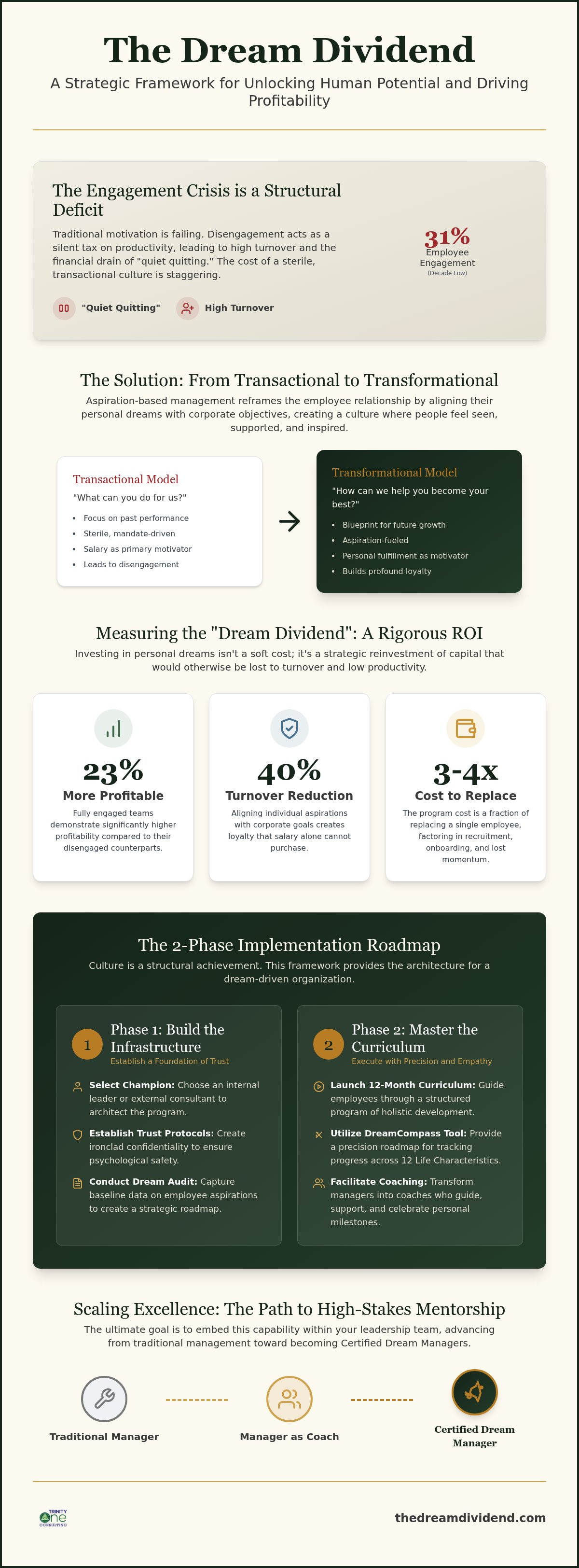
What if the highest return on your corporate investment wasn't found in a software upgrade or a market expansion, but in the unvoiced aspirations of your front-line staff? With Gallup reporting that US employee engagement has dipped to a decade-low of 31 percent, the cost of a sterile, transactional culture is no longer just a HR headache; it's a structural deficit. You've likely felt the weight of high turnover and the silent drain of "quiet quitting" within your own halls. By examining successful dream manager program case studies, leaders are discovering that the bridge between a disengaged workforce and a thriving, 23 percent more profitable team is built on personal fulfillment.
You understand that people are your most valuable asset, yet the mechanics of truly "seeing" them often remain elusive. This guide provides the strategic architecture you need to move beyond theory into a functioning, ROI-positive reality. We'll explore a step-by-step methodology to transform your culture by aligning individual dreams with corporate objectives. You'll learn how to transition your leadership team from managers to coaches, utilize the DreamCompass tool for precision tracking, and ultimately secure a "Dream Dividend" that compounds over time.
Key Takeaways
- Transition from passive concepts to active results by treating the program as a strategic coaching framework that secures a measurable "Dream Dividend."
- Build a secure infrastructure for growth by selecting the ideal internal champion and establishing the trust protocols necessary for genuine human connection.
- Utilize the DreamCompass tool and the 12 Life Characteristics to create a precision roadmap for your team's holistic development and professional flourishing.
- Examine dream manager program case studies to understand how aligning individual aspirations with corporate goals can reduce turnover by as much as 40 percent.
- Advance your leadership trajectory by pursuing the path to becoming a Certified Dream Manager, moving from traditional management toward high-stakes mentorship.
Table of Contents
- Beyond the Book: Why Implementation Requires a Strategic Pivot
- Phase 1: Building the Infrastructure for a Dream-Driven Culture
- Phase 2: Mastering the 12-Month Curriculum with the DreamCompass Tool
- Measuring the Dividend: Dream Manager Program Case Studies
- Scaling Excellence: The Path to Becoming a Certified Dream Manager
Beyond the Book: Why Implementation Requires a Strategic Pivot
Many executives treat Matthew Kelly's "The Dream Manager" as a pleasant narrative rather than a blueprint for structural change. Reading the story is a catalyst; building the infrastructure is the investment. This isn't a corporate book club meant for occasional reflection. It's a strategic coaching framework designed to align individual potential with organizational velocity. When you look at dream manager program case studies, the differentiator isn't how many people read the book, but how many leaders pivoted their operational philosophy to treat employee aspirations as a primary asset. Success requires a bridge between the philosophy of the page and the rigorous execution of the "Manager as Life Coach" model.
In 2026, the stakes of this pivot have never been higher. Traditional levers of motivation are failing against the rising tide of "Quiet Quitting," where disengagement acts as a silent tax on productivity. Gallup research indicates that employee engagement in the U.S. has dipped to just 31 percent. This isn't just a morale issue; it's a structural failure of the transactional model. Aspiration-based management solves this by replacing sterile mandates with a shared vision of personal and professional flourishing. By treating the employee's life as the priority, the organization earns a level of loyalty that salary alone cannot purchase.
The ROI of Aspiration-Based Management
Investing in a team member's personal dreams might seem like a soft cost, but the financial logic is rigorous and grounded in data. Replacing a single employee can cost three to four times their annual salary when you factor in recruitment, onboarding, and lost momentum. If a program helps a high-performer achieve a personal milestone, their loyalty isn't just a feeling; it's a stabilized asset. The Dream Dividend is the compounding value of a fully engaged workforce that views their daily labor as the fuel for their personal success. When you analyze dream manager program case studies, you see that companies aren't just spending money on coaching; they're reinvesting what they would have lost to turnover back into their human capital.
From Transactional to Transformational Leadership
Performance reviews are often post-mortems of past failures rather than blueprints for future growth. They focus on what the individual did for the company, ignoring what the company is doing for the individual. To move forward, leaders must stop asking "What can you do for us?" and start asking "How can we help you become your best version?" This shift requires dream management consulting to bridge the gap between corporate objectives and human needs. When employees realize that their career is the vehicle for their life's dreams, their output transforms from a requirement into a choice. This is the heart of transformational leadership: it builds an architecture where people feel seen, supported, and inspired to contribute at their highest level.
Phase 1: Building the Infrastructure for a Dream-Driven Culture
Culture isn't a happy accident; it's a structural achievement. To move from a transactional environment to one fueled by aspiration, you must first build a foundation that can support the weight of your team's collective dreams. This begins with a deliberate choice between an internal champion and an external consultant. While an internal leader understands your company's unique shorthand, an external architect provides the objective distance and specialized expertise necessary to challenge the status quo. Regardless of the path you choose, the primary objective remains the same: to create a framework where employees feel seen, heard, and valued as whole people.
Trust is the currency of this new economy. Before a single dream is recorded, you must establish ironclad confidentiality and trust protocols. If an employee suspects their personal aspirations will be weaponized in a future performance review, the program will fail before it starts. Once safety is secured, you can launch the Dream Audit. This diagnostic tool captures baseline data on employee desires, providing the raw material for your strategic roadmap. By aligning these personal milestones with existing KPIs, you ensure the program isn't just a "feel-good" initiative, but a driver of high-performance output that mirrors the successes found in leading dream manager program case studies.
The Role of the Certified Dream Manager
A successful Dream Manager is a unique blend of three essential qualities: empathy, strategy, and accountability. They must possess the emotional intelligence to listen deeply, the strategic mind to build actionable plans, and the professional backbone to hold employees to their own standards of growth. This role must remain distinct from traditional HR functions. While HR manages the contract between the employee and the company, the Dream Manager manages the contract between the employee and their own potential. Pursuing professional development through the Certified Dream Manager program ensures your leader has the tools to navigate these complex human dynamics with authority and grace.
Setting the Communication Cadence
Consistency is the engine of compounding returns. You must establish a monthly one-on-one cadence focused exclusively on the employee's strategic life plan. These sessions aren't for discussing project deadlines or technical hurdles; they're for navigating the architecture of a person's future. To integrate this without disrupting operational workflows, treat these meetings as high-priority strategic investments rather than optional check-ins. You can further solidify this culture by creating a "Dream Wall" or a digital dashboard to celebrate collective wins. When a team member sees a colleague achieve a personal goal, it reinforces the belief that the company is a partner in their success. To see how these frameworks scale across different industries, you can explore the resources at The Dream Dividend for deeper implementation insights.
By treating the implementation as a rigorous business process, you transform the workplace into a laboratory for personal excellence. This infrastructure ensures that your investment in people isn't just a cost, but a catalyst for long-term organizational health. When you analyze dream manager program case studies, the common thread is always a disciplined approach to these early structural phases.
Phase 2: Mastering the 12-Month Curriculum with the DreamCompass Tool
Once the infrastructure is established, the program transitions from a structural framework to a dynamic engine of personal growth. This phase is governed by the 12 Life Characteristics, which serve as a comprehensive blueprint for employee excellence. By addressing dimensions such as physical health, financial stability, and intellectual growth, the organization moves beyond the narrow scope of professional output. The goal is to facilitate a holistic transformation where the individual becomes the best version of themselves, which in turn fuels the company's collective success. This is a journey of navigation, not just a series of meetings.
Central to this execution is the DreamCompass tool, a proprietary instrument designed for precision tracking. It allows the Dream Manager and the employee to map personal aspirations against the 12 Life Characteristics with surgical accuracy. By identifying "Dream Gaps", the distance between current reality and desired outcomes, the tool generates a sequence of actionable next steps. This data-driven approach transforms abstract desires into a manageable portfolio of personal investments. For leadership, this provides the ability to report on organizational "Health Dividends," correlating personal flourishing with reduced absenteeism and increased cognitive energy. When you examine dream manager program case studies, the most successful implementations are those that treat this tracking with the same rigor as a financial audit.
Utilizing the DreamCompass for Precision Tracking
The DreamCompass does more than list goals; it identifies the structural foundations required to achieve them. If an employee's dream is homeownership, the tool helps map the financial and intellectual characteristics needed to secure a mortgage. By visualizing progress across physical, emotional, and professional dimensions, the employee feels a sense of compounding momentum. This clarity eliminates the sterile ambiguity of traditional goal setting and replaces it with a roadmap for personal flourishing. Organizations can then aggregate this anonymized data to identify cultural trends, allowing for more targeted investments in the well-being of the entire workforce.
The Monthly Curriculum: A Strategic Roadmap
The 12-month journey is divided into four distinct quarterly milestones, ensuring steady momentum and sustainable results:
- Months 1-3: The Discovery Phase. This period is dedicated to identifying the "100 Dreams" and prioritizing the most impactful starting points.
- Months 4-9: The Tactical Phase. Focus shifts to the mechanics of achievement, including financial literacy, health habits, and skill acquisition.
- Months 10-12: The Legacy Phase. The final quarter is spent reviewing the "Dividend" earned through the year and setting new, more ambitious targets for the future.
By integrating this curriculum into daily operational practice, the "Best Version of Yourself" framework becomes more than a slogan; it becomes a cultural standard. It challenges the status quo of corporate life by proving that personal growth and professional performance are not mutually exclusive, but are instead deeply interdependent. This methodical approach ensures that every participant is navigating toward a specific destination, backed by the structural support of the organization. As highlighted in various dream manager program case studies, this level of clarity is what prevents the program from fading into another forgotten HR initiative.
Measuring the Dividend: Dream Manager Program Case Studies
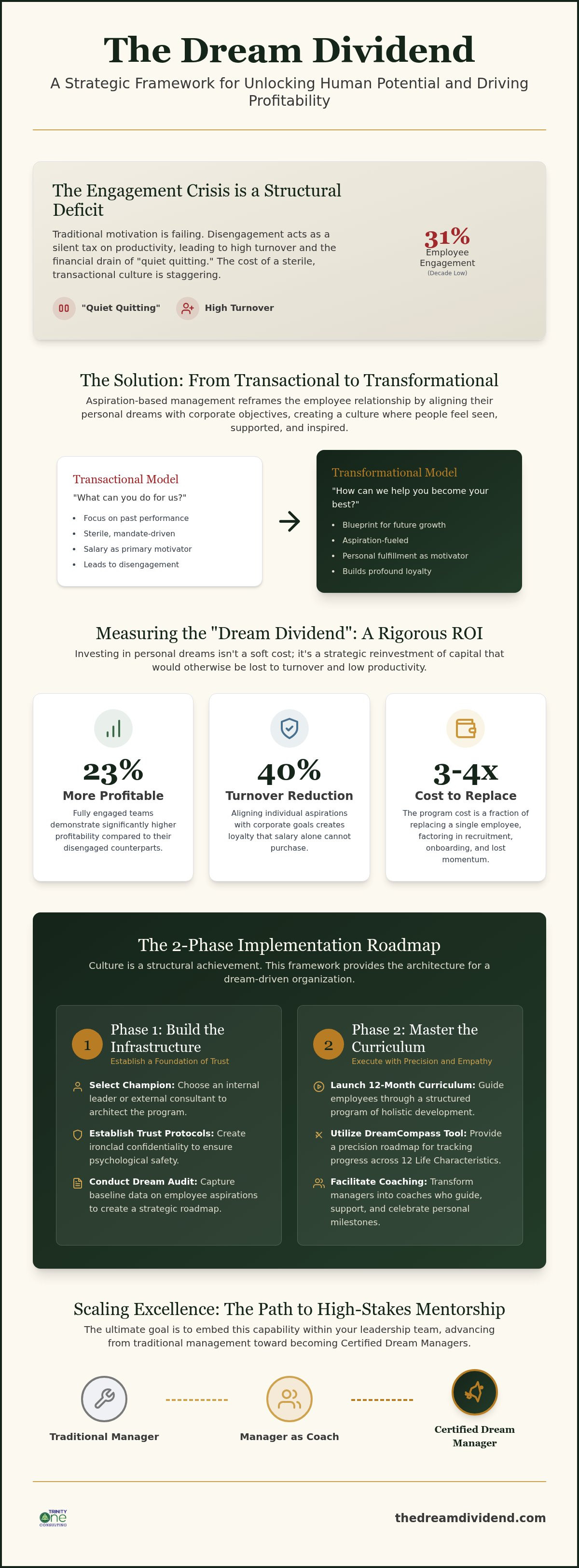
Data is the final arbiter of any cultural shift. While the philosophy of dream management is inspiring, its adoption in the corporate world is driven by its ability to produce a measurable return on investment. When evaluating dream manager program case studies, the most striking metric is the impact on human capital stability. Mid-size firms that have moved beyond transactional management to an aspiration-based model have seen turnover rates slashed by as much as 40 percent. This isn't a fluke; it's the logical result of an employee realizing that their current role is the primary vehicle for their life's ambitions. When the company invests in the person, the person reinvests in the company.
This cultural shift also acts as a powerful recruitment magnet. In a competitive labor market, top-tier talent is increasingly looking for more than just a premium salary. They're seeking environments that offer holistic growth and personal recognition. By positioning the organization as a partner in an individual's dreams, companies are attracting high-performers who might otherwise be out of reach. In one documented instance, the implementation of Personal Strategic Plans directly correlated with a 15 percent increase in departmental efficiency. This proves that a focused employee is a productive employee, and a supported employee is a loyal one.
The Financial Case for Dreams
The "Retention Dividend" is more than just a saved recruitment fee. It represents the preserved knowledge, maintained momentum, and reduced onboarding costs that come with a stable workforce. Employees who utilize a structured framework for their personal goals often become more disciplined and professional contributors in their daily tasks. The "Origin Bank" model serves as a primary example for the 2026 service industry. By prioritizing the personal flourishing of their staff, they created a culture where passion became a strategic asset rather than a happy coincidence. This disciplined approach to human well-being ensures that every dollar spent on coaching compounds into long-term organizational health. To begin building your own culture of excellence, you can book a strategic consultation to explore your implementation options.
Solving the 'Quiet Quitting' Crisis
The phenomenon of "Quiet Quitting" is rarely about a lack of work ethic; it's almost always a symptom of a "Dream Deficit." When an employee feels that their personal life is on hold so their professional life can proceed, disengagement is the natural defense mechanism. Evidence-based results from dream manager program case studies show that re-engaging these "checked-out" individuals requires a pivot toward their personal aspirations. By bridging the gap between daily labor and future dreams, the program reignites the intrinsic motivation that mandates and bonuses cannot reach. You can listen to more insights on how to navigate these complex human dynamics on The Dream Dividend Podcast, where we break down the mechanics of leading with purpose.
Ultimately, the dividend is found in the alignment of destinies. When the employee's personal success is inextricably linked to the organization's success, the resulting energy is transformative. This is the architecture of a high-performance culture, where the investment in the individual's future pays daily dividends in the company's present.
Scaling Excellence: The Path to Becoming a Certified Dream Manager
Transitioning from a traditional overseer to a Certified Dream Manager represents a career-defining evolution. It's a move from managing tasks to architecting futures. While the concepts of personal flourishing are inspiring, maintaining the integrity of the results seen in successful dream manager program case studies requires a disciplined adherence to proven program methodologies. Scaling this excellence from a single pilot team to an enterprise-wide strategy ensures that your organizational culture isn't just surviving, but is actively compounding in value. This evolution turns your leadership team into a group of strategic architects who are equipped to build a foundation for long-term stability.
The process isn't about adding another title to your email signature. It's about acquiring a sophisticated toolkit for human development. By following a proven system, you protect the investment the company is making in its people. If you want to see the same 40 percent reduction in turnover documented in prominent dream manager program case studies, you must commit to the professional standards of the certification. This ensures that the coaching remains objective, confidential, and results-oriented across every department in your organization.
The Certification Journey
The path to mastery begins with a 2-day intensive training session that moves beyond high-level theory into the mechanics of tactical implementation. You'll learn to navigate the DreamCompass tool, facilitate the 12 Life Characteristics curriculum, and manage the delicate balance of psychological safety. Following the initial training, newly certified managers enter a 12-month group coaching program. This period provides the structural support needed to refine your skills, share insights with peers, and access the monthly participant materials necessary for a high-impact rollout. It's a journey of professional growth that provides you with the licensing and resources to lead with authority.
Your Next Step as a Strategic Architect
As we navigate 2026, the demand for "Whole Person Leadership" has become a non-negotiable standard for organizational health. If you want to pitch this program to your executive board, focus on the "Dividend" framework; highlight the measurable ROI of engagement, retention, and performance. Position yourself as a visionary leader who can stabilize the workforce and unlock untapped potential. The evidence is clear: when you invest in the person, the organizational returns are both inevitable and sustainable. You have the opportunity to move beyond traditional management and become a catalyst for transformation. Apply for the Certified Dream Manager Program today and begin your journey as a strategic architect of culture.
Architecting the Future of Your Organization
The shift from a transactional workplace to a high-performance culture requires more than good intentions; it demands a rigorous, strategic architecture. By building a secure infrastructure, utilizing precision tools like the DreamCompass, and committing to the 12-month curriculum, you transform your organization into a laboratory for personal and professional excellence. As evidenced by dream manager program case studies, this alignment of individual aspirations with corporate goals doesn't just improve morale. It stabilizes your workforce, reduces recruitment costs, and secures a compounding Dream Dividend that pays out in every department.
You've seen the data and you understand the framework. Now, it's time to move from theory to execution. With Certified Dream Manager expertise and our proprietary DreamCompass methodology, we help you navigate the complexities of culture transformation to achieve proven ROI. If you're ready to evolve beyond traditional management and lead your team toward their best versions, Book a Strategic Consultation with The Dream Dividend. The future of your organization is built on the dreams of your people. Let's start building it today.
Frequently Asked Questions
Is the Dream Manager program only for large corporations?
The program is designed for any organization that recognizes human potential as its primary asset. While dream manager program case studies often highlight mid-size firms or large entities, the framework is equally effective for small teams. The core methodology focuses on individual alignment, which makes it a scalable solution for any business size. Whether you lead ten people or ten thousand, the structural principles of dream management remain the same.
How much time does a Dream Manager program take to implement?
You can establish the initial infrastructure within a few weeks, but the curriculum itself is a structured 12-month journey. This timeframe allows for the compounding of new habits and the realization of initial "Dream Dividends." It's not a quick fix but a long-term investment in organizational health. The pace is deliberate to ensure sustainable growth rather than temporary excitement. Most organizations see tangible engagement shifts within the first quarter.
What is the difference between a Life Coach and a Dream Manager?
A Dream Manager operates as a strategic architect within the corporate framework. While a traditional life coach focuses solely on the individual, a Dream Manager aligns those personal aspirations with the company's objectives. They utilize proprietary tools like the DreamCompass to track progress across the 12 Life Characteristics. This ensures that personal flourishing directly fuels organizational excellence. It's a role specifically designed to bridge the gap between personal fulfillment and professional output.
How do we measure the ROI of employee dreams?
ROI is measured through the "Dream Dividend," which includes reduced turnover and increased productivity. By analyzing dream manager program case studies, we see that mapping employee dreams can slash turnover by as much as 40 percent. You track metrics such as recruitment cost savings, absenteeism rates, and performance output. When an employee's personal goals are met through their professional labor, their value to the company compounds. This creates a measurable financial return on human capital.
Can a manager really be a coach without overstepping personal boundaries?
Professional boundaries are maintained through ironclad confidentiality protocols and specialized training. A Certified Dream Manager doesn't pry; they facilitate a strategic life plan based on what the employee chooses to share. The focus remains on the 12 Life Characteristics as a neutral framework for growth. This structure ensures psychological safety while providing the support needed for personal excellence. It's a partnership based on mutual respect and professional distance.
What happens if an employee's dream is to leave the company?
You support their dream with the same rigor as any other goal. If an employee's ultimate destination is elsewhere, helping them get there ensures they remain a high-performer until their departure. This transparency prevents "quiet quitting" and allows for seamless succession planning. Moreover, this level of care creates a "Magnet" culture. When people see you support even those who leave, your reputation for genuine leadership attracts top-tier talent.
How do the 12 Life Characteristics fit into the Dream Manager framework?
The 12 Life Characteristics serve as the foundational blueprint for the entire program. They provide a comprehensive framework that covers physical, financial, intellectual, and emotional dimensions of a person's life. By using these categories, the Dream Manager helps employees identify "Dream Gaps" and create actionable roadmaps. This holistic approach ensures that growth is balanced and sustainable. It moves beyond narrow professional skills to develop the "whole person" for long-term excellence.
Is there a certification required to lead this program internally?
Internal leaders must undergo the Certified Dream Manager training to ensure program integrity and results. This process includes a 2-day intensive session followed by 12 months of group coaching. Certification provides the licensing, participant materials, and tactical tools like the DreamCompass needed for a successful rollout. Without this professional foundation, the program risks becoming a surface-level initiative. Certification transforms a manager into a strategic architect capable of driving real culture change.