What if the secret to retention isn't a better dental plan, but a deeper investment in the human spirit? While 83% of employees report positive feelings toward their organizations in 2026, their commitment remains conditional on receiving genuine support for their personal growth. You've likely felt the frustration of high turnover despite offering traditional benefits, or perhaps you've encountered common dream manager program implementation mistakes that leave your team feeling more drained than inspired. It's easy to feel overwhelmed by the distance between your current reality and the best version of yourself.
We understand that you want more than just a happy team; you want a culture where personal fulfillment and professional performance compound together. This guide will show you how to maximize your Dream Dividend by optimizing the structural alignment between your daily cadence and your deepest aspirations while avoiding the utility trap. You'll discover a clear system for tracking growth, learn to master the DreamCompass tool, and gain the clarity needed to turn your team's potential into a strategic, measurable asset.
Key Takeaways
- Learn to transition from treating dream management as a superficial perk to a core business strategy, helping you avoid the dream manager program implementation mistakes that lead to the "Utility Trap."
- Discover how to utilize the 12 Life Characteristics as a structural blueprint for growth by performing quarterly audits that identify and bridge gaps in your personal and professional architecture.
- Master the "Multiplication Effect" through three strategic equations that elevate human potential and secure your team’s value in an increasingly automated landscape.
- Gain clarity on scaling your Dream Dividend from a personal practice into a thriving organizational culture led by the expertise of a Certified Dream Manager.
- Implement a "Deep Honesty" audit using the DreamCompass tool to transform vague aspirations into a precise map for navigating life’s 12 critical dimensions.
Table of Contents
- Defining Your Dream Dividend: Avoiding the 'Utility Trap'
- Refining the DreamCompass: 5 Steps to Strategic Navigation
- The 12 Life Characteristics Audit: Identifying Gaps in Your Growth
- The Multiplication Effect: Elevating Humanity in the AI Era
- Scaling the Dividend: From Personal Growth to Organizational Culture
Defining Your Dream Dividend: Avoiding the 'Utility Trap'
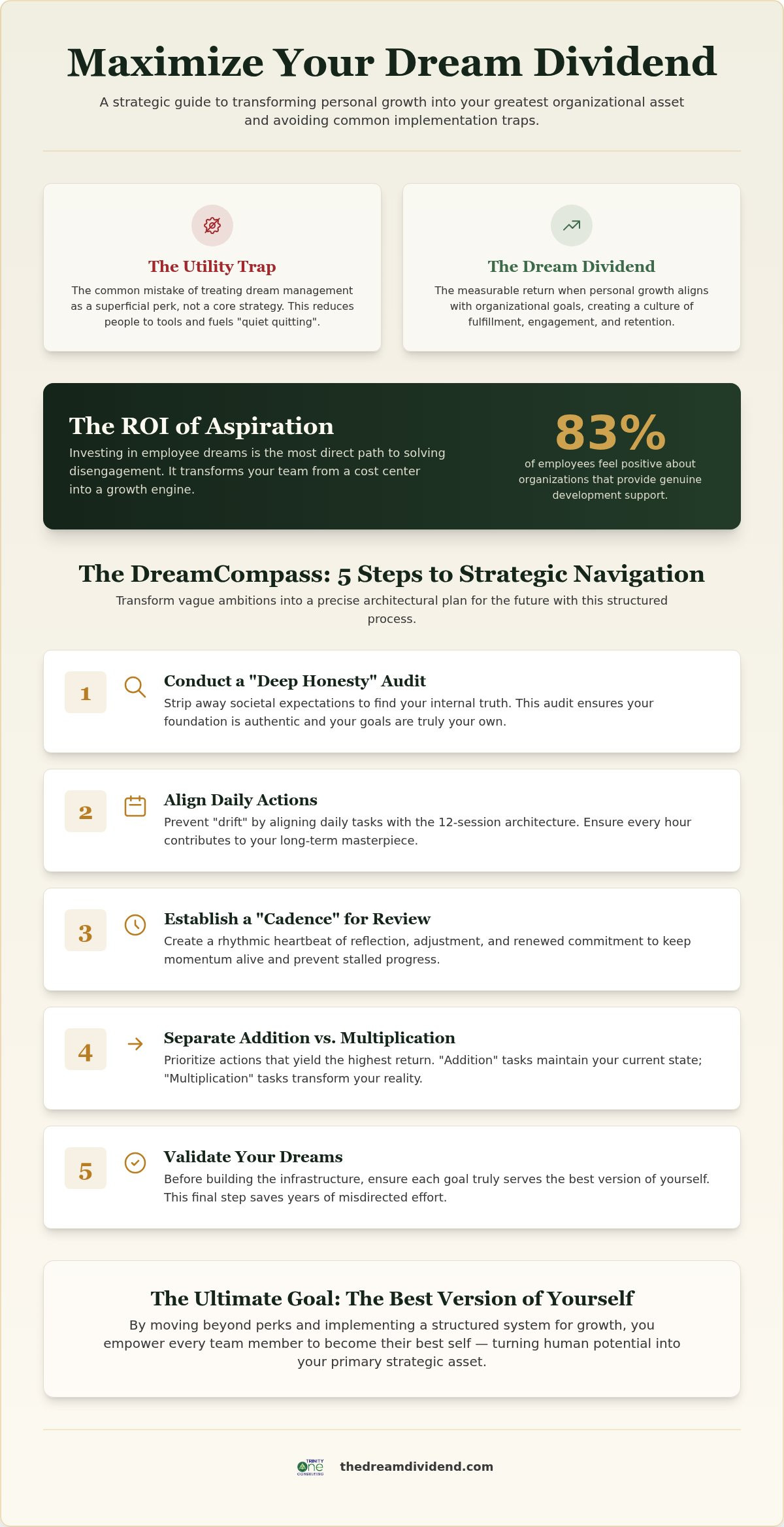
The Dream Dividend represents the compounded return on personal and professional aspirations. It is the measurable value created when an individual’s internal growth aligns with organizational objectives. Many leaders stumble by viewing this framework as a "perk" similar to a catered lunch or a fitness stipend. This is one of the most critical dream manager program implementation mistakes. When you treat dream management as a secondary benefit, you fall into the "Utility Trap." This trap reduces human beings to mere tools of production, ignoring the reality that a person's private dreams fuel their professional drive.
True implementation success requires a focus on three distinct areas of improvement. First, individual clarity allows employees to name their deepest desires; second, team alignment ensures these dreams support a collective mission; and third, organizational ROI manifests as lower turnover and higher engagement. The ultimate benchmark for this process is whether each person is moving toward becoming the "Best Version of Yourself." If your program doesn't facilitate this transformation, it's merely an administrative exercise.
The ROI of Aspiration
Employee dreams are the most undervalued assets in the modern enterprise. While traditional management focuses on extracting value, dream management focuses on investing it. This shift from a "usefulness" mindset to a "stewardship" mindset is essential for long-term health. By supporting a person's life goals, you solve the "quiet quitting" crisis at its source. Research shows that 83% of employees in 2026 are positively inclined toward organizations that provide genuine development support. When you steward their dreams, you reduce the massive costs associated with turnover, which can reach four times an employee's salary.
The Architecture of the Dividend
A sustainable dividend requires a professional foundation. The framework, popularized by author Matthew Kelly, provides the structural blueprints for this growth. You must avoid the busywork and other dream manager program implementation mistakes that dilute your focus on long-term value. Instead, use the system to build a culture of high-stakes mentorship where every person's growth is considered a vital asset. The Dream Dividend is the primary strategic asset for 2026, serving as the bridge between personal fulfillment and organizational excellence.
Refining the DreamCompass: 5 Steps to Strategic Navigation
The DreamCompass is far more than a simple goal list or a generic tracking sheet. It functions as a sophisticated map for life’s 12 dimensions, ensuring that personal growth is neither accidental nor isolated. One of the most frequent dream manager program implementation mistakes is treating this tool as a static document rather than a living, breathing guide. Without a structured navigation plan, leaders often lose the connection between their team's daily grind and their ultimate aspirations. By following a strategic process, you transform vague ambitions into a precise architectural plan for the future.
- Step 1: Conduct a "Deep Honesty" audit. You must name what truly matters, stripping away societal expectations to find your internal truth. We often chase dreams that belong to others; this audit ensures your foundation is authentic.
- Step 2: Align daily actions with the 12-session architecture. This alignment prevents the "drift" that occurs when short-term demands overshadow long-term growth. It ensures every hour spent contributes to a larger masterpiece.
- Step 3: Establish a "Cadence" for review. Stalled progress is a hallmark of failed implementations. You need a rhythmic heartbeat of reflection, adjustment, and renewed commitment to keep the momentum alive.
- Step 4: Separate "Addition" tasks from "Multiplication" tasks. Addition maintains your current state, while multiplication transforms your entire reality. Use the Compass to prioritize the actions that yield the highest return on aspiration.
- Step 5: Validate your dreams. Before you build the infrastructure for a goal, ensure it actually serves the best version of yourself. This validation step saves years of misdirected effort.
Mastering the 12-Session Architecture
Each session in the framework acts as a foundational stone for sustainable transformation. If you neglect even one dimension, such as your physical vitality or financial health, the entire structure becomes unstable. These sessions are designed to turn abstract desires into clear, actionable milestones within the DreamCompass tool. This holistic approach is vital because global employee engagement trends show that modern workers demand support that transcends the office walls. If you're ready to refine your own internal navigation, consider exploring our Dream Management Consulting services.
Avoiding the 'System Prison'
A system should serve the human, not the other way around. You must recognize when a tracking tool starts to restrict your creativity or feels like another administrative burden. Your role as a leader is to maintain system flexibility while fostering deep human connection. You can find more about this balance in The Dream Dividend Podcast, where we discuss leading with purpose. Avoiding common dream manager program implementation mistakes requires you to keep the system agile, responsive, and focused on the individual’s unique journey toward fulfillment.
The 12 Life Characteristics Audit: Identifying Gaps in Your Growth
Imagine your life as a grand estate with twelve distinct rooms. Each room represents one of the 12 Life Characteristics, serving as the blueprint for both personal fulfillment and organizational excellence. When these rooms are well-maintained, you project a level of professional authority that is impossible to fake. However, many leaders ignore the structural integrity of their internal lives, focusing only on the "public" rooms of career and status. This negligence creates a fragile foundation that eventually buckles under the weight of high-stakes responsibility.
To build a sustainable legacy, you must perform a quarterly audit of each dimension, including the Physical, Financial, and Intellectual rooms. This audit allows you to identify "leaking rooms" where energy, focus, or productivity is quietly draining away. Failing to conduct these regular inspections is one of the most common dream manager program implementation mistakes. When leaders skip the audit phase, they often build strategies on top of unstable foundations. Consistent assessment ensures that your personal architecture remains robust enough to support your professional ambitions.
The Core Characteristics of High Performers
High performers prioritize the foundational rooms that others overlook. They cultivate their "inner voice" to maintain clarity and protect their physical health to sustain high-intensity performance. Mastery of these personal characteristics is the catalyst for professional consulting success, as it allows a leader to guide others from a place of authentic experience rather than theoretical knowledge. The 12 Life Characteristics are the secret sauce of the Dream Manager program because they provide the specific, measurable framework required to build the best version of yourself.
From Assessment to Action
An audit without action is merely a diagnostic. Once you identify your weakest rooms, you must create a 90-day scorecard to track specific improvements. Focus on small, intentional shifts. Progress in your Physical room often unlocks breakthroughs in your Intellectual room, creating a powerful compounding effect that accelerates your overall growth. Use the DreamCompass tool to visualize this data and hold yourself accountable to your aspirations. By treating your character development as a strategic investment, you ensure that every quarter yields a higher return on your human potential.
The Multiplication Effect: Elevating Humanity in the AI Era
"Will AI make my role obsolete?" This question often masks a deeper anxiety about our intrinsic value in an increasingly digital world. As a strategic architect of your organization, you must reframe this implementation not as a replacement of people, but as an elevation of humanity. One of the most common dream manager program implementation mistakes is viewing technology and human growth as separate silos. When you divorce digital efficiency from personal aspiration, you create a sterile environment that stifles the very engagement you seek to build. You aren't just managing a workforce; you're stewarding human potential.
Kevin Patrick defines this relationship through three distinct equations that determine your organizational health. First is Subtraction, where the machine replaces the human entirely. This is the efficiency trap, a mistake where organizations trade soul for speed and wonder why their culture feels hollow. Second is Addition, where the human plus the machine creates linear, incremental growth. This is a race to the bottom; if everyone uses the same tools in the same way, no one gains a competitive edge. The ultimate goal is Multiplication, where the human times the machine elevates judgment, discernment, and purpose.
Automate, Elevate, Originate
To achieve multiplication, you must categorize your work into three tiers. Automate the machine-doable tasks to free up human capacity for dreams. Elevate your uniquely human discernment by using tools to enhance empathy, professional authority, and strategic thinking. Finally, Originate new directions and ideas that machines simply cannot conceive. This approach ensures that your team isn't just working faster, but is working on things that actually matter. By focusing on these three pillars, you build a structural foundation that thrives in the AI era.
Applying the Equation to Management
Managers who embrace this shift use AI to handle administrative burdens, allowing them to spend more time focusing on their team's personal aspirations. Speed without direction leads a company off a cliff; purpose acts as the steering wheel. You must ask the stewardship question: "If the machine can do that, what was I actually for?" The answer lies in your ability to guide others toward becoming the best version of themselves. Avoiding dream manager program implementation mistakes means ensuring that every technological advancement serves to deepen human connection rather than replace it. If you are ready to scale these improvements, consider how Dream Management Consulting can transform your organizational health.
Scaling the Dividend: From Personal Growth to Organizational Culture
Moving the Dream Dividend from a solitary pursuit to a collective identity requires a deliberate shift in your organizational architecture. It isn't enough for a leader to have a personal vision; that vision must be woven into the very fabric of the company's daily operations. One of the primary dream manager program implementation mistakes is keeping the framework siloed within a small group or treating it as a temporary pilot. To see a true return on aspiration, the philosophy must move beyond the individual and become the heartbeat of the entire firm. When personal growth becomes the engine of professional success, you create a culture that is both resilient and magnetic.
External consulting often fails because it lacks the deep, localized roots necessary to sustain a cultural shift over time. While an outside perspective provides a spark, an internal system provides the heat. This is where the compounding effect truly takes hold. By building an internal infrastructure for dream management, you ensure that the investment in your people stays within the company walls. You'll see this manifest in measurable ways: reduced turnover, increased employee lifetime value, and a significant rise in profitability. You aren't just managing a team; you're building a legacy where every contributor is invested in the collective outcome.
The Certified Dream Manager Advantage
A Certified Dream Manager acts as the strategic architect for your team’s aspirations, bridging the gap between corporate goals and human needs. These leaders are trained to function as life coaches within a rigorous professional framework, ensuring that personal development never feels like a distraction from the mission. One of the most transformative shifts occurs when you move from traditional, sterile performance reviews to "Dream Reviews." In these sessions, you don't just audit past mistakes; you align future goals, ignite passion, and foster deep loyalty. This transition ensures that the dream manager program implementation mistakes of the past are replaced by a robust, human-centric strategy.
The Future of Purpose-Driven Leadership
Whole Person Leadership is the only sustainable strategy for 2026 and beyond. In an era defined by rapid technological shifts and changing workforce expectations, the organizations that flourish will be those that treat their employees as multi-dimensional individuals. You have the opportunity to lead with vision, compassion, and strategic authority. By focusing on the 12 Life Characteristics and utilizing the tools we've discussed, you position your company as a beacon of excellence in a crowded marketplace. Ready to lead with vision? Explore the Certified Dream Manager Program and begin your journey toward a higher return on aspiration today.
Secure Your Human Capital Architecture
You now possess the blueprints to move beyond the utility trap and build a culture where human potential is the primary driver of organizational health. By mastering the 12 Life Characteristics and utilizing the DreamCompass framework, you ensure that every personal aspiration compounds into professional excellence. Avoiding common dream manager program implementation mistakes is the first step toward reclaiming the lost productivity that traditional management styles fail to capture. This journey is about more than just employee retention; it's about the multiplication of purpose in an era of rapid automation.
Founded by Kevin Patrick and built on the foundational principles of Floyd Consulting and Matthew Kelly, our approach provides the structural integrity your company needs to thrive. If you're ready to transition from a traditional manager to a strategic visionary, it's time to take the next step. Become a Certified Dream Manager and Transform Your Culture today. Your team's best version is waiting to be built, and the dividend on that investment will pay out for years to come.
Frequently Asked Questions
What are the most common Dream Manager program implementation mistakes?
The most frequent dream manager program implementation mistakes include treating the framework as a superficial perk rather than a core strategy, failing to maintain a consistent review cadence, and neglecting the 12 Life Characteristics. When you treat it as a "nice-to-have" benefit, you fall into the utility trap. Success requires a commitment to stewardship, professional authority, and the structural integration of the program into your company’s DNA.
What exactly is 'The Dream Dividend' in a business context?
The Dream Dividend is the compounded return on personal and professional aspirations. It represents the measurable value that an organization captures when its people are actively pursuing the best versions of themselves. This isn't a vague feeling of happiness; it's a strategic asset that manifests as lower turnover, higher productivity, and a more resilient corporate culture. It is the ultimate ROI on human potential.
How does the Dream Manager framework help with employee retention?
The framework boosts retention by solving the "quiet quitting" crisis at its source. When you invest in an employee’s personal dreams, you build a bridge of loyalty that traditional benefits simply can't replicate. Employees stay because they feel seen, valued, and supported. This alignment ensures that their professional output is fueled by their personal drive, making them significantly more likely to remain committed long-term.
What is the difference between a life coach and a Certified Dream Manager?
While a life coach offers general guidance, a Certified Dream Manager is a strategic architect trained in the specific Matthew Kelly and Floyd Consulting methodology. They operate within a professional framework designed to align individual growth with organizational health. They focus on the 12 Life Characteristics and use the DreamCompass tool to ensure that personal development translates into tangible, high-stakes business outcomes.
How do I use the DreamCompass tool for my team?
You use the DreamCompass tool as a navigational map to turn abstract ambitions into a precise architectural plan. It allows team members to audit their current reality across 12 dimensions and set specific milestones for growth. By reviewing this tool regularly, you maintain a rhythmic heartbeat of progress. It helps separate simple "addition" tasks from the "multiplication" actions that truly transform a person’s life and career.
Can the Dream Manager program work for small businesses or just large corporations?
The program is highly scalable and works effectively for small businesses, mid-size firms, and large corporations alike. In smaller teams, the impact is often more immediate because the human connection is more direct. For larger organizations, the framework provides the necessary structure to maintain a purpose-driven culture across multiple departments. It’s about the quality of the stewardship, not the size of the payroll.
What are the 12 Life Characteristics and why do they matter?
These are the 12 dimensions of human life, including physical health, financial stability, and intellectual growth, that form the blueprint for excellence. They matter because neglecting even one "room" in your life can jeopardize your entire professional performance. By auditing these characteristics, you identify the gaps in your growth. This holistic approach ensures you are building a foundation strong enough to support high-stakes leadership.
How do I measure the ROI of investing in my employees’ dreams?
You measure ROI by tracking the reduction in turnover costs, the increase in team engagement scores, and the successful attainment of personal milestones. Compare the cost of replacing an employee with the investment in their growth. Avoiding dream manager program implementation mistakes ensures these metrics remain positive. When you stop extracting value and start stewarding it, the financial dividend becomes a natural byproduct of human flourishing.