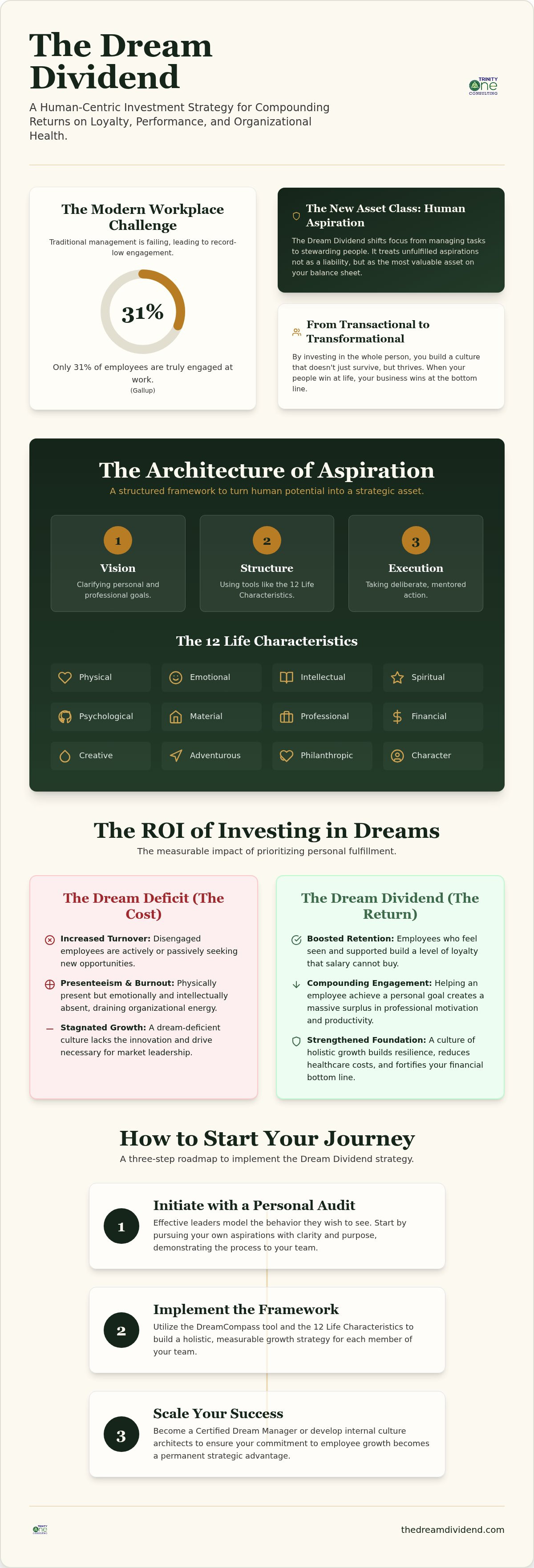
What if the most valuable asset on your balance sheet isn't your equipment or your intellectual property, but the unfulfilled aspirations of your people? You've likely felt the sting of high turnover despite offering competitive pay, watched engagement scores stagnate, and realized that traditional management feels increasingly transactional. It's a common struggle in a landscape where Gallup reports only 31% of employees are truly engaged. This Complete guide to The Dream Dividend reveals why traditional perks fail and how a human-centric investment strategy succeeds. By aligning individual aspirations with corporate objectives, you create a compounding return on loyalty, performance, and organizational health.
We understand that when your employees win at life, your business wins at the bottom line. You need a clear framework to boost retention, an inspired workforce, and measurable results from your culture. This article provides a strategic roadmap for that evolution. We'll explore how to utilize tools like the DreamCompass and the 12 Life Characteristics to navigate this transformation. You'll learn to move beyond sterile processes toward a model of high-stakes mentorship that helps every team member become the best version of themselves.
Key Takeaways
- Define the Dream Dividend as a strategic asset class where personal fulfillment fuels organizational profit. This Complete guide to The Dream Dividend provides the roadmap to unlock this hidden value.
- Utilize the DreamCompass tool and the 12 Life Characteristics to build a holistic growth strategy. This framework addresses the physical, emotional, and spiritual needs of your workforce.
- Measure the tangible ROI of human aspiration. Learn how investing in personal dreams reduces presenteeism, boosts retention, and strengthens your financial foundation.
- Initiate the transformation through a personal audit. Effective leaders model the behavior they wish to see by pursuing their own aspirations with clarity and purpose.
- Scale your success by becoming a Certified Dream Manager. Developing internal culture architects ensures that your commitment to employee growth remains a permanent strategic advantage.
Table of Contents
- What is the Dream Dividend? Defining the New Asset Class of Management
- The Architecture of Aspiration: The 12 Life Characteristics and DreamCompass
- Calculating the Return: Why Investing in Dreams is a Strategic Priority
- Implementing the Framework: How to Start Your Dream Management Journey
- Becoming a Certified Dream Manager: Scaling the Dividend
What is the Dream Dividend? Defining the New Asset Class of Management
Management is undergoing a radical evolution. For decades, the relationship between employer and employee remained strictly transactional; you provided a salary, and they provided their time. But in 2026, this model is collapsing under the weight of quiet quitting and record-low engagement. This Complete guide to The Dream Dividend introduces a superior alternative: treating human aspiration as a primary asset class. The Dream Dividend is the measurable surplus in productivity and retention created when a company actively helps its employees achieve their personal dreams.
This concept, pioneered by Matthew Kelly, shifts the focus from managing tasks to stewarding people. It's the difference between seeing a worker as a cog in a machine and seeing them as a multi-dimensional individual with specific goals. The Dream Dividend is a compounding return on human aspiration. When you invest in the person, you secure the professional. By moving from transactional management to transformational stewardship, you build a culture that doesn't just survive the current labor market but thrives within it.
The Philosophy of the 'Whole Person' at Work
The artificial barrier between work life and personal life is an industrial-age relic. It's a structural flaw that ignores how humans actually function. If an employee is struggling with financial stress, health issues, or a lack of purpose at home, that dissatisfaction creates a deficit in workplace performance. You can't hire half a person. Modern leaders must act as strategic architects of human potential. By acknowledging the whole person, you transform the workplace from a sterile environment into a foundation for holistic growth. If your people are winning at life, they'll ensure the company wins in the marketplace.
From Aspiration to ROI: The Dividend Metaphor
In finance, a dividend is a distribution of profits to those who have invested in the entity. In management, the Dream Dividend is the return on your investment in the individual. Think of it as compounding engagement. When you help a team member buy their first home, run a marathon, or learn a new language, you build a level of loyalty that no traditional perk can match. Conversely, a dream deficit represents the hidden cost of employees who've stopped dreaming. These individuals are physically present but emotionally absent. A dream deficit fuels burnout, increases turnover, and drains organizational energy. When personal success aligns with corporate growth, the resulting momentum is unstoppable.
The Architecture of Aspiration: The 12 Life Characteristics and DreamCompass
To move from a vague desire for better culture to a measurable reality, you need a blueprint. This Complete guide to The Dream Dividend provides the structural foundation required to turn human potential into a strategic asset. Transformation isn't accidental. It's the result of a deliberate architecture that balances personal needs with professional demands through what we call the Trinity Cadence: vision, structure, and execution. Without this structure, even the best intentions dissipate into the noise of daily operations. With it, you build a sustainable engine for growth.
Breaking Down the 12 Life Characteristics
The 12 Life Characteristics serve as the primary rooms in the house of a person's life. These rooms include Physical Health, Emotional Intelligence, and Intellectual Growth, alongside often-ignored areas like Spiritual and Financial wellness. When a leader helps an employee navigate these rooms, they aren't just being nice. They're reducing the friction that prevents that person from becoming the best version of themselves. Data supports this holistic approach; research on the Return on Employee Wellness Programs demonstrates that supporting the whole person leads to lower healthcare costs, higher productivity, and increased resilience. By focusing on these specific characteristics, you're not just improving a worker; you're fortifying the very foundation of your organization. This process turns abstract goals into a concrete path for human excellence.
DreamCompass: The Navigation Tool for Modern Leaders
The DreamCompass tool is the tactical engine of this framework. It prevents aspiration from dissolving into mere wishful thinking by mapping out daily actions against a larger, life-defining purpose. Within a structured 12-session architecture, managers use the DreamCompass to guide coaching conversations that feel deeply human yet remain professionally rigorous. This isn't a standard performance review. It's a strategic navigation session designed to preserve the humanity of the individual while maintaining focus on their growth. By integrating this tool into regular management cadences, you ensure that the pursuit of dreams becomes a consistent, disciplined practice rather than a one-time event. If you want to see how this looks in practice, you can explore the implementation resources to begin your own journey. This tactical approach ensures that every team member is moving toward their personal North Star, which in turn drives the collective success of the company.
Calculating the Return: Why Investing in Dreams is a Strategic Priority
The 2026 talent war is won by those who offer more than just a competitive salary. It's won by leaders who offer a future. In this Complete guide to The Dream Dividend, we treat retention as an active financial strategy rather than a passive hope. Replacing an employee costs 3 to 4 times their annual salary, a figure that represents a massive drain on organizational resources. Implementing a formal dream management framework typically reduces recruitment costs by 30-40% by securing long-term institutional knowledge. When you reduce the churn, you protect your bottom line. You stabilize your teams. You preserve your culture.
The financial case for human aspiration is undeniable. A 10% increase in retention doesn't just save on hiring costs; it compounds the value of every training dollar you've spent. This strategic shift is supported by the U.S. Surgeon General's emphasis on Workplace Mental Health and Well-Being as a critical priority for organizational success. By investing in dreams, you're not just being altruistic. You're building a resilient, high-performing asset class that competitors cannot easily replicate.
Retention as a Result of Aspiration
Employees don't leave companies; they leave environments that fail to recognize their growth. People stay where they feel seen, heard, and supported in their life goals. We've observed anonymized case studies where dream-centered leadership led to radical turnover reduction in high-pressure industries. When a company helps an employee achieve a dream outside the office, it creates a bond of loyalty that transcends a standard paycheck. For a deeper analysis of these dynamics, read our guide on Reducing Employee Turnover via Personal Growth Initiatives. This connection transforms the workplace into a launchpad for the individual's highest potential.
The Productivity Multiplier
The ROI of dream management extends to the daily output of your team. Achieving a personal goal, such as buying a first home or finishing a marathon, builds a specific kind of psychological grit. This resilience transfers directly to professional challenges. Helping an employee navigate a personal milestone creates a stewardship mindset. They stop acting like "renters" of their roles and start acting like "owners" of the company's mission. This is the ultimate cure for presenteeism. An inspired workforce is a present workforce. They are engaged, they are loyal, and they are ready to innovate. This creates the psychological safety necessary for a truly dream-driven culture to flourish.
Implementing the Framework: How to Start Your Dream Management Journey
Action is the bridge between a visionary philosophy and a profitable reality. While understanding the ROI of human aspiration is essential, the true value of this Complete guide to The Dream Dividend lies in its practical application. To transform your culture, you must move beyond the conceptual and into the tactical. This requires a structured implementation that respects the individual while driving the organization forward. If you build the right environment, then your people will build the business you've always envisioned. Start small. Build trust. Scale the impact.
The journey begins with four foundational steps designed to integrate dream management into the DNA of your leadership. First, conduct a Personal Audit. Leaders must model the behavior by identifying their own dreams; vulnerability at the top creates permission at the bottom. Second, establish a sanctuary for dialogue. Create the space for dream-based conversations that are distinct from standard performance reviews. Third, deploy the DreamCompass tool across the team to align individual velocity with corporate direction. Finally, implement a 90-day scorecard. This allows you to measure progress in both personal dream milestones and traditional business KPIs, ensuring that growth remains balanced and visible.
The Manager as Life Coach: A New Leadership Paradigm
The role of the manager is shifting from a taskmaster to a facilitator of potential. This new paradigm requires a specific set of coaching skills: active listening, deep discernment, and the ability to maintain professional boundaries. You aren't there to solve every personal problem, but rather to act as a strategic mentor who helps employees navigate their own growth. When you handle sensitive personal dreams with care, you build a level of psychological safety that fuels innovation. This transformation turns a sterile, transactional process into a high-stakes mentorship that benefits both the individual and the enterprise.
Overcoming Common Implementation Obstacles
Resistance is a natural part of any structural change. The most common objection is the perceived lack of time. However, you must view time spent on dream management as a strategic investment rather than an administrative expense. If employees are hesitant to share their dreams, it's often a symptom of low trust or a history of transactional management. Address this by remaining consistent, supportive, and patient. As trust compounds, the program will naturally scale from a single team to the entire organization. To accelerate your implementation, explore our Dream Management Consulting services for expert guidance. This methodical approach ensures that your culture becomes a sustainable engine for long-term excellence.
Becoming a Certified Dream Manager: Scaling the Dividend
Sustainable transformation requires more than a temporary shift in mindset. It demands a permanent structural change within the hierarchy of your organization, where the principles of human aspiration are woven into every management level. This Complete guide to The Dream Dividend has outlined the "why" and the "how" of this framework; now, we address the "who." Scaling the dividend across a global enterprise or a growing firm requires specialized culture architects. By developing internal expertise, you move beyond external dependency and create a self-sustaining engine of growth. Empower your leaders, stabilize your retention, and compound your cultural returns.
The Certified Dream Manager program is the definitive path for leaders who wish to master this discipline. Utilizing the proven methodologies of Floyd Consulting and the foundational principles of Matthew Kelly, this certification equips your team with the license to use the official curriculum. While external consulting offers a powerful jumpstart, an internal Dream Manager provides the daily, consistent stewardship necessary for long-term excellence. They become the strategic navigators of your workforce, ensuring that the pursuit of the best version of yourself is not a slogan, but a daily reality.
The Path to Certification
The journey toward becoming a culture architect is both rigorous and rewarding. The certification process involves an intensive two-day training event followed by 12 months of group coaching to ensure successful implementation. For those looking to start their journey in 2026, official virtual training sessions are scheduled for July 23-24, 2026, with in-person sessions in North Palm Beach, FL, taking place on October 22-23, 2026. During this training, participants master the 12 Life Characteristics and the DreamCompass tool. You join a global network of purpose-driven leaders, share best practices, and gain the discernment required to handle complex human aspirations within a professional framework.
Why Organizations Partner with The Dream Dividend
Every organization starts its journey from a different foundation. Some requires the high-impact energy of a Keynote Speaking event to ignite the collective imagination of the workforce. Others need the deep, structural intervention of Dream Management Consulting to repair a fractured culture or navigate a period of intense growth. By partnering with experts, you gain access to specialized tools and the experience of seasoned mentors who have seen these principles transform diverse industries. As you conclude this Complete guide to The Dream Dividend, the choice becomes clear. You can continue to manage through transactional processes, or you can begin to architect a future where human aspiration fuels organizational profit. Start your journey today and unlock the compounding returns of an inspired workforce.
Architecting a Culture of Aspiration
The transition from transactional management to visionary stewardship isn't merely a cultural preference; it's a strategic imperative for the modern enterprise. This Complete guide to The Dream Dividend has illustrated how aligning individual aspirations with organizational goals creates a resilient foundation for long-term excellence. By utilizing the 12 Life Characteristics and the proprietary DreamCompass tool, you move beyond surface-level perks toward a model of high-stakes mentorship. You don't just hire employees; you invest in the potential of the whole person.
Founded by Kevin Patrick, a Certified Dream Manager, our platform is built on the transformative principles of Matthew Kelly's best-selling book, 'The Dream Manager'. We bridge the gap between personal fulfillment and professional performance through proven methodologies that drive measurable ROI. Ready to unlock your organization's potential? Explore our Dream Management Consulting services. When your people win at life, your business wins in the marketplace. Begin building the best version of your organization today.
Frequently Asked Questions
Is Dream Management too personal for the workplace?
Dream management isn't about intruding into private lives; it's about facilitating the personal growth that fuels professional excellence. By acknowledging that employees are multi-dimensional, leaders build a foundation of trust, loyalty, and mutual respect. It shifts the relationship from a sterile transaction to a transformational partnership. This approach respects professional boundaries while providing the structural support people need to become the best version of themselves.
How do I calculate the ROI of The Dream Dividend?
You calculate the ROI by measuring the reduction in turnover and the decrease in recruitment costs, which often drop by 30% to 40%. Additionally, track the impact on presenteeism and overall team engagement scores. When employees are actively pursuing their aspirations, their workplace grit and productivity compound. This Complete guide to The Dream Dividend helps you identify the measurable surplus in performance that directly impacts your bottom line.
What is the difference between a Dream Manager and a traditional HR professional?
Traditional HR professionals primarily navigate compliance, benefits, and policy enforcement to maintain the organizational structure. In contrast, a Dream Manager acts as a strategic architect of human potential focused on aspiration and growth. Their role is to coach individuals through the 12 Life Characteristics and facilitate personal milestones. While HR manages the system, the Dream Manager inspires the people. This distinction transforms management into a high-stakes mentorship.
Can a small business implement the DreamCompass tool effectively?
Small businesses are often the most effective environments for the DreamCompass tool because they allow for deeper individual connections. The tool's architecture provides a clear roadmap for growth regardless of company size. By integrating these sessions into existing management cadences, small teams can foster a culture of high performance and loyalty. It turns abstract aspirations into daily, tactical actions that drive the collective success of the entire firm.
What are the 12 Life Characteristics in the Dream Manager framework?
The 12 Life Characteristics provide a holistic blueprint for human excellence across every dimension of life. They include Physical Health, Emotional Intelligence, Intellectual Growth, and Spiritual Wellness. The framework also covers Financial, Psychological, Creative, and Professional dimensions. Finally, it addresses Adventure, Legacy, Character, and Social Relationships. Mastering these rooms helps employees align their daily habits with their highest purpose, creating a more inspired and balanced workforce.
How long does it take to see results from a Dream Management program?
You'll notice an immediate shift in team morale and engagement as soon as you begin the personal audit process. However, the measurable ROI, such as significant turnover reduction and improved productivity, typically compounds over a 6 to 12 month period. Cultural transformation is a marathon, not a sprint. By staying consistent with the DreamCompass architecture, you build a sustainable engine for long-term organizational health and profitability.
Is there a certification for becoming a Dream Manager?
Yes, leaders can become a Certified Dream Manager through an official training program provided by Floyd Consulting. This certification equips you with the methodologies of Matthew Kelly and the license to use the official curriculum. The process involves an intensive training event followed by a year of group coaching. It's designed for culture architects who want to scale the Dream Dividend across their entire organization effectively.
How does the Dream Dividend Podcast support this framework?
The Dream Dividend Podcast serves as a continuous learning resource for leaders who want to stay at the forefront of human-centric management. It features insights on the 12 Life Characteristics and real-world applications of the DreamCompass tool. By listening to stories of transformation, your team stays inspired and connected to the larger vision of the program. It provides the steady, intentional flow of ideas needed to sustain a dream-driven culture.