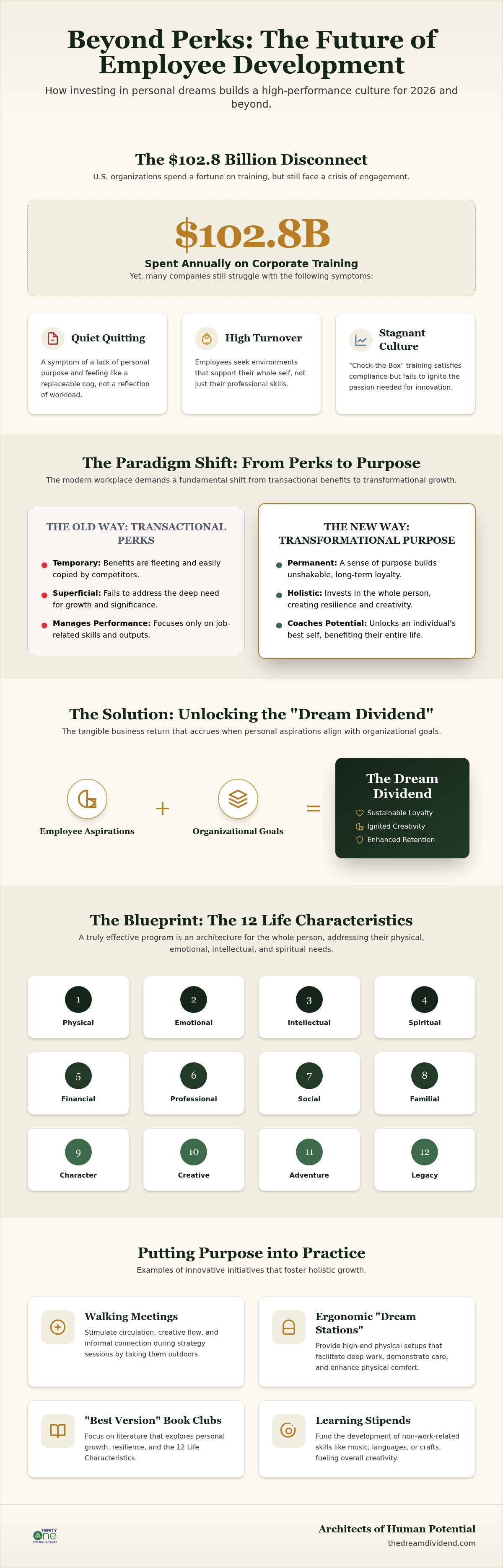
What if the secret to solving "quiet quitting" isn't found in a better dental plan or a team-wide step challenge, but in the private dreams of your people? You already know that the $102.8 billion spent annually on corporate training often fails to move the needle on true engagement. It's difficult to justify the ROI of employee personal development programs when participation is low, turnover is high, and the culture feels stagnant. If you want to build a high-performance organization, you must view human potential as a vital, strategic investment rather than a line-item expense.
In this guide, you'll discover how to move beyond superficial perks to implement initiatives that align individual aspirations with organizational excellence. We'll explore 27 actionable ideas designed to foster resilience, ignite passion, and cultivate AI literacy. By anchoring the personal growth of your workforce to the structural foundations of your business, you can create a workplace where development is both measurable and transformative. Here's how to navigate the shift toward a high-performance culture for 2026 and beyond.
Key Takeaways
- Discover why the transition from generic skill-building to holistic growth is the cornerstone of a resilient 2026 workforce.
- Learn to utilize the 12 Life Characteristics as a blueprint for employee personal development programs that cultivate the whole person.
- Master the "Dream Audit" process to navigate the gap between corporate objectives and the personal aspirations of your team.
- Understand how the Dream Manager framework creates a strategic architecture for long-term loyalty and measurable cultural transformation.
- Explore 27 actionable initiatives that turn personal development into a compounding dividend for organizational health.
Table of Contents
- The Evolution of Employee Personal Development: Why 'Perks' No Longer Work
- 27 Innovative Personal Development Ideas Categorized by the 12 Life Characteristics
- Dream Management: The Ultimate Personal Development Strategy
- How to Build Your Dream-Driven Development Program
- Securing the Dividend: Consulting and Certification for 2026
The Evolution of Employee Personal Development: Why 'Perks' No Longer Work
The corporate landscape of 2026 has rendered the traditional "perk" obsolete. While U.S. organizations spent $102.8 billion on training in 2025, many leaders are still struggling with stagnant engagement and high turnover. If your strategy for employee personal development programs begins and ends with technical upskilling or superficial wellness challenges, you are building your culture on sand. The modern workplace demands a fundamental shift from transactional training to a holistic investment in the human being. Perks are temporary. Purpose is permanent.
Many organizations fall into the "Check-the-Box" trap. They offer generic L&D modules that satisfy a compliance requirement but fail to ignite a single spark of passion. This sterile approach to Personal development ignores the deep-seated psychological need for growth, contribution, and significance. When an employee feels like a replaceable cog in a machine, "quiet quitting" is the natural result. This phenomenon is rarely about the workload itself; it's a symptom of a lack of personal purpose. If a job doesn't help an individual move toward Becoming the Best Version of Yourself, they will eventually look for a place that does.
The ROI of Aspirational Development
We call the tangible business return on human fulfillment the "Dream Dividend." It's the compounding interest that accrues when an employee's personal aspirations align with their professional output. Contrast the massive financial hit of turnover with the sustainable cost of a purpose-driven development program. If you invest in the dreams of your people, you build a structural foundation for organizational retention that no competitor can shake. You aren't just buying their time; you are earning their loyalty, their creativity, and their best effort.
Moving Beyond the Traditional Training Model
Professional skills are the floor of development, while personal aspirations are the ceiling. In our modern hybrid office, the lines between life and work have blurred, making the need for holistic support more critical than ever. Managers must evolve. We must transition from the cold mechanics of "managing performance" to the visionary work of "coaching human potential." This shift is the core of dream management consulting, where leadership becomes a form of high-stakes mentorship. When you help an employee navigate their own path to success, they become a vital, strategic asset for the entire organization. You stop being a boss and start being an architect of their future.
27 Innovative Personal Development Ideas Categorized by the 12 Life Characteristics
To build a high-performance culture, you must move beyond the narrow silo of job training. A truly effective framework for employee personal development programs uses the 12 Life Characteristics as its architectural blueprint. This approach recognizes that an individual is not just a worker, but a complex system of physical, emotional, intellectual, and spiritual needs. When you invest in the whole person, you create a compounding return of loyalty, creativity, and innovation. It's about helping your people thrive in every room they walk into, not just the office.
Physical and Intellectual Growth Initiatives
Physical health and mental agility are the structural foundations of professional performance. If an employee is physically drained or mentally stagnant, their ability to contribute is capped by their own exhaustion. Intellectual curiosity in an employee's personal life directly fuels professional innovation by expanding the mental models they bring to problem-solving. Many high-performing teams now integrate these personal growth milestones into a formal Individual Development Plan (IDP) to ensure personal aspirations are tracked with the same rigor as quarterly KPIs. Consider these 14 growth-focused ideas:
- Walking meetings: Stimulate circulation and creative flow during strategy sessions.
- Ergonomic "Dream Stations": Provide high-end setups that facilitate deep work and physical comfort.
- "Best Version" book clubs: Focus on literature that explores the 12 Life Characteristics.
- Learning stipends: Fund non-work skills like music, languages, or even pilot licenses.
- AI literacy workshops: Empower employees to use technology for personal productivity.
- Speed reading courses: Help your team process information with greater efficiency.
- Financial literacy seminars: Reduce personal stress by teaching wealth management.
- Public speaking workshops: Build confidence that translates into leadership presence.
- Expert-led nutrition coaching: Provide the fuel required for sustained mental energy.
- Healthy cooking classes: Encourage wellness through shared culinary experiences.
- Sleep hygiene workshops: Optimize the most critical recovery tool for high performance.
- Photography or art workshops: Foster creative thinking through different mediums.
- Subscription to growth apps: Provide tools for daily mental exercise.
- On-site yoga or stretching: Integrate physical recovery into the workday.
Emotional and Spiritual Connection Programs
In our distributed, hybrid world, the crisis of disconnection is a major threat to organizational health. Spiritual and emotional development offers the navigation tools employees need to find meaning in their work and connection with their peers. These 13 initiatives solve the disconnection crisis by providing groundedness and shared purpose:
- Peer-to-peer appreciation rituals: Build emotional bank accounts through public recognition.
- "Meaningful Work" sabbaticals: Offer extended breaks for personal projects after five years of service.
- Volunteer "Dream Days": Grant paid time off for employees to support a cause they love.
- Dedicated "Quiet Spaces": Designate areas for reflection, meditation, or spiritual groundedness.
- Emotional intelligence (EQ) coaching: Improve collaboration by mastering self-regulation.
- Mentorship for life goals: Pair employees with leaders who care about their personal dreams.
- Relationship workshops: Provide tools for better communication at home and work.
- Journaling prompts and workshops: Encourage self-reflection as a path to clarity.
- Community family events: Integrate the employee's personal support system into the culture.
- Resilience training: Build the psychological stamina needed for high-stress periods.
- Values-alignment workshops: Help employees find the "why" behind their daily tasks.
- Gratitude challenges: Cultivate an optimistic mindset through daily practice.
- Legacy planning sessions: Help employees think about the long-term impact of their lives.
These initiatives do more than just improve morale; they provide the stability required to sustain long-term performance. If you're looking for a way to structure these ideas into a cohesive strategy, exploring the Certified Dream Manager program can help you identify which areas of your culture need the most immediate investment.
Dream Management: The Ultimate Personal Development Strategy
A Dream Manager is a leader who understands that the best version of an employee is the one who is actively pursuing their personal aspirations. This role represents the ultimate evolution of employee personal development programs. It moves beyond the sterile delivery of skill sets and enters the space of high-stakes mentorship. By adopting the "Manager as Life Coach" model, organizations signal a profound shift in their value proposition. They are no longer just buying labor. They are investing in the individual's future.
The core philosophy of dream management consulting is built on a simple, yet radical, insight: an organization cannot become the best version of itself unless its employees are becoming the best versions of themselves. When a company demonstrates genuine interest in what an employee wants for their life, the psychological contract changes. Loyalty is no longer a matter of policy; it becomes a natural byproduct of mutual investment. You create a culture where people feel seen, heard, and supported in their most human ambitions.
The DreamCompass: A Tool for Strategic Aspiration
Vague development goals often lead to low participation and uninspired results. The DreamCompass tool provides a rigorous tracking mechanism to transform abstract desires into concrete, achievable milestones. By using this framework, a Certified Dream Manager guides employees through a comprehensive assessment of the 12 Life Characteristics. This process helps individuals identify specific life dreams that drive daily motivation. Whether the goal is financial stability, physical health, or creative fulfillment, the DreamCompass ensures that personal growth is mapped with the same precision as a corporate product launch. It provides the navigation required to move from aspiration to realization.
Integrating Life Dreams into the Performance Review
To secure the Dream Dividend, you must change the architecture of your performance conversations. Shift the dialogue from a retrospective on output to a prospective vision of growth. We recommend allocating 10% of every 1-on-1 meeting to personal dream tracking and life coaching. This isn't "fluff"; it's a strategic investment in the person behind the performance. When a team member achieves a personal milestone, such as buying their first home or completing a marathon, the culture should celebrate it as a corporate win. This integration proves that the company values the person as a whole, creating a workplace where personal growth is the most valuable asset on the balance sheet.
How to Build Your Dream-Driven Development Program
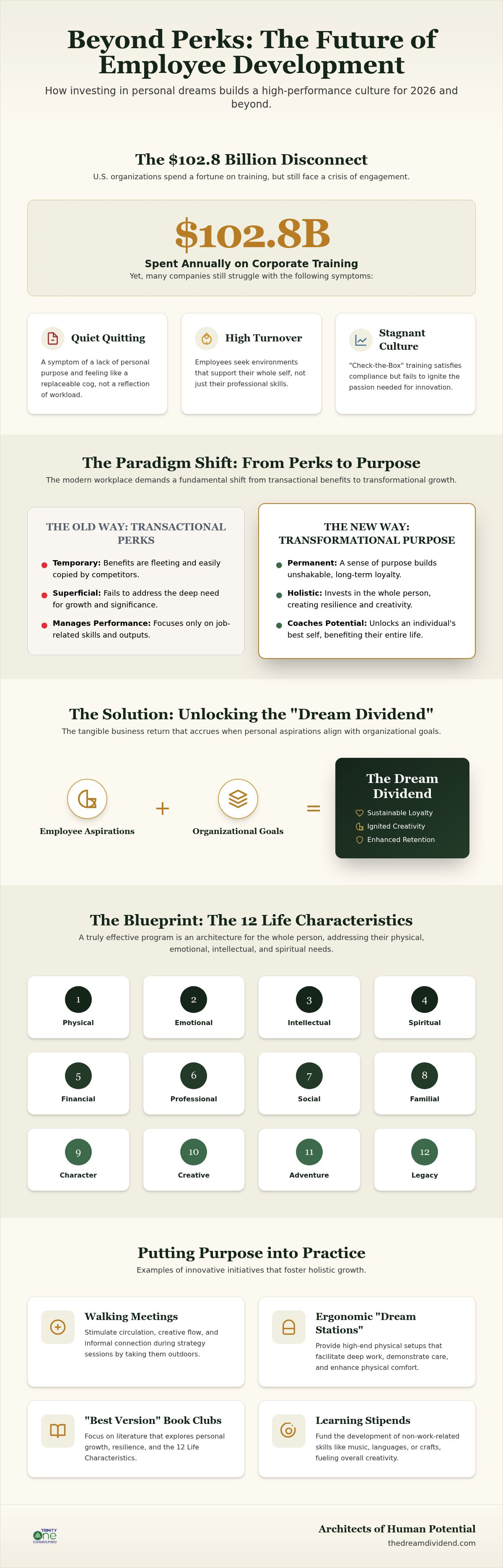
If you want to build a high-performance organization, your employee personal development programs must be more than a collection of random workshops. You need a structured architecture that bridges the gap between individual desire and corporate health. By following this five-step framework, you transform employee personal development programs from a cost center into a strategic engine for growth.
- Step 1: Conduct a Dream Audit. This is not a standard satisfaction survey; it is a strategic inquiry into the personal missions that drive your people when they leave the office. You must understand what they value beyond their paycheck to align their work with their life.
- Step 2: Train your leadership. Appoint or train a Dream Manager within your team. You can explore how other organizations have successfully navigated this shift by reviewing dream manager program case studies.
- Step 3: Align corporate resources. Support individual aspirations with tangible action. This might mean offering flexible scheduling for an employee training for a marathon or providing resources for a first-time homebuyer.
- Step 4: Measure the Dividend. Track engagement, retention, and productivity metrics against dream achievement. When people see that their dreams are possible because of their work, their performance naturally compounds.
- Step 5: Celebrate the Best Version. Publicly recognize personal milestones alongside professional KPIs. This validates the individual as a whole person, not just a producer of results.
Avoiding the 'Corporate Wellness' Trap
A development program fails when it feels like a PR exercise. Authenticity is the only currency that matters in culture change. To ensure your program is more than a superficial perk, your leadership must walk the talk. When executives share their own vulnerabilities, personal dreams, and long-term goals, it gives the rest of the organization permission to do the same. Transparency in how you track the ROI of these programs builds trust with skeptical stakeholders. It proves that you are committed to a long-term investment in human potential rather than a quick fix for recruitment stats.
Scaling Development for Large Teams
Scaling a human-centric approach requires a blend of technology and peer support. Use The Dream Dividend Podcast as an internal inspiration tool to keep the conversation about purpose alive across distributed teams. You can also leverage "Dream Circles," which are small peer groups that support each other's life goals through the 12 Life Characteristics. These groups foster a sense of community and accountability that a top-down mandate cannot achieve. Finally, consider creating a "Dream Fund" to provide small grants for employees pursuing significant personal milestones, creating a tangible link between their hard work and their personal fulfillment.
Ready to start building a culture where personal growth is a strategic asset? Schedule a Dream Management consulting session to begin your organizational transformation.
Securing the Dividend: Consulting and Certification for 2026
The transition from traditional training to Dream Management is a shift from managing a cost center to cultivating a strategic asset. While many organizations struggle to prove the ROI of their employee personal development programs, those who adopt the Dream Manager framework see a compounding return in engagement, retention, and innovation. Navigating this shift requires more than a new policy. It demands a fundamental redesign of the leadership architecture. External expertise provides the objective navigation needed to move away from sterile management styles toward a culture of high-stakes mentorship.
Becoming a "Dream-Driven" organization creates a structural foundation that is difficult for competitors to replicate. In a competitive labor market where a vast majority of workers report they'd stay longer if a company invested in their growth, this human-centric approach is no longer optional. It's a pragmatic business strategy. When you align the personal dreams of your people with the excellence of your organization, you stop fighting turnover and start building a legacy of success. You don't just hire workers; you partner with individuals who are motivated by their own aspirations to deliver their best work for the collective.
The Certified Dream Manager Advantage
The Certified Dream Manager program equips leaders with the specific tools to drive transformation from the inside out. By mastering the principles of "The Dream Manager" framework by Matthew Kelly, your leadership team becomes more than just supervisors. They become strategic architects of human potential. This certification doesn't just improve the workforce; it deepens leadership retention by giving managers a more profound sense of purpose in their daily work. Leading a team toward their highest aspirations requires a sense of calculated optimism, a belief that the individual’s growth is the vital fuel for the collective’s success.
Next Steps: Consultation and Keynotes
Transforming your culture is a long-term investment that begins with a visionary perspective. You can engage with Kevin Patrick for Keynote Speaking to inspire your leadership team on the direct link between visionary leadership and employee retention. We also offer customization of the 12 Life Characteristics assessment to ensure the framework aligns with your specific industry or workforce demographic. If you're ready to humanize your workplace and unlock the Best Version of your team, subscribe to The Dream Dividend Podcast for ongoing insights into human potential. The future of work isn't just about output; it's about the dreams that fuel it.
Architecting a Culture of Significance
The shift toward 2026 demands a departure from superficial benefits and "check-the-box" training. You've explored how integrating the 12 Life Characteristics provides a structural foundation for growth that transcends the traditional office environment. When you stop viewing employee personal development programs as a static line item and start seeing them as the strategic engine of your organization, the culture begins to transform. This evolution is about more than morale. It is about the compounding interest of human fulfillment that allows your team to ignite passion, cultivate loyalty, and drive innovation.
You now possess the blueprint to move from managing output to coaching potential. It's time to secure the long-term dividend of your most valuable asset. Transform your culture today with Dream Management Consulting. By partnering with a Certified Dream Manager, you can implement the proprietary DreamCompass tool to bridge the gap between personal aspiration and organizational health. The path to becoming the best version of your organization starts with the dreams of your people. Lead them well, and the results will follow.
Frequently Asked Questions
What is the difference between a traditional training program and dream management?
Traditional training programs focus on specific technical skills or compliance to benefit the organization's immediate needs. Dream management addresses the whole person by aligning their personal aspirations with their professional contributions. While one builds a skill set, the other builds a life, creating a deeper psychological contract. It transforms the manager into a coach who navigates the 12 Life Characteristics alongside the employee.
How do you measure the ROI of employee personal development programs focused on dreams?
You measure the return by tracking key performance indicators such as retention rates, engagement scores, and internal promotion velocity. When employee personal development programs prioritize personal fulfillment, the business sees a decrease in turnover costs and an increase in discretionary effort. We call this the "Dream Dividend," where the investment in human potential compounds into tangible organizational health and financial stability.
Is it appropriate for a manager to know an employee's personal life goals?
It is appropriate when the information is shared within a high-trust framework of mentorship and mutual growth. This isn't about corporate intrusion; it's about understanding the "why" behind an employee's work. By knowing what drives a person, a manager can better architect a role that supports those goals. This leads to a more meaningful, productive, and transparent professional relationship between the leader and the team.
Can dream management work for remote or hybrid teams in 2026?
Dream management is particularly effective for distributed teams as it solves the modern crisis of disconnection. Digital tools like the DreamCompass allow managers to maintain a structural foundation of support regardless of physical location. These conversations provide a human touchpoint that transcends standard video calls. It ensures that remote workers feel seen as individuals and remain anchored to the company's mission through their own progress.
What happens if an employee's dream is to start their own business and leave?
Supporting an employee's ultimate dream, even if it leads elsewhere, fosters an environment of radical honesty and high performance. It's far better to have an inspired, fully engaged team member for three years than a "quiet quitter" who stays for ten. Often, when an employee feels their current job is the bridge to their dream, they stay longer and work harder than they would in a transactional environment.
How much does it cost to implement a dream-driven development program?
The cost of implementation is a variable investment that depends on the scale of your organization and the depth of the integration. Rather than viewing it as a sunk cost, leaders should see it as a strategic reallocation of existing budgets toward more effective initiatives. The expense of a employee personal development programs framework is consistently lower than the staggering financial impact of high turnover and disengaged talent.
Do you need a full-time Dream Manager, or can existing leaders take on the role?
Existing leaders can effectively take on this role provided they receive the proper training and certification. While some large organizations appoint a dedicated Dream Manager, many find success by integrating these principles into their current leadership architecture. The key is ensuring that these leaders have the navigation tools and the time to focus on coaching human potential rather than just managing daily tasks.
What are the first steps to transforming our current L&D program into a dream-driven one?
The first step is to conduct a "Dream Audit" to identify the real aspirations of your workforce. This data allows you to move beyond generic perks and start aligning corporate resources with what your people actually value. Once you understand their dreams, you can begin training your leadership team in the 12 Life Characteristics to provide the mentorship required for a high-performance culture.