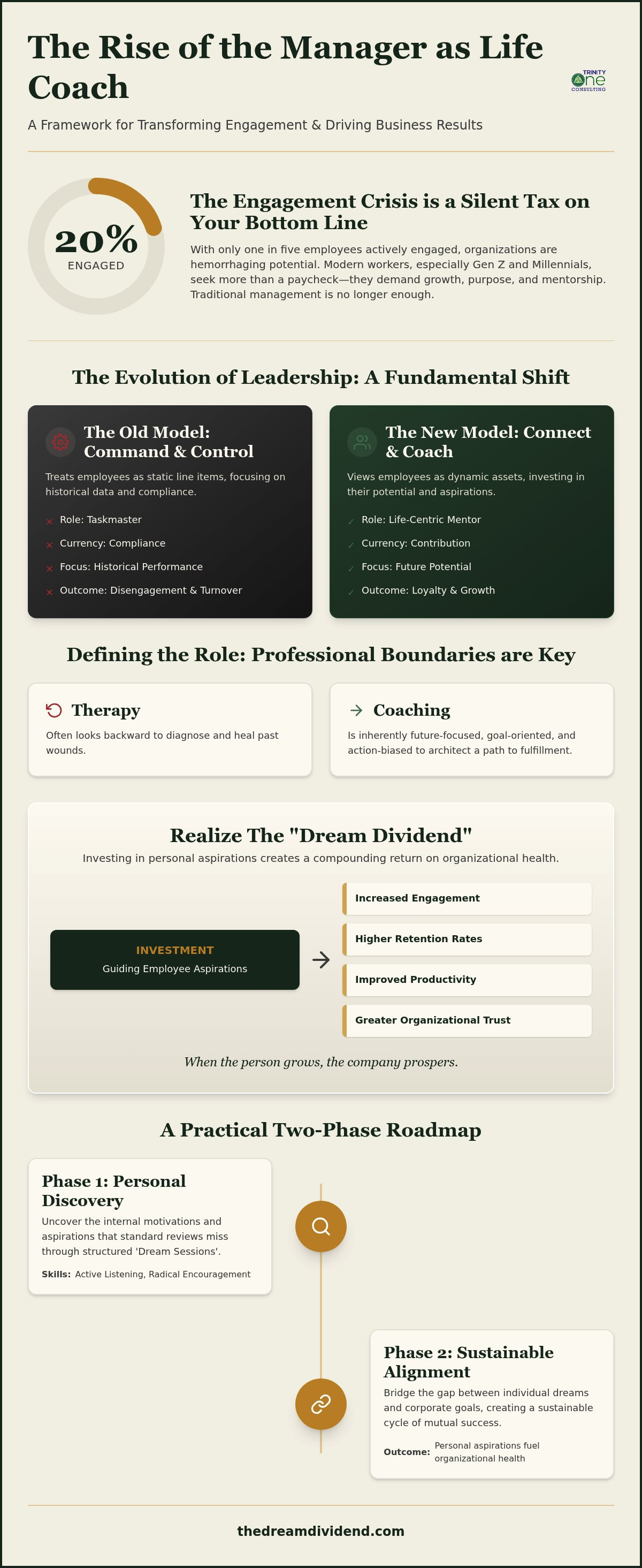
If only 20 percent of your workforce is actually engaged, you aren't just losing productivity; you're hemorrhaging the very potential your organization's future depends on. You've likely felt the frustration of high turnover despite offering competitive pay, particularly as Gen Z and Millennial employees demand more than just a salary. Transitioning into the role of a manager as life coach allows you to meet these expectations by treating employee aspirations as a strategic asset. You know that a paycheck is no longer enough to buy loyalty. It requires a deeper investment, a clearer vision, and a more compassionate approach.
This article provides a practical framework to help you guide this vital evolution from taskmaster to life-centric mentor. When you invest in the whole person, you unlock a compounding return on employee engagement and organizational trust. We will explore how focusing on the 12 Life Characteristics creates a culture of excellence, improves retention rates, and delivers the tangible business results that only come when people feel empowered to become the best version of themselves.
Key Takeaways
- Transition from a traditional taskmaster to a visionary mentor who prioritizes human potential, holistic well-being, and strategic organizational health.
- Clarify the professional boundaries of the manager as life coach role to ensure your guidance remains future-focused, goal-oriented, and strategically aligned.
- Realize the "Dream Dividend" by understanding how investing in employee aspirations creates a compounding return on engagement, retention, and productivity.
- Apply a practical two-phase roadmap using the 12 Life Characteristics to move from personal discovery toward a sustainable alignment of dreams and professional duties.
- Professionalize your leadership by exploring how certification transforms a standard management approach into a sophisticated, high-impact consulting practice.
Table of Contents
- Beyond the Performance Review: The Rise of the Manager as Life Coach
- Defining the Role: Coaching Personal Aspirations within a Professional Framework
- The Dream Dividend: Why Investing in Personal Aspirations Drives Business ROI
- Implementing the Model: A Practical Roadmap for Managers
- Scaling Excellence: The Path to Becoming a Certified Dream Manager
Beyond the Performance Review: The Rise of the Manager as Life Coach
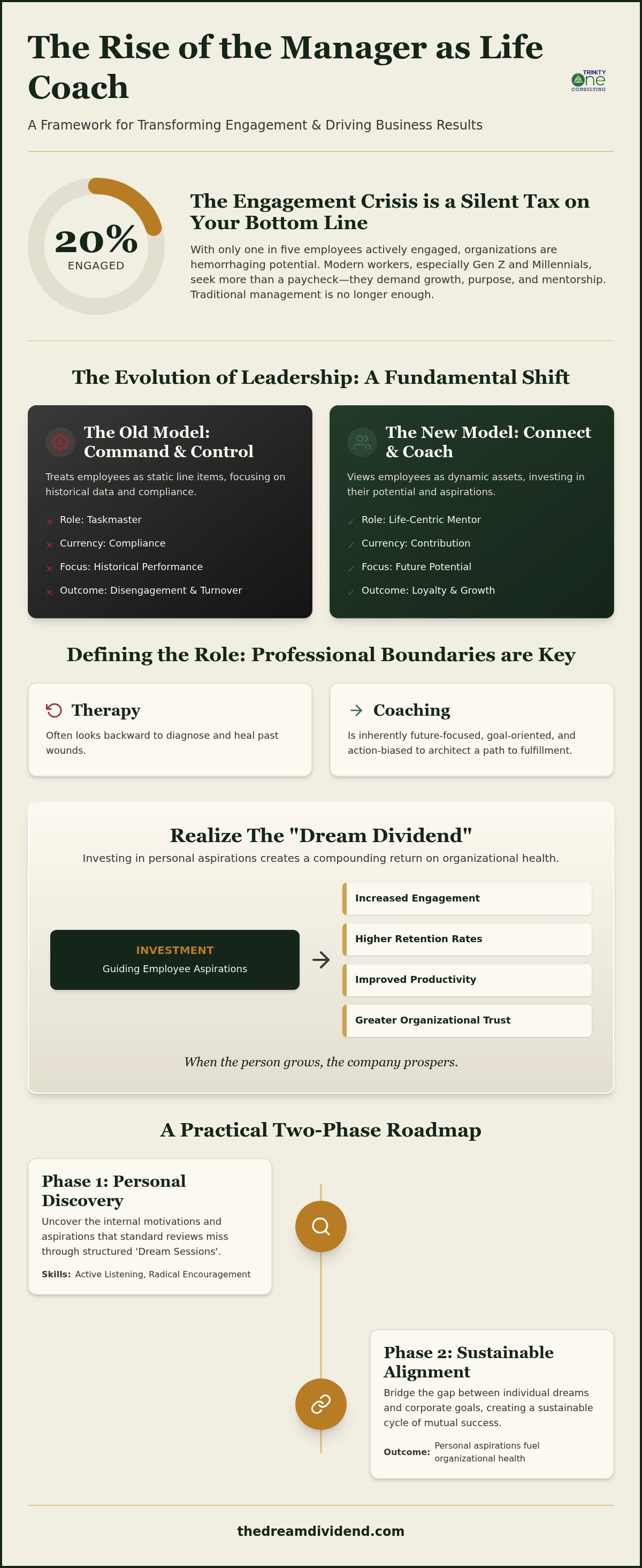
The era of 'Command and Control' has reached its expiration date. In 2026, leadership has evolved into a 'Connect and Coach' model where the most valuable currency is no longer compliance, but contribution. Traditional performance reviews often fail because they treat employees as static line items rather than dynamic assets. They focus on historical data, miss the nuances of internal motivation, and ignore the personal aspirations that actually drive peak performance. Employees don't leave their personal lives at the door; they bring their worries, dreams, and physical health with them every single day. If you only manage a person’s tasks, you are practicing basic management. If you manage their potential, you are fulfilling the sophisticated role of a manager as life coach.
Why Traditional Management is No Longer Enough
Disengagement is a silent tax on your bottom line. With global employee engagement reaching a historic low of 20 percent in 2025, the cost of 'quiet quitting' has become a structural liability for the modern economy. The power dynamic has shifted decisively toward fulfillment, purpose, and autonomy. Modern workers are no longer satisfied with a transactional relationship. They seek growth, require mentorship, and demand a sense of belonging that transcends the office walls. To survive this shift, you must adapt your Management styles to reflect a human-centric reality. A manager as life coach acts as a strategic architect of human potential, designing environments where personal fulfillment and professional output are inextricably linked.
The Best Version of Yourself Framework
At the heart of this evolution is a core philosophy: helping your people become the best version of themselves. This isn't a 'soft' initiative; it's a high-stakes business strategy that yields significant dividends. When an employee experiences personal growth, that expansion naturally flows into their professional excellence. They become more resilient, more creative, and more loyal to the organization that facilitated their transformation. By utilizing a becoming the best version of yourself framework, you bridge the gap between individual dreams and corporate goals. This alignment ensures that as the person grows, the company prospers. It creates a sustainable cycle of mutual success where personal aspirations become the primary fuel for long-term organizational health.
Defining the Role: Coaching Personal Aspirations within a Professional Framework
Adopting the mindset of a manager as life coach requires a precise understanding of professional boundaries. It is essential to recognize that coaching is not therapy. While therapy often looks backward to heal past wounds, coaching is inherently future-focused, goal-oriented, and action-biased. Your role is not to diagnose psychological issues, but to architect a path toward personal and professional fulfillment. By focusing on the 12 Life Characteristics, you provide a structural foundation for growth that respects the individual's privacy while championing their potential. Many great leaders as coaches have already discovered that this shift in mindset is the key to unlocking hidden talent and securing long-term organizational health.
The Dream Manager Framework
The Dream Manager framework offers a structured approach to this evolution. It transforms the manager from a simple supervisor into a Dream Manager; a leader who takes an active, sincere interest in what their employees want to achieve in life. This process begins with 'Dream Sessions' designed to uncover the internal motivations that a standard performance review would miss. Success in these sessions depends on active listening, radical encouragement, and a commitment to the person's holistic well-being. When you demonstrate that you value their dreams, you build a level of rapport and trust that traditional management styles simply cannot replicate. If you want to deepen your impact, exploring the Dream Dividend methodology is a vital first step toward mastering these high-stakes conversations.
Managing Dreams vs. Managing Deadlines
Effective coaching doesn't come at the expense of productivity; it serves as its primary fuel. The challenge lies in integrating dream-tracking into your regular 1-on-1 meetings without losing sight of organizational KPIs. By using the DreamCompass tool, you can provide a tangible structure for personal goal tracking that runs parallel to professional milestones. This dual focus ensures that the employee sees their daily tasks as a vehicle for their own aspirations. It turns a job into a mission. When personal dreams and professional deadlines are aligned, the result is a compounding return on effort. You aren't just hitting targets; you're building a culture where people are motivated to bring their best selves to work because they know their work is helping them become who they want to be.
The Dream Dividend: Why Investing in Personal Aspirations Drives Business ROI
The Dream Dividend represents the tangible, measurable return that occurs when an organization shifts its focus from mere task management to the active cultivation of human aspiration. It is the profit generated by a workforce that feels seen, supported, and strategically empowered. When you embrace the role of a manager as life coach, you are effectively allocating resources into a high-yield asset: the unfulfilled potential of your team. This investment doesn't just improve morale; it compounds over time, creating a culture where loyalty is earned through mutual growth rather than just a bi-weekly paycheck. According to 2026 research, organizations report an average return on investment of 600% from their coaching initiatives. This data proves that humanistic leadership isn't just a "soft skill" but a rigorous financial strategy for organizational health.
Reducing Turnover through Personal Growth
High employee turnover is often a symptom of an uninspired culture where the professional role feels disconnected from personal meaning. By reducing employee turnover through coaching, you stabilize your human capital and slash the exorbitant costs of recruitment and retraining. This transformation is rooted in a renewed psychological contract: if you help your employees realize their personal dreams, they will naturally invest their best energy into helping you achieve the company's goals. Evidence suggests that when managers facilitate personal growth, retention rates soar because the workplace becomes a foundation for the employee's larger life vision. It is much harder for a competitor to poach an employee who views their current manager as a vital partner in their life's success.
The Strategic Advantage of Engagement
The global engagement crisis, with rates falling to 20 percent in 2025, requires a bold departure from traditional oversight. Managers acting as coaches provide the ultimate solution to the 'Quiet Quitting' epidemic by restoring a sense of agency and purpose to the daily grind. When an individual's well-being is prioritized, their capacity for creative problem-solving and innovation expands significantly. They no longer work just to meet a quota; they work to fuel the life they want to lead. The Dream Dividend is the ultimate hedge against talent wars because it builds a structural foundation of trust that competitors cannot simply buy with a higher salary. It turns your organization into a destination for top talent who seek an authoritative mentor rather than a traditional taskmaster.
Implementing the Model: A Practical Roadmap for Managers
Transitioning from a traditional supervisor to a manager as life coach requires more than just good intentions; it demands a rigorous, structured methodology. This evolution is achieved through a four-phase implementation roadmap designed to turn abstract aspirations into concrete results. Phase one begins with the Discovery Call, where you use a specialized framework to uncover the employee's current state and internal motivations. Phase two involves the Alignment Strategy, where you map their personal dreams to their professional responsibilities, creating a synergy between individual and corporate goals. Phase three establishes the Accountability Loop, ensuring monthly progress remains steady through consistent, supportive feedback. Finally, phase four focuses on the Celebration, where personal milestones are recognized as collective organizational victories. This systematic approach ensures that coaching remains a professional discipline rather than a casual conversation.
Utilizing the 12 Life Characteristics
The 12 Life Characteristics serve as a holistic assessment tool, providing a blueprint for excellence across every dimension of a person's life. By evaluating areas such as physical health, emotional stability, and intellectual growth, you can identify the structural foundations that support or hinder professional performance. Coaching across these diverse areas allows you to provide resources that help employees grow in ways that extend far beyond their immediate job description. It demonstrates a commitment to the person's long-term value and holistic well-being. If you are ready to master this framework, you can start your journey with the Dream Dividend today to access the tools necessary for this high-level mentorship.
The DreamCompass in Action
The DreamCompass tool provides the necessary navigation for this journey, offering a clear visual for goal tracking and progress. It allows managers to help employees identify 'Micro-Dreams', which are smaller, achievable goals that build psychological momentum and early wins. Maintaining a dedicated 'Dream Folder' for each team member creates a historical record of their growth, proving that the company is a partner in their personal evolution. This consistent attention to detail transforms the workplace into an incubator for potential. It replaces the anxiety of the unknown with the confidence of a well-charted path, ensuring that every individual is moving toward the best version of themselves while delivering exceptional value to the firm. By documenting these wins, you create a culture where progress is visible, measurable, and deeply personal.
Scaling Excellence: The Path to Becoming a Certified Dream Manager
Becoming an effective leader isn't an accident; it's a deliberate choice to master the structural foundations of human growth. While many try to adopt the persona of a manager as life coach, true mastery requires a professional methodology that balances empathy with strategic rigor. The Certified Dream Manager Program represents the gold standard for this evolution. It transforms you from a traditional supervisor into a high-level strategic consultant capable of navigating the complex intersection of personal aspirations and professional performance. One intentional leader can ignite a ripple effect that reshapes an entire organizational culture, replacing stagnation with momentum, apathy with purpose, and turnover with long-term loyalty.
Professional Development for the Modern Leader
Certification isn't just a badge; it's a significant investment in your own career capital. By mastering the methodologies developed by Floyd Consulting, you position yourself as a rare asset in an economy that increasingly values human-centric leadership. You gain the tools to drive sustainable growth, foster deep loyalty, and deliver the Dream Dividend with predictable accuracy. Beyond the training, you join a sophisticated community of purpose-driven architects who are redefining the corporate world. You can immerse yourself in these high-level conversations by tuning into The Dream Dividend Podcast, where visionary strategy meets practical application. This continuous learning ensures your coaching remains sharp, relevant, and impactful.
Next Steps for Your Organization
Scaling this model across your company requires a clear, persuasive pitch to senior leadership. You must frame the transition not as a "perk," but as a vital hedge against turnover and a primary driver of ROI. Start small. Propose a pilot program or schedule a keynote speaking engagement to illustrate the transformative power of this approach. For organizations ready for a complete structural overhaul, Dream Management Consulting provides the roadmap to unlock a high-performance culture at scale. This isn't about immediate, superficial fixes. It's about building a sustainable future where every employee is empowered to become the best version of themselves. To begin your organization's transformation and move from accidental coaching to intentional leadership, contact The Dream Dividend today.
Architecting a Legacy of Human Potential
The transition to a manager as life coach is no longer a peripheral leadership trend; it's a vital strategic pivot for any organization seeking sustainable growth. You now have the roadmap to move beyond transactional oversight by investing in the whole person, aligning individual dreams with corporate goals, and fostering a culture of radical encouragement. This holistic approach ensures that your team members don't just work for a paycheck. They work to become the best version of themselves, delivering a compounding return on talent that no competitor can easily replicate.
The Dream Dividend is real, measurable, and highly scalable. Based on the bestselling book The Dream Manager by Matthew Kelly and led by world-class consultants from Floyd Consulting, our programs deliver proven ROI in engagement and retention. Stop managing tasks and start architecting a high-performance culture that values the individual as a vital asset. Transform your leadership style with the Certified Dream Manager Program and begin your journey today. The future of your organization depends on the dreams of your people.
Frequently Asked Questions
Is it appropriate for a manager to talk to employees about their personal life?
Yes, it's appropriate when the conversation focuses on growth and potential rather than past trauma. A manager as life coach understands that personal fulfillment is the foundation of professional excellence. By discussing aspirations, you build a bridge between an individual's life vision and their daily contribution to the firm.
How much time does the Dream Manager framework take to implement?
Implementation is a deliberate process that begins with discovery sessions and evolves into monthly 1-on-1 check-ins. While the initial setup requires an intentional time investment, the long-term efficiency gained through improved engagement saves hundreds of hours otherwise lost to turnover and conflict. It's a compounding asset for your team's health.
Can a manager be a life coach without formal certification?
You can practice basic mentorship without credentials, but formal certification professionalizes your approach. Becoming a Certified Dream Manager equips you with a rigorous framework and strategic consulting tools. This ensures your coaching is intentional, sustainable, and capable of delivering the predictable ROI that senior leadership expects from high-level management initiatives.
What happens if an employee's dream is to leave the company?
You should support their journey with radical encouragement. If an employee's path leads elsewhere, helping them reach that milestone creates a powerful legacy of trust and positive brand advocacy. Ironically, when people feel a company truly cares about their future, they often stay longer and work harder during their tenure.
How do I measure the ROI of acting as a life coach for my team?
Measure the "Dream Dividend" through specific organizational KPIs. Track improvements in retention rates, employee engagement scores, and overall productivity levels. Research from 2026 indicates that organizations can see an ROI of 600 percent from coaching investments, proving that these structural human improvements translate directly into tangible financial health.
What are the 12 Life Characteristics used in Dream Management?
The 12 Life Characteristics provide a holistic blueprint for excellence. They include dimensions such as physical, emotional, intellectual, and spiritual health, alongside professional and financial goals. By coaching across these diverse areas, you help employees build a stable structural foundation that supports their growth into the best version of themselves.
How does the DreamCompass tool help in manager-led coaching?
The DreamCompass tool serves as a navigation system for personal and professional growth. It provides a visual roadmap that helps employees track their "Micro-Dreams" and long-term aspirations. For the manager, it offers a tangible framework to guide coaching sessions, ensuring every conversation is methodical, goal-oriented, and focused on measurable progress.
What is the difference between a life coach and a Dream Manager?
While both roles focus on growth, a Dream Manager operates specifically within the architecture of an organization. They are strategic mentors who align an employee's personal aspirations with the company's mission. This creates a unique synergy where personal fulfillment becomes the primary engine for professional high-performance and long-term loyalty.