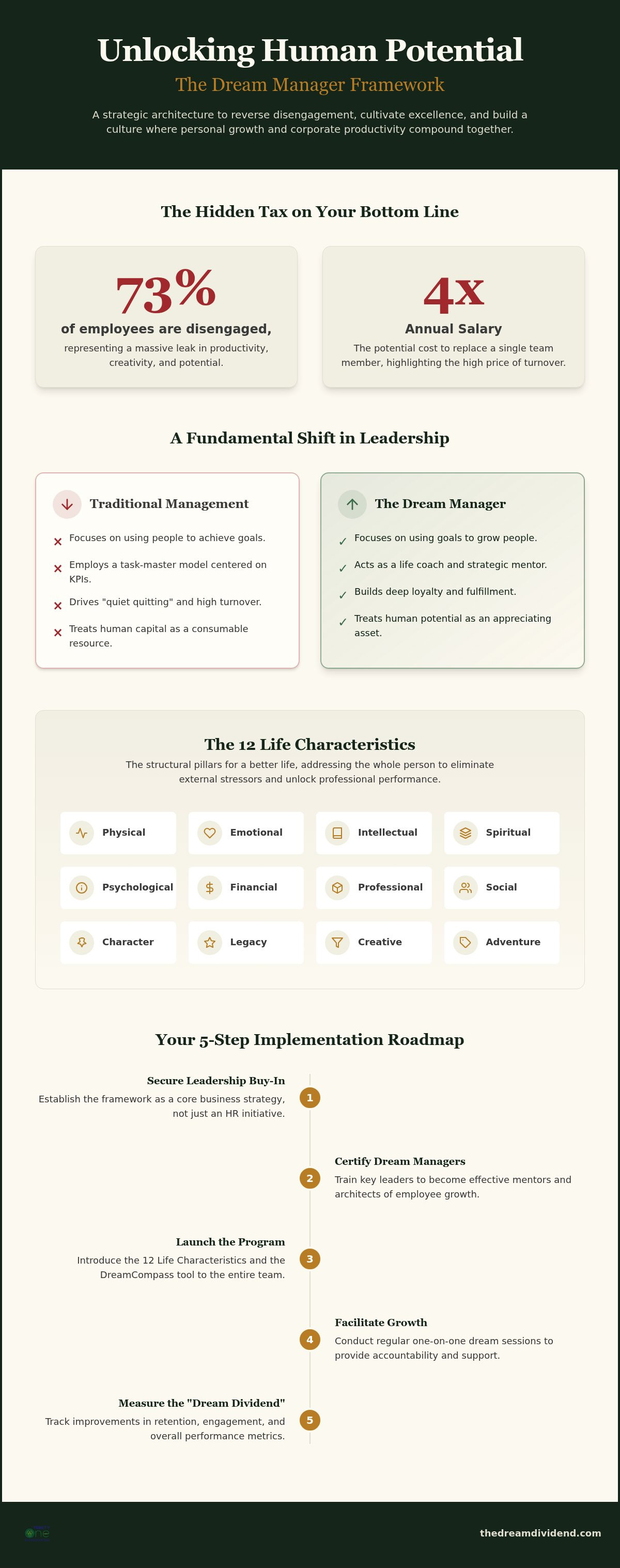
What if the most valuable asset on your balance sheet isn't your intellectual property, but the untapped personal aspirations of your workforce? With 73% of employees currently disengaged, the cost of a stagnant culture has become an unsustainable tax on your bottom line. You already know that traditional performance reviews often fail to inspire, yet the cost to replace a single team member can reach four times their annual salary. This is where the dream manager framework shifts the paradigm from simple management to strategic mentorship. It functions as a structural foundation for excellence, allowing leaders to act as architects of a culture where personal growth and corporate productivity compound together.
By aligning individual dreams with organizational objectives, you can transform a disconnected office into a vibrant community of high performers. In this guide, we'll explore the 12 Life Characteristics and the practical application of the DreamCompass tool to stabilize your retention metrics. You'll discover a proven methodology to humanize the workplace, drive measurable engagement, and secure the long-term health of your enterprise. It's time to move beyond superficial fixes and invest in the human potential that fuels every successful business outcome.
Key Takeaways
- Understand why the dream manager framework is the strategic architecture needed to reverse chronic disengagement and unlock hidden human capital.
- Explore the 12 Life Characteristics and the DreamCompass tool to create a structured foundation for personal and professional growth.
- Move beyond the limitations of traditional performance reviews by treating employee aspirations as a vital asset that yields a measurable "Dream Dividend."
- Identify the clear, five-step path to implementing this culture shift, including the professional value of becoming a Certified Dream Manager.
Table of Contents
- Beyond Engagement: The Core Philosophy of the Dream Manager Framework
- Anatomy of the Framework: The 12 Life Characteristics and DreamCompass
- Traditional Management vs. The Dream Manager Framework
- Implementing the Framework: A 5-Step Roadmap for 2026
- Becoming a Certified Dream Manager: The Next Evolution
Beyond Engagement: The Core Philosophy of the Dream Manager Framework
The modern corporate world faces a quiet but devastating insolvency. Recent data reveals that 73% of the workforce is disengaged, representing a massive leak in productivity, creativity, and potential. The dream manager framework addresses this crisis by moving beyond superficial perks toward a holistic leadership methodology. It's built on the premise that an organization can only reach its peak performance when its people are actively pursuing their own excellence. This isn't a soft human resources initiative. It's a strategic investment that yields what we call the "Dream Dividend," which is a measurable return in retention, innovation, and cultural health.
This philosophy, pioneered by Matthew Kelly, recognizes that the interests of the employee and the employer are not mutually exclusive. They're actually deeply intertwined. When a company acts as a strategic architect for its employees' futures, it builds a foundation of loyalty that traditional benefits simply cannot buy. By focusing on the individual's growth, the organization secures its own path to excellence.
The Inseparable Link Between Employee and Organization
Corporations often treat human capital as a resource to be consumed rather than an asset to be appreciated. However, the destiny of your company is inextricably tied to the personal aspirations of your team members. If they're stagnant in their personal lives, they'll inevitably be stagnant in their professional roles. The dream manager framework shifts the focus from using people to achieve goals to using goals to grow people. Becoming the Best Version of Yourself is the dynamic pursuit of excellence across every dimension of one's life, from physical health to professional mastery.
The Manager as a Life Coach: A 2026 Necessity
Traditional management styles are collapsing under the weight of modern expectations. The old task-master model, focused purely on KPIs and oversight, is the primary driver of "quiet quitting" and record-high turnover. In 2026, the manager's role must evolve into that of a dream-facilitator. This transition requires a shift in perspective, a commitment to growth, and a genuine interest in the individual. By facilitating personal dreams, managers eliminate the friction of disengagement. They transform the workplace from a site of obligation into a platform for fulfillment. This evolution isn't optional; it's the only way to secure a competitive advantage in a talent-scarce market.
Anatomy of the Framework: The 12 Life Characteristics and DreamCompass
To move a culture from disengagement to excellence, leadership needs more than inspiration. It requires a robust architecture. The dream manager framework provides this through a structured, dual-purpose methodology that addresses the whole person. When an organization invests in the multi-dimensional growth of its people, it sees a compounding return on that investment. Research indicates that dual-purpose training, which impacts both personal and professional spheres, can increase information retention by up to 60%. This isn't accidental. It's the result of a Personal Strategic Plan that treats an employee's life with the same rigor as a corporate quarterly report.
The 12 Life Characteristics: A Blueprint for Excellence
The framework is built upon 12 Life Characteristics that serve as the structural pillars for a better life. These categories include Physical Health, Financial, Intellectual, Emotional, Spiritual, Psychological, Creative, Professional, Adventure, Legacy, Character, and Social. By addressing non-work areas like financial stability or physical well-being, the framework eliminates the external stressors that bleed into professional performance. A team member who is financially secure and physically energized is inherently more capable of high-level contribution. This holistic approach ensures that character development and professional output grow in tandem. If you're ready to explore how these pillars can stabilize your team, you might consider how strategic growth consulting can customize this architecture for your specific needs.
DreamCompass: Navigating the Path to Aspiration
Dreams require a map. Without one, aspirations dissipate into the ether of "someday." The DreamCompass tool serves as this tactical navigation tool, transforming vague desires into a concrete, time-bound trajectory for every employee. It functions as the infrastructure for the coaching relationship, allowing for visual tracking and organizational accountability across all 12 categories.
This software-supported approach ensures that the program remains consistent and measurable. It moves the conversation from abstract "engagement" to specific, documented milestones. By using the DreamCompass, managers can help their teams navigate obstacles, celebrate wins, and maintain momentum. This structured curriculum is vital. It preserves the integrity of the framework while providing the clarity necessary for long-term commitment. When employees see their progress visualized, their buy-in for the organization's goals intensifies. They aren't just working for a paycheck anymore. They're working for their future, and they're doing it within the walls of your company.
Traditional Management vs. The Dream Manager Framework
Traditional management operates on a sterile, transactional axis. It treats employees as interchangeable units of production, focusing exclusively on quarterly KPIs, output volume, and cost containment. While this approach might provide short-term stability, it creates a rigid ceiling for productivity. It ignores the fundamental reality that human beings don't leave their personal lives at the door. When you manage only the task and ignore the person, you incur a heavy "Turnover Tax." Replacing a single mid-level employee costs between three to four times their annual salary when you account for recruiting, onboarding, and lost momentum.
The dream manager framework replaces this outdated model with a strategic architecture focused on aspiration. It recognizes that the most effective way to drive corporate excellence is to fuel the individual's pursuit of their own dreams. This isn't corporate fluff; it's a pragmatic strategy to capture the "Dream Dividend." By helping your people build better lives, you build a better company. You move from a culture of compliance to a culture of contribution, transforming the workplace from a site of obligation into a platform for genuine fulfillment.
Shift from Transactional to Transformational Leadership
Transactional leadership is built on an exchange of effort for a paycheck. It's a binary relationship that rarely inspires discretionary effort or long-term loyalty. Transformational leadership, however, acts as a catalyst for peak performance by connecting the organization's mission to the individual's personal "why." The dream manager framework is the infrastructure for transformational leadership. It provides the tools and the language for managers to evolve from supervisors into strategic mentors. This shift eliminates the "quiet quitting" phenomenon by making the workplace a primary engine for personal growth, character development, and professional mastery.
The ROI of Aspiration: Measuring the Unmeasurable
Critics often argue that personal dreams are too intangible to measure. However, the financial impact of a high-performance culture is undeniable. You can track the success of this methodology through reduced turnover rates, higher engagement scores, and the successful achievement of personal milestones within the team. When employees see the organization as a partner in their success, their loyalty compounds. They don't just show up for the job; they show up for the vision.
Engaging in dream management consulting provides a clear path to quantifying these gains. It allows you to move beyond gut feelings and into data-driven culture transformation. By treating personal aspirations as a vital asset, you reduce the friction of disengagement and maximize the return on your human capital. The result is a resilient organization that attracts the best talent, retains top performers, and secures a competitive advantage in a volatile market.
Implementing the Framework: A 5-Step Roadmap for 2026
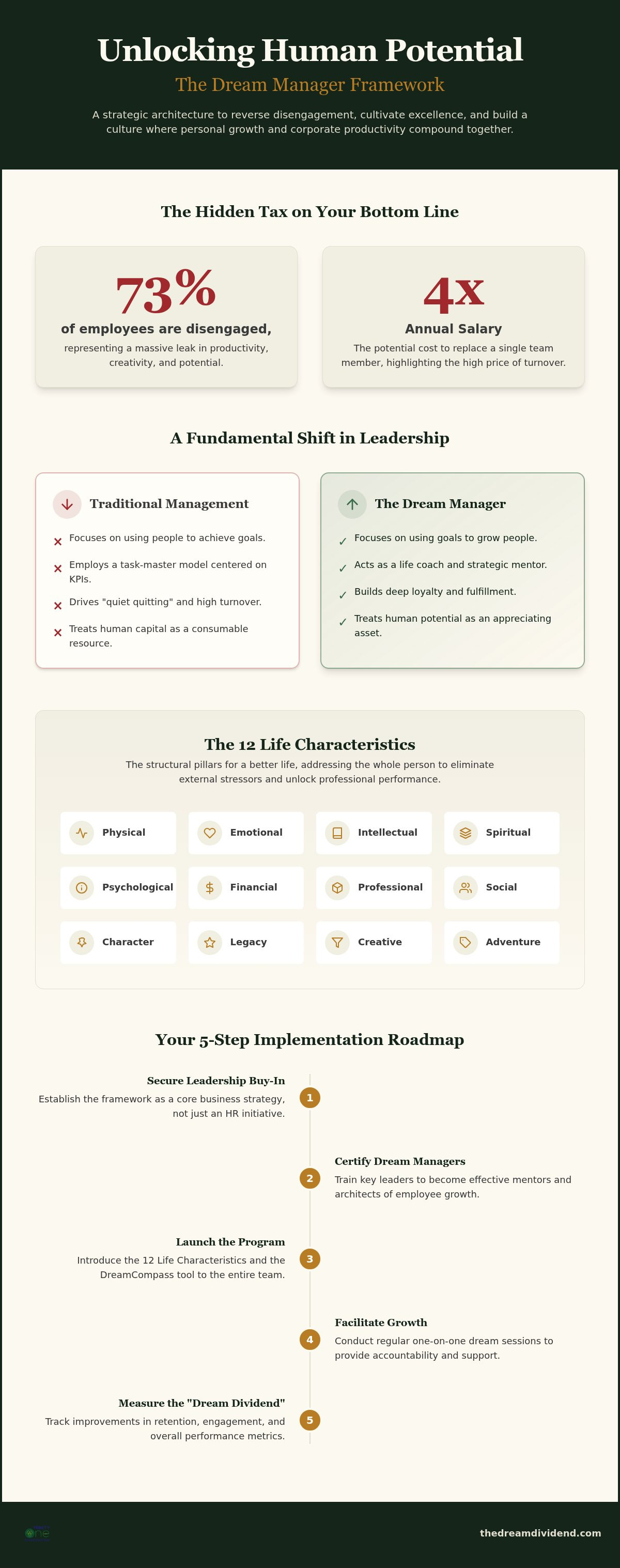
Execution is the bridge between a visionary concept and a high-performance culture. To implement the dream manager framework effectively in 2026, you must follow a deliberate, phased approach that prioritizes long-term value over immediate optics. This isn't a weekend retreat or a brief seminar. It's a structural shift in how your organization views its people. Success depends on moving from abstract theory to a concrete, 12-month rhythm of growth and accountability.
- Step 1: Leadership Buy-in. Secure philosophical alignment at the executive level. If the C-suite doesn't view employee dreams as a strategic asset, the program will lack the necessary gravity.
- Step 2: Appointing a Certified Dream Manager. Identify a leader who can act as the strategic architect of your culture. This role requires a unique blend of empathy, professional authority, and coaching expertise.
- Step 3: Launching the Dream Experience. Introduce the program to your workforce as an invitation, not a mandate. Frame it as a partnership in their pursuit of becoming the best version of themselves.
- Step 4: Continuous Coaching. Integrate the monthly curriculum into the standard work week. Use the DreamCompass tool to track progress across the 12 Life Characteristics and maintain momentum.
- Step 5: Reviewing the Dream Dividend. Analyze your metrics. Look at retention rates, engagement scores, and internal promotion data to quantify the return on your investment.
Internal vs. External Dream Managers
Deciding whether to certify an internal leader or hire an external consultant is a critical strategic choice. Certifying an internal leader allows for a deeper, daily integration into the company's existing culture rituals. However, external dream management consulting often provides a necessary level of neutrality and trust. Employees may feel more comfortable sharing personal aspirations with an outside facilitator who isn't involved in their direct performance reviews. If your goal is a rapid, high-impact transformation, an external partner can provide the professional distance required for genuine vulnerability.
Sustainable Scaling: Beyond the Initial Launch
The greatest risk to any cultural initiative is "program of the month" syndrome. To avoid this, you must weave the framework into the very fabric of your organization. Integrate dream-related milestones into quarterly reviews. Celebrate personal wins during team meetings. Encourage leaders to utilize resources like a leadership development podcast to stay informed on the latest coaching methodologies. When the pursuit of dreams becomes a standard operating procedure, you move beyond temporary engagement and into sustainable excellence. If you're ready to build this foundation for your team, connect with our strategic architects to begin your implementation plan.
Becoming a Certified Dream Manager: The Next Evolution
Leadership in 2026 requires a specialized toolkit that transcends traditional management theory. Obtaining the Certified Dream Manager designation is the definitive step for leaders who want to move beyond oversight and into the high-stakes world of strategic mentorship. This certification doesn't just add a title to your profile; it fundamentally alters your professional trajectory. By mastering the dream manager framework, you become the primary driver of organizational health, turning disengagement into a compounding asset of loyalty and performance.
The Certification Journey
The path to becoming a Floyd-certified coach is rigorous, intentional, and deeply supportive. For the 2026 cycle, upcoming virtual certification sessions are scheduled for July 23-24 and October 22-23. The process begins with a two-day intensive training event where you'll dive into the 12 Life Characteristics and the DreamCompass methodology. However, the true value lies in the subsequent 12 months of group coaching. This year-long support cycle ensures you have the guidance needed to implement the curriculum effectively, navigate complex cultural challenges, and maintain the integrity of the framework within your organization.
Your Role as a Strategic Architect
Certification shifts your career focus from short-term task management to long-term human investment. You'll stop being a supervisor of work and start being a facilitator of dreams. This transition allows you to build a legacy of impact that outlasts any single project or fiscal year. You'll learn to identify aspirations, clear structural hurdles, and celebrate the milestones that define a life well-lived. If you're ready to lead the next evolution of corporate culture, you can learn more about the Certified Dream Manager program and start your journey today. Your evolution into a strategic architect is the most significant investment you can make in your professional future.
As you move forward, remember that the "Dream Dividend" isn't just for the company. It's for you. By helping others become the best version of themselves, you inevitably accelerate your own growth. Stay connected with our community through The Dream Dividend Podcast to continue learning from leaders who have successfully bridged the gap between personal fulfillment and professional excellence. The future of leadership belongs to those who dare to dream alongside their people.
Designing a Culture of Compounding Success
The shift from a transactional workplace to a high-performance culture isn't a matter of chance; it's a matter of strategic architecture. By adopting the dream manager framework, you move beyond the stagnant costs of disengagement and begin capturing the true ROI of human potential. You now have the roadmap to integrate the 12 Life Characteristics and the DreamCompass tool into your organizational fabric. This methodology, rooted in the proven principles of Matthew Kelly and Floyd Consulting, ensures that your investment in your people yields a measurable dividend in both loyalty and productivity.
Our expertise as Certified Dream Managers provides the mentorship required to navigate this transition with confidence. It's time to stop managing tasks and start facilitating the aspirations that fuel your enterprise. Transform your culture with the Dream Manager Framework today and secure a future where your organization and your people thrive in unison. The path toward becoming the best version of your company is clear, and the rewards of this journey will compound for years to come.
Frequently Asked Questions
What is the Dream Manager framework?
The dream manager framework is a strategic leadership methodology designed to align an individual's personal aspirations with the organization's corporate objectives. It functions as a structural foundation for excellence, moving beyond traditional management to address the whole person. By facilitating the pursuit of personal dreams, the organization creates a culture of high performance, deep loyalty, and mutual growth that standard management styles can't achieve.
How does the Dream Manager framework reduce employee turnover?
Turnover is often a symptom of stagnation and disconnection. This framework reduces attrition by transforming the workplace into a platform for personal fulfillment, which eliminates the primary driver of "quiet quitting." When employees see that their organization is an architect of their future success, their commitment compounds. This shift from a transactional relationship to a transformational one makes your company a destination for top talent.
Is the Dream Manager program only for large corporations?
No, the program is effective for organizations of any scale, from small businesses to global enterprises. While large corporations often use it to bridge the gap in massive workforces, smaller teams frequently see faster cultural stabilization due to shorter feedback loops. Any leader who views their people as a vital asset rather than a line-item expense can implement these principles to drive excellence and secure a competitive advantage.
What are the 12 Life Characteristics used in the framework?
The framework focuses on 12 essential dimensions of human life: Physical Health, Emotional, Intellectual, Spiritual, Psychological, Creative, Financial, Professional, Character, Social, Adventure, and Legacy. These pillars serve as a blueprint for becoming the best version of yourself. By addressing these areas, the methodology ensures that growth is holistic and sustainable, preventing the burnout that often results from a narrow focus on professional output alone.
How long does it take to see results from the Dream Manager framework?
Cultural shifts often begin immediately after the initial Dream Experience launch as morale and engagement levels rise. However, measurable improvements in retention and productivity typically manifest within a six to twelve-month window. This timeframe allows the monthly curriculum to take root and the DreamCompass tracking to show tangible progress. Long-term excellence is a result of consistent, incremental investment in human potential rather than a quick fix.
Can a manager really be a life coach to their employees?
Yes, provided they transition from a task-master mindset to that of a dream-facilitator. This doesn't require the manager to become a therapist; rather, it requires them to act as a strategic mentor who supports the employee's Personal Strategic Plan. With proper training, a manager becomes a guide who helps navigate obstacles and celebrate milestones, which naturally strengthens the professional relationship and improves the quality of work produced.
What is the difference between Dream Management and traditional coaching?
Traditional coaching usually focuses on specific skill gaps or immediate performance metrics. In contrast, the dream manager framework is a holistic approach that prioritizes the individual's life aspirations as the primary engine for professional success. It recognizes that if an employee's life is working, their work will work. This methodology builds a foundation of character and well-being that makes traditional skill-based coaching far more effective and sustainable.