What if the most powerful lever for your company’s fiscal growth isn't a new software suite, a revised sales script, or a leaner supply chain, but the unvoiced personal aspirations of your team? You've likely felt the sharp sting of high turnover costs and watched as quiet quitting erodes your productivity, even while traditional engagement surveys fail to move the needle on your dream manager ROI. It's a common struggle. Visionary leaders realize that standard retention tactics often fail to address the human heart of the business.
By shifting your perspective, you can transform individual goals into a measurable Dream Dividend that pays compounding returns for years to come. This article provides a clear framework to move beyond superficial fixes and create a strategic environment that reduces turnover, improves performance, and attracts top-tier talent. You'll discover how tools like the DreamCompass and the 12 Life Characteristics help you build a sturdy foundation for sustainable growth. Prepare to learn how helping your people become the best version of themselves is the most pragmatic, high-stakes financial decision you can make for your organization's future.
Key Takeaways
- Recognize why ignoring employee aspirations acts as a structural financial leak that traditional corporate perks can no longer plug.
- Quantify the dream manager ROI by establishing clear baselines for turnover reduction, absenteeism, and the compounding rate of personal milestone achievement.
- Evaluate the superior long-term value of investing in dreams compared to the diminishing returns and "hedonic treadmill" of standard salary increases.
- Learn to utilize the DreamCompass tool to bridge the gap between individual excellence and measurable high-performance business outcomes.
- Discover a phased implementation strategy to internalize the Dream Dividend through consulting, keynotes, or the Certified Dream Manager program.
Table of Contents
- The Disengagement Deficit: Why Ignoring Dreams is a Financial Liability
- The Mechanics of the Dream Dividend: How Aspiration Drives Performance
- Dream Management vs. Traditional Incentives: A Comparative Analysis
- A Strategic Framework for Measuring Your Dream Manager ROI
- Securing the Dividend: How to Implement for Maximum ROI
The Disengagement Deficit: Why Ignoring Dreams is a Financial Liability
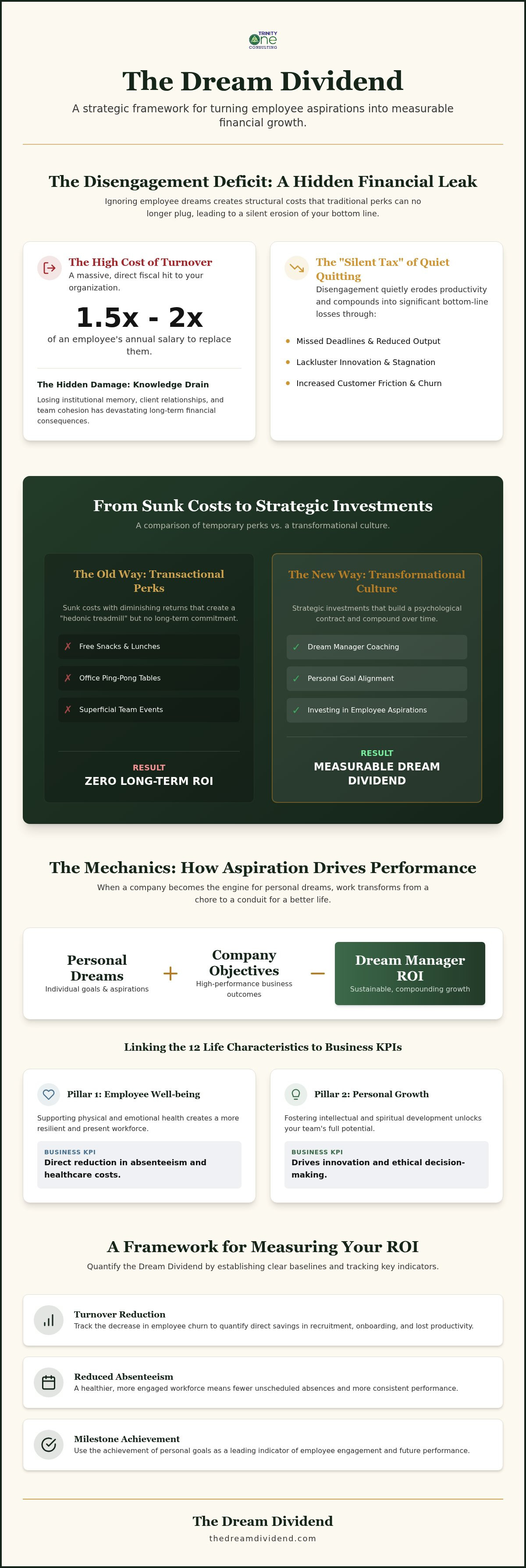
Your balance sheet tells a story, but it often hides the most expensive line item: the cost of unfulfilled potential. We define dream manager ROI as the measurable financial gain realized when an organization actively helps its employees achieve their personal goals. It's the fiscal delta between a person who shows up for a paycheck and a person who shows up to fund their future. When an individual sees their work as the primary engine driving their personal dreams, their commitment ceases to be a negotiation. It becomes a partnership. It becomes a strategic advantage.
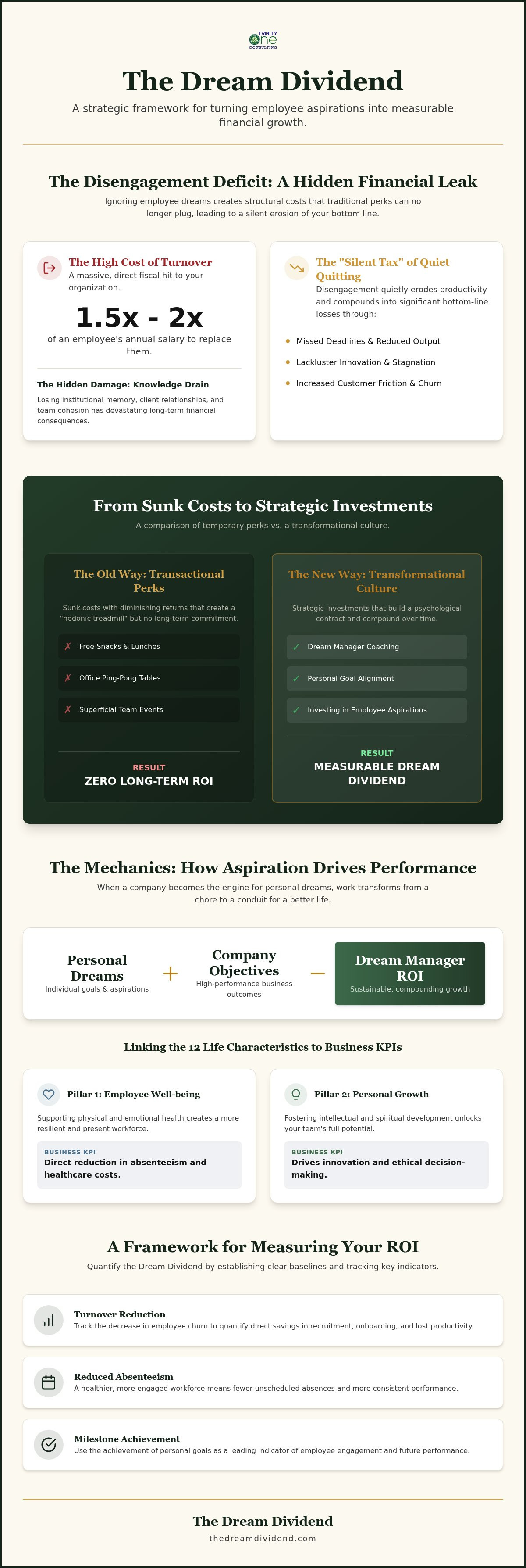
Looking toward the 2026 disengagement crisis, it's clear that traditional perks have lost their efficacy. Free snacks, colorful offices, and casual Fridays are no longer enough to stop the financial leak. These are superficial bandages on a structural wound. Quiet quitting isn't just a trend; it's a silent tax on your operations. It compounds into a significant bottom-line loss through missed deadlines, lackluster innovation, and customer friction. The Dream Dividend serves as your only true hedge against the rising, volatile costs of talent acquisition.
The True Cost of Turnover in Modern Organizations
Losing a talented team member is a massive fiscal hit. Industry research suggests the replacement cost for a mid-level professional ranges from 1.5x to 2x their annual salary. This figure accounts for recruitment fees, onboarding time, and lost productivity. However, the Knowledge Drain is often even more damaging to your long-term health. You lose institutional memory, client relationships, and team cohesion. By investing in employee aspirations, the Certified Dream Manager program acts as high-stakes retention insurance for your high-potentials.
Sunk Costs vs. Strategic Investments in Culture
Many leaders confuse transactional benefits with transformational culture. Ping-pong tables and free lunches are sunk costs that provide zero long-term ROI. They are temporary distractions rather than permanent foundations. Transformational coaching, however, creates a psychological contract that money alone cannot buy. A Dream Manager is a strategic architect of organizational health, designing frameworks where personal excellence and corporate objectives coexist. This shift from transactional to transformational is where your greatest competitive advantage lies. It's where you stop spending on distractions and start investing in the people who build your legacy.
The Mechanics of the Dream Dividend: How Aspiration Drives Performance
Performance is rarely a matter of raw skill alone. It's an issue of alignment. When a company honors the psychological contract by caring about an employee's "why," the nature of the work changes from a chore to a conduit. By mapping the Dream Manager framework to high-performance outcomes, leaders create a culture where personal ambition fuels corporate objectives. This isn't a soft initiative. It's a strategic architecture designed to maximize your human capital.
Personal growth has a powerful compounding effect on professional reliability. As individuals work toward becoming the best version of themselves, they naturally develop greater discipline, resilience, and focus. This philosophy creates a self-correcting workplace culture. If an employee is committed to their own excellence, they're less likely to tolerate mediocrity in their daily tasks. They don't just work for you; they work for the person they're becoming, which is the ultimate driver of dream manager ROI. When personal aspirations and professional duties are synchronized, the resulting momentum is nearly impossible to disrupt.
Linking the 12 Life Characteristics to Business KPIs
The 12 Life Characteristics serve as the structural pillars of this growth. When an organization supports physical and emotional health, it sees a direct reduction in absenteeism and healthcare costs. Intellectual and spiritual growth foster the kind of innovation and ethical decision-making that protects your brand's reputation. Tracking these 12 traits provides a leading indicator of organizational performance, allowing you to identify potential burnout or disengagement before they impact your quarterly results. If your team is growing personally, your business is growing professionally.
The DreamCompass: A Tool for Navigating ROI
Alignment requires more than good intentions. It requires a rigorous methodology. Using the DreamCompass tool allows managers to align individual aspirations with company milestones without resorting to micromanagement. The Dream Manager acts as a navigator, helping employees chart a course toward their goals while ensuring those goals remain tethered to the organization's success. In one pilot group, this precise mapping of dreams led to a 40% reduction in turnover, proving that when people see a future for themselves, they stay to build the future of the company. If you're ready to explore these mechanics further, listening to The Dream Dividend Podcast can provide the tactical depth your leadership team needs to begin this transformation.
Dream Management vs. Traditional Incentives: A Comparative Analysis
Standard incentives are often a race to the bottom. Many leaders rely on the "Hedonic Treadmill" of salary increases, only to find that more money rarely translates into more engagement. While a 5% raise might satisfy a team member temporarily, it quickly becomes the new expected baseline. It's a fixed cost that compounds your overhead without necessarily compounding your results. Calculating your dream manager ROI requires looking past these immediate expenses and toward the long-term appreciation of your human capital.
Consider the direct comparison. A blanket salary increase across a department is a significant, permanent financial commitment. In contrast, the cost of implementing a Dream Manager program is a strategic investment in a structural asset. The impact of a raise fades as lifestyle inflation catches up. The impact of achieving a personal dream, however, creates a life-long brand advocate. When you help an employee buy their first home or pay off a debt, you aren't just a boss. You're a partner in their success. This is where dream management consulting solves the "meaning gap" that no amount of cash can bridge.
Why Monetary Bonuses Fail to Drive Long-Term Retention
Cash bonuses suffer from severe "recency bias." Data suggests that engagement spikes immediately after a payout, only to drop back to the baseline within 90 days. Aspiration, however, acts as a permanent motivator because the dream is always ahead, keeping the employee anchored to the organization that facilitates it. Think of it this way: a monetary bonus provides the temporary sugar high of a quick win, while a dream provides the sustained energy of a long-term mission. One is a transaction; the other is a transformation.
The Recruitment Advantage: Attracting Talent with Purpose
Purpose is a powerful magnet. In a competitive market, a culture focused on employee aspirations can significantly lower your Cost Per Hire (CPO). Top-tier candidates often choose a Dream-Driven environment over higher-paying competitors because they value the investment in their whole self. This creates a powerful "Dream Dividend" in your employer branding, turning your current staff into your most effective recruiters. Social proof matters. Authentic "Dream Stories" of employees reaching personal milestones consistently outperform generic Glassdoor reviews, building a foundation of trust before a candidate even applies.
A Strategic Framework for Measuring Your Dream Manager ROI
Measurement is the bridge between skepticism and strategy. To realize true dream manager ROI, you must treat human potential with the same analytical rigor as any other capital investment. If your leadership team is hesitant, the solution isn't to lean on "feel-good" anecdotes. Instead, you must build a robust reporting structure that translates personal growth into financial gain. This isn't just about tracking happiness; it's about auditing the health of your most valuable asset.
- Step 1: Establish the Baseline. Audit your current turnover rates, record absenteeism data, and analyze your most recent engagement scores. This data provides the ground floor for your calculation.
- Step 2: Track Dream Velocity. Monitor the rate at which employees are achieving personal milestones. A high velocity indicates a culture of momentum, discipline, and success.
- Step 3: Correlate Performance. Cross-reference dream achievement data with standard performance reviews. You'll likely find that your most fulfilled employees are also your most reliable contributors.
- Step 4: Calculate Turnover Avoidance. Use the replacement cost figures we established earlier, typically 1.5x to 2x an annual salary, and multiply them by the number of high-potentials you've retained.
- Step 5: Report the Dream Dividend. Present these findings to the C-suite as a strategic asset update. Show them how helping people become the best version of themselves directly fuels the bottom line.
Quantifying Intangibles: Engagement and Morale
While the human heart is complex, the financial impact of a fulfilled heart is remarkably easy to track if you have the right framework. Use the Employee Net Promoter Score (eNPS) as a proxy for your cultural health and brand loyalty. We also recommend establishing an "Aspiration Index" to measure the percentage of your workforce actively pursuing a personal goal. This metric allows you to present "soft" cultural data in a "hard" financial report, showing exactly how morale drives your performance. If you're ready to start these calculations, you can explore our consulting services to begin your baseline audit.
The Role of the Certified Dream Manager in Data Collection
Data collection shouldn't feel like surveillance. The Certified Dream Manager program equips leaders to act as strategic navigators who gather data through the lens of support. They maintain strict confidentiality while providing leadership with the aggregate data needed to prove the ROI. This approach transforms the manager into a life coach, creating a data-driven leadership style that employees actually trust. When the person collecting the data is also the person helping you achieve your dreams, the quality and honesty of that data improves exponentially. It's a system built on trust, transparency, and tangible results.
Securing the Dividend: How to Implement for Maximum ROI
Implementation is where visionary strategy meets operational reality. To maximize your dream manager ROI, you must choose an entry point that aligns with your current organizational maturity. Some firms require a bold catalyst to break through cultural stagnation, while others need a methodical, phased rollout to ensure long-term stability. The goal is to move from a static environment to one where human aspiration is the primary engine of growth. By starting with high-impact teams, you can prove the financial case internally before scaling the framework across the entire enterprise.
Integrating this methodology into your existing HR processes doesn't require a total overhaul. It requires a shift in perspective. Instead of viewing performance reviews as a post-mortem on past mistakes, they become a forward-looking navigation session. You start to treat your people as dynamic assets rather than fixed expenses. This transition ensures that the Dream Dividend isn't a one-time gain, but a compounding return that builds organizational equity over time.
Consulting and Keynotes: Accelerating the Culture Shift
A leadership development keynote often serves as the initial spark, creating the buy-in momentum needed to shift the internal narrative. It challenges the status quo and introduces the possibility of a "growth culture" where individual success is the fuel for corporate excellence. Professional consulting then provides the structural support to overcome institutional resistance. By auditing your current workflows, you can begin to integrate the 12 Life Characteristics into daily operations. It's a deliberate process of turning a traditional performance culture into a human-centric powerhouse.
The Path to Certification: Building In-House Expertise
While external guidance is vital for the initial launch, the highest long-term ROI comes from building in-house expertise. Training your own leaders to become a Certified Dream Manager ensures that the framework is woven into the very fabric of your company. These internal experts are uniquely positioned to identify and nurture employee aspirations within the specific context of your unique industry. They use the DreamCompass tool to keep personal goals and business KPIs in constant alignment, creating a self-sustaining ecosystem of excellence.
As you scale, your organization evolves into a "Dream Factory." This is the ultimate vision: a workplace where the achievement of personal dreams fuels the achievement of organizational excellence. You stop competing solely on salary and start competing on the quality of life you offer your people. If you're ready to move beyond theory and start building this foundation, you can calculate your potential Dream Dividend with our consulting team. It's time to turn your culture into your greatest financial asset.
Capitalizing on Potential: The Future of Your Dream Dividend
Investing in the personal aspirations of your team is a structural imperative for any organization seeking sustainable growth. You've discovered how traditional perks fail to stop the drain of quiet quitting and how a clear framework can transform intangible morale into a measurable Dream Dividend. By aligning individual 'whys' with corporate KPIs, you build a culture that is both high-performing and deeply resilient. This methodology, rooted in the principles of Matthew Kelly's best-selling book, has consistently proven to reduce turnover across diverse sectors. It treats employees as dynamic assets rather than fixed costs.
If you're ready to move beyond superficial fixes and secure your dream manager ROI, it's time to take the next step. Led by Kevin Patrick, a pioneer in this field, our team is ready to help you navigate this transition. You can Book a Strategic ROI Discovery Call with a Certified Dream Manager to begin your baseline audit. The potential of your people remains the most valuable asset on your balance sheet. Start investing in the version of themselves they are becoming, and they will build the organization you've always envisioned.
Frequently Asked Questions
How do you calculate the ROI of a Dream Manager program?
You calculate the return by measuring the reduction in turnover costs against the initial investment in the program. Start by establishing a baseline for your current cost per hire and multiply that by the number of high-potentials retained. When you factor in reduced absenteeism and increased productivity, the dream manager ROI becomes a clear, measurable line item on your balance sheet. It's a strategic audit of human capital appreciation.
Is Dream Management appropriate for all industries?
Yes, because human aspiration is the primary engine of every industry, from manufacturing to high-tech software development. Any organization that relies on human talent to execute its strategy can benefit from this framework. Whether you're managing a remote creative team or a local service crew, the core need for purpose remains the same. It's a universal methodology that adapts to the specific structural needs of your unique sector.
How long does it take to see a financial return from the Dream Manager framework?
Most organizations witness a significant shift in morale and engagement within the first 90 days of implementation. However, the full structural dream manager ROI typically manifests over a six to twelve-month period as retention rates stabilize. This timeframe allows for the compounding effect of dream achievement to take hold. It's a long-term investment in organizational health rather than a quick, superficial fix for quarterly numbers.
What is the difference between a Dream Manager and a Life Coach?
A Dream Manager operates within the specific context of the workplace, acting as a strategic bridge between personal excellence and corporate objectives. While a life coach focuses solely on the individual, a Dream Manager ensures that personal aspirations fuel professional performance. They use tools like the DreamCompass to navigate this alignment. They are strategic architects of a culture where the company and the employee grow in tandem.
How do you handle employees who say they 'don't have any dreams'?
Many people have simply suppressed their aspirations due to years of transactional work environments. We use the 12 Life Characteristics to help these individuals rediscover what it means to become the best version of themselves. Often, a dream isn't a grand ambition; it might be as simple as financial stability or improved physical health. Once they realize the company actually cares about their "why," the dialogue usually opens up quite naturally.
Does the Dream Manager program replace traditional performance reviews?
It doesn't replace them; it transforms them into a more powerful, forward-looking conversation. Traditional reviews often focus on past failures, while the Dream Manager framework focuses on future potential. By integrating personal goals into the professional dialogue, you create a more holistic view of the employee's contribution. This alignment makes the standard review process feel less like an interrogation and more like a strategic planning session for mutual success.
What is the cost of becoming a Certified Dream Manager?
The investment for certification varies based on the size of your organization and the specific implementation path you choose. We recommend contacting our team to discuss a tailored plan that fits your strategic objectives. This ensures your leadership team receives the exact level of training and support required to internalize the Dream Dividend. We focus on creating a sustainable, high-impact program that delivers long-term value for your specific culture.
Can a small business see the same ROI as a large corporation?
Smaller organizations often see a more immediate and visible return because each individual represents a larger percentage of the total workforce. In a small team, one high-potential employee staying instead of leaving can have a massive impact on the bottom line. The principles of aspiration and engagement are scalable. Whether you have ten employees or ten thousand, the financial case for investing in their dreams remains equally pragmatic and compelling.