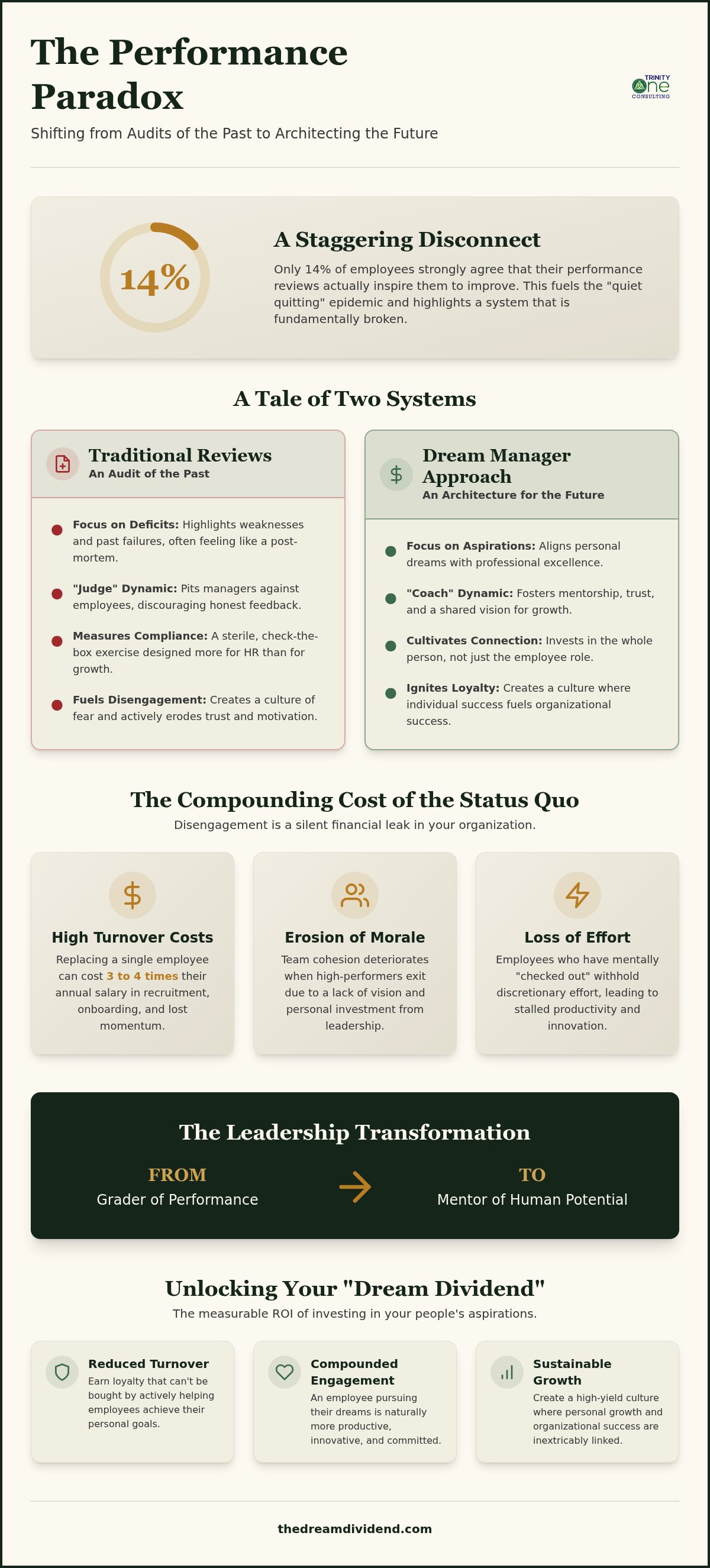
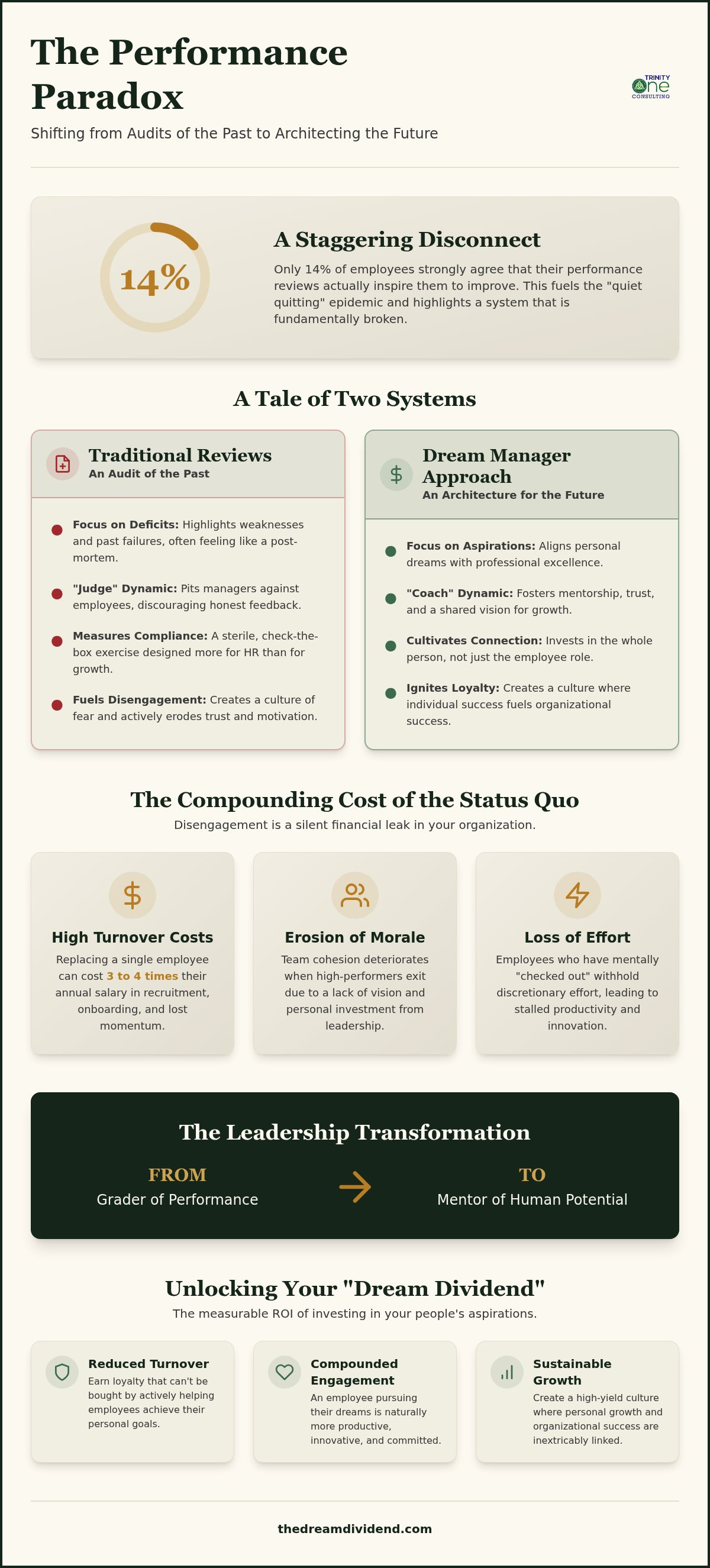
Only 14% of employees strongly agree that their performance reviews actually inspire them to improve, a staggering indictment of the corporate status quo. You likely feel the weight of this disconnect every year as engagement scores dip, talent slips away, and productivity stalls despite competitive compensation packages. It's a frustrating cycle of auditing the past while ignoring the future. When we examine the dream manager vs traditional performance reviews, we see more than just a change in HR policy. We see a fundamental shift from monitoring tasks to mentoring people.
You deserve a management system that naturally increases loyalty and turns your culture into a high-yield strategic asset. In this guide, you'll discover how replacing sterile metrics with aspiration-based management transforms employee retention and organizational ROI. We'll provide a clear framework to transition away from traditional reviews, moving toward a model where personal dreams fuel professional excellence. By the end, you'll understand how to generate a Dream Dividend that rewards your people and your bottom line through a culture of calculated optimism and shared growth.
Key Takeaways
- Understand why traditional reviews act as an audit of the past that inadvertently fuels disengagement and the "quiet quitting" epidemic.
- Learn how the dream manager vs traditional performance reviews debate centers on shifting from monitoring tasks to architecting individual aspirations.
- Discover how to utilize the DreamCompass tool to replace sterile compliance metrics with a framework focused on holistic well-being.
- Identify the "Dream Dividend" in your organization, capturing the measurable ROI of reduced turnover and compounded employee loyalty.
- Gain a clear strategic framework to transition your leadership team from being graders of performance to being mentors of human potential.
Table of Contents
- The Performance Paradox: Why Traditional Reviews Fail in 2026
- Defining the Dream Manager Approach: Performance Through Aspiration
- Side-by-Side: Dream Manager vs. Traditional Performance Reviews
- Implementing the Shift: From Grading Employees to Investing in Dreams
- The Dream Dividend: Measuring the Strategic ROI of Aspiration
The Performance Paradox: Why Traditional Reviews Fail in 2026
The annual review has become a ritual of friction. It's an audit of past failures rather than an architecture for future growth. By 2026, the gap between corporate expectations and employee reality has widened into a chasm. When we look at the dream manager vs traditional performance reviews, the fundamental flaw is clear. One measures compliance while the other cultivates connection. Traditional systems focus on what went wrong, while modern leaders focus on what is possible.
A standard performance appraisal often feels like a post-mortem on a project that ended six months ago. It focuses on deficits, highlights weaknesses, and assigns a numeric value to human complexity. This sterile approach doesn't just fail to motivate. It actively erodes trust. It encourages "quiet quitting" because employees feel like cogs in a machine rather than individual assets with unique aspirations. You can't expect high-stakes loyalty from a workforce that feels like a line item on a spreadsheet.
Compliance vs. Connection: The Structural Flaw
Most reviews are designed by HR for HR. They're check-the-box exercises that prioritize legal safety over human potential. This creates a "Judge vs. Coach" dynamic that stifles growth. When a manager acts as a judge, the employee hides their struggles and inflates their wins to survive the grading cycle. You can't build the "Best Version of Yourself" in an environment where honesty feels like a professional liability. A deficit-based system will never yield high-engagement returns because it ignores the internal engine of the employee: their dreams.
The ROI of Disengagement: Counting the Cost
Disengagement is a silent financial leak that compounds over time. Replacing a single employee can cost three to four times their annual salary when you factor in recruitment, onboarding, and lost momentum. Traditional reviews fail to address why people actually leave. They don't ask about the person's life beyond the cubicle. They don't invest in the individual's future. When evaluating the dream manager vs traditional performance reviews from a financial perspective, the ROI of the former becomes undeniable. The hidden costs of the status quo include:
- The skyrocketing expense of constant recruitment and training.
- The erosion of team morale when high performers exit due to lack of vision.
- The loss of discretionary effort from those who stay but have mentally checked out.
Modern leadership requires a strategic shift toward humanizing the workplace as a core business necessity. If you don't connect an employee's daily grind to their long-term personal vision, you're merely renting their time. You aren't earning their loyalty. We must move away from backward-looking metrics and start architecting a culture where personal growth and organizational success are inextricably linked.
Defining the Dream Manager Approach: Performance Through Aspiration
The Dream Manager approach isn't a soft HR initiative; it's a strategic framework that aligns individual aspiration with corporate objective. In the ongoing debate of dream manager vs traditional performance reviews, the distinction lies in the direction of the investment. Traditional models ask what the employee can do for the company. The Dream Manager approach asks how the company can help the employee become the best version of themselves. This shift recognizes a simple truth. An employee pursuing their dreams is naturally more engaged, productive, and loyal. They're no longer just working for a paycheck; they're working for a future they believe in. By helping people achieve their personal goals, the organization creates a culture of compounding returns where individual success fuels corporate growth.
Managers in this system evolve beyond taskmasters. They become strategic coaches, mentors, and visionary guides. They don't just audit the past; they architect the future. This transformation turns leadership into a high-stakes mentorship, where the focus stays on long-term value rather than immediate, superficial fixes. If you're ready to lead this transition, exploring the path of a Certified Dream Manager can provide the professional authority needed to shift your culture.
The 12 Life Characteristics: A Foundation for Excellence
True excellence requires a holistic foundation. We utilize the 12 Life Characteristics to assess human potential far beyond simple job descriptions. Professional success is inseparable from personal well-being, physical health, and emotional stability. By mapping these characteristics, we replace the generic "strengths and weaknesses" list with a clear navigation chart for growth. This methodology uses the DreamCompass tool to provide a structured way to measure what truly matters. It identifies gaps in an individual's foundation before they become structural failures in their performance. When you invest in the whole person, you build a resilient, multi-dimensional team capable of navigating any market volatility.
Becoming the Best Version of Yourself
Development is a shared responsibility between the leader and the employee. When a leader invests in an employee's personal dreams, the psychological contract changes fundamentally. The employee moves from being "managed" to being "invested in." This transition is a key reason why outdated performance reviews cause top talent to exit. They offer no vision for the individual's future and provide no space for personal fulfillment. By contrast, the Dream Manager framework focuses on becoming the best version of yourself as a professional necessity. It’s about compounding human potential to drive organizational health. You aren't just managing tasks; you're architecting a life that thrives within the company's ecosystem.
Side-by-Side: Dream Manager vs. Traditional Performance Reviews
Traditional reviews are an audit of past performance. Dream Management is an architecture for future potential. When we analyze the dream manager vs traditional performance reviews, the most striking difference is the shift from metric to meaning. Traditional systems obsess over quantitative output, often reducing a human being's contribution to a single numeric rating. By contrast, the Dream Manager framework prioritizes qualitative aspiration. It recognizes that when an employee's personal "why" is clear, their professional "how" becomes significantly more effective. This is not about lowering standards; it is about raising the stakes by connecting daily tasks to a larger personal mission.
The frequency of these interactions also dictates their success. Traditional reviews often create a culture of annual anxiety, where feedback is saved for a high-pressure meeting once or twice a year. The Dream Manager approach replaces this with consistent, purpose-driven dialogue. It shifts the ownership of growth from the company to the individual. Instead of the organization pushing development onto a passive employee, the individual pulls resources from the organization to fuel their own aspirations. This creates a sustainable momentum that traditional compliance-based models can never replicate.
The Review Form vs. The DreamCompass Tool
A standard HR form is designed to document performance for the files. The DreamCompass tool is designed to navigate a life. While traditional forms focus on whether an employee met a specific KPI, the DreamCompass facilitates a deeper level of engagement by tracking personal milestones alongside professional goals. Whether an employee is saving for their first home, training for a marathon, or learning a new language, these aspirations are mapped and supported. This process visualizes the "Dream Gap," the distance between where an employee is and where they want to be. By helping close this gap, the organization turns personal motivation into a powerful engine for professional excellence.
Feedback vs. Facilitation
Traditional feedback is a one-way street where a manager reports on what has already happened. Dream facilitation is a collaborative hunt for what is possible. In this model, the manager’s role evolves from being a reporter to being a vital resource. They don't just point out deficits; they provide the structural foundations for growth. This shift is a critical component of organizational culture transformation. When leaders act as facilitators of their people's dreams, trust is restored, engagement compounds, and the workforce becomes an inspired collective of high-achievers. You are no longer just managing a team; you are architecting a culture of success.
Implementing the Shift: From Grading Employees to Investing in Dreams
Transitioning from a deficit-based model to an aspiration-based one requires more than a simple policy change. It demands a structured roadmap. You aren't just swapping forms; you're re-architecting your organizational soul. This transition begins with a cold-eyed assessment of your current culture. Identify the "Quiet Quitting" hotspots where engagement is lowest. These are the areas where the friction of traditional management is most apparent. Once identified, introduce the concept to your leadership team as a strategic ROI play. Show them that when you compare the dream manager vs traditional performance reviews, the former is the only model that addresses the root cause of talent attrition.
The implementation follows five distinct phases:
- Phase 1: Culture Audit. Pinpoint where trust has eroded and where sterile metrics have replaced meaningful connection.
- Phase 2: Leadership Alignment. Frame the shift as an investment in human capital that yields measurable dividends.
- Phase 3: Practitioner Training. Enroll your key leaders in the Certified Dream Manager program to give them the tactical skills for deep facilitation.
- Phase 4: Tool Integration. Roll out the DreamCompass and the 12 Life Characteristics to provide a shared language for growth.
- Phase 5: Performance Iteration. Continuously measure the Dream Dividend through retention data and productivity surplus.
Preparing the Soil: Cultural Readiness
Trust is the non-negotiable prerequisite for this framework. If your people don't believe you care about their future, they'll never share their true aspirations. You must communicate this shift with pragmatic clarity. Avoid sounding corporate-sentimental. Instead, explain that the company's success is fueled by their individual progress. Even the skeptics, often your highest performers, will thrive here. They value the respect of being seen as a whole person with an agenda beyond the next quarterly report. To begin this journey, you can schedule a consultation to evaluate your team's readiness.
The Role of the Certified Dream Manager
Specialized certification is what separates a temporary initiative from a sustainable culture. A Certified Dream Manager acts as a strategic architect within your walls. They don't just "manage" people; they facilitate their evolution. They understand how to use the DreamCompass to bridge the gap between personal fulfillment and professional performance. By building an internal Dream Team, you ensure that the principles of Matthew Kelly’s framework become woven into the daily fabric of the business. This isn't a one-time fix. It is a long-term commitment to becoming the best version of your organization.
The Dream Dividend: Measuring the Strategic ROI of Aspiration
The Dream Dividend is not a metaphorical concept; it is a measurable financial reality. It represents the surplus of productivity generated when an inspired workforce stops simply fulfilling a job description and starts contributing with purpose. When you evaluate the dream manager vs traditional performance reviews, the difference in return on investment becomes stark. Traditional reviews often lead to a "compliance minimum," where employees do just enough to avoid a negative rating. Dream Management, however, unlocks discretionary effort. This is the holy grail of leadership: the effort that people choose to give because they see a direct link between the organization's success and their personal fulfillment.
This shift in management philosophy directly addresses the most expensive problem in modern business: turnover. Replacing a key team member can cost three to four times their salary in lost momentum and recruitment fees. By investing in employee aspirations, you aren't just being "nice." You are making a calculated strategic move. For a deeper look at the financial justification, exploring the dream manager ROI reveals how aspiration-based management slashes turnover costs and compounds organizational health over time. You stop hemorrhaging talent and start attracting it.
Hard Metrics from Soft Initiatives
Skeptics often label culture work as "soft," but the results are concrete. We track the direct correlation between Dream Achievement and professional KPI attainment. When an employee utilizes the DreamCompass to reach a personal milestone, their engagement scores typically skyrocket. Mid-size companies that have transitioned away from the dream manager vs traditional performance reviews conflict toward an integrated aspiration model report significant shifts in their bottom line. The benefits include:
- A noticeable reduction in recruitment marketing spend as the organization becomes a "Best Place to Work" organically.
- Higher levels of innovation as employees feel secure enough to take calculated risks.
- Improved customer satisfaction scores driven by a more present and energized workforce.
Your Next Step: Beyond the Performance Review
The traditional performance review is a relic of the industrial age. It was designed for a time when labor was viewed as a commodity to be managed rather than a potential to be cultivated. In a volatile market, your people are your only true competitive advantage. You can continue to audit the past, or you can begin to architect the future. We invite you to explore Dream Management Consulting to see how this framework can be tailored to your specific organizational needs. It's time to move beyond grading employees and start investing in them. Start architecting a culture that pays a dividend on every dream, ensuring your organization and your people become the best version of themselves together.
Architecting Your Strategic Future
The annual review cycle is a relic of a bygone era. It's a structure built for compliance rather than growth. By shifting your perspective, you can transform your management system from a rigid audit into a high-yield investment. When you weigh the dream manager vs traditional performance reviews, the decision is clear. You're choosing between managing tasks, auditing the past, and mentoring human potential. One creates a paper trail; the other creates a culture of excellence.
Our framework leverages Certified Dream Manager expertise and the proprietary DreamCompass methodology to help your people become the best versions of themselves. This isn't just a cultural shift; it's a strategic necessity that delivers a proven Dream Dividend ROI. You can stop reacting to turnover and start architecting a culture of sustainable loyalty. If you're ready to move beyond sterile metrics and secure your organization's health, it's time to take the next step. Transform your culture with Dream Management Consulting and start building a foundation where every dream fuels your collective success. Your people are your greatest asset. Invest in them today.
Frequently Asked Questions
What is the primary difference between a Dream Manager and a traditional manager?
The primary difference is the shift from monitoring compliance to mentoring human potential. Traditional managers focus on what the employee does for the company, while a Dream Manager focuses on what the company can do for the employee. When comparing the dream manager vs traditional performance reviews, you move from auditing past deficits to architecting future possibilities. This transition replaces sterile oversight with a high-stakes mentorship that prioritizes long-term value over immediate fixes.
How do you measure the ROI of a Dream Manager program?
We measure ROI through the "Dream Dividend," which captures the financial surplus of an inspired workforce. This includes tracking reductions in turnover costs, decreases in recruitment marketing spend, and increases in discretionary effort. When employees feel their aspirations are supported, they contribute at a higher level than a standard job description requires. This strategic shift turns intangible human qualities into tangible corporate assets that strengthen your organizational health and bottom line.
Is Dream Management applicable to all industries, including blue-collar sectors?
Dream Management is exceptionally effective in blue-collar sectors and was actually pioneered in the janitorial industry. Regardless of the job title, every human being possesses personal aspirations that drive their behavior. By investing in these dreams, organizations in labor-intensive fields can slash turnover rates and build a remarkably loyal workforce. It proves that when you treat people as individuals rather than commodities, they respond with increased productivity, reliability, and commitment.
Won't employees just use the company to achieve personal dreams and then leave?
This is a common fear, but the reality is that loyalty compounds when an organization helps a person achieve their goals. If you help an employee buy their first home or learn a new skill, they don't just leave; they become an advocate for your culture. The real risk isn't that they achieve their dreams and leave, but that they stop dreaming and stay, draining your resources through disengagement and low productivity.
How often should Dream Management sessions occur compared to traditional reviews?
Dream Management sessions should occur consistently, ideally once per month, rather than during a single annual event. Traditional reviews often create a culture of annual anxiety that stifles honest communication. Frequent, purpose-driven dialogues allow for real-time adjustments and steady progress toward personal and professional milestones. This rhythmic approach ensures that the relationship between the leader and the employee remains a steady, reflective partnership focused on sustainable, long-term growth.
What tools are used to track progress in a Dream Manager system?
We utilize the proprietary DreamCompass Tool to track progress and identify the "Dream Gap" for each individual. This tool works alongside the 12 Life Characteristics to provide a holistic assessment of an employee's well-being and aspirations. By mapping these specific areas, managers can visualize a clear navigation chart for development. These resources replace generic HR forms with a structured framework that bridges the gap between personal fulfillment and professional performance.
Can a traditional HR department transition into a Dream Management office?
A traditional HR department can certainly transition into a Dream Management office by shifting its focus from compliance to coaching. This transformation requires leaders to evolve into strategic architects who prioritize human potential. Enrolling your team in the Certified Dream Manager program is the logical training path for this shift. It provides the methodology needed to move away from deficit-based reviews toward a culture that invests in the whole person.
Is the Dream Manager framework based on a specific book or methodology?
Yes, the framework is based on the principles found in Matthew Kelly's book, "The Dream Manager," and the methodologies of Floyd Consulting. It is a highly structured system designed to drive organizational excellence by helping people become the best version of themselves. This approach has been refined through years of real-world application, proving that the most effective way to achieve corporate goals is to help your employees achieve their personal ones.