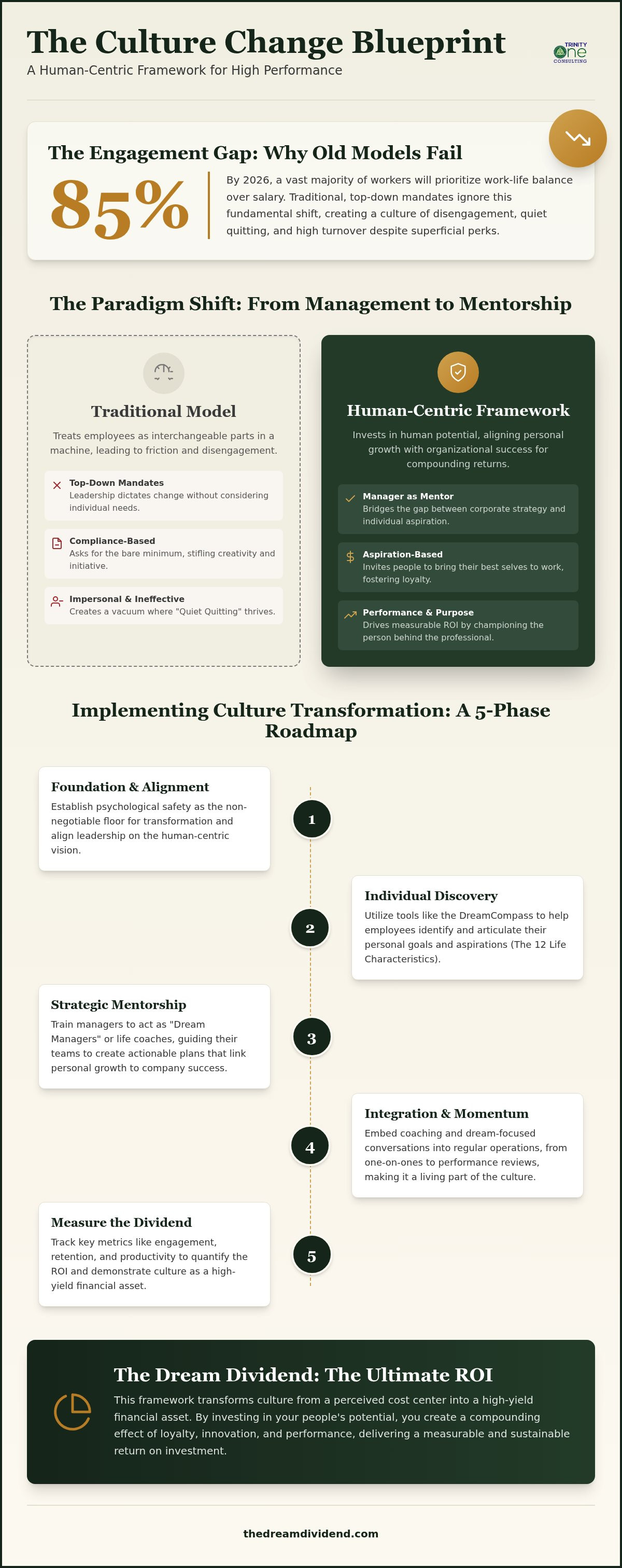
What if the thousands of dollars invested in traditional change management are yielding a zero percent return because they ignore the person behind the desk? By 2026, 85% of workers prioritize work-life balance over their salary, yet many leaders still attempt to implement a culture change management framework through top-down mandates and superficial perks. You've likely felt the sting of disengagement: high turnover despite "culture" initiatives, quiet quitting that erodes profit, and a general sense that corporate values are just fluff. It's exhausting to build a vision that your team doesn't actually share.
Lasting transformation occurs when you stop treating culture as a project and start viewing it as a structural investment in human potential. If you bridge the gap between organizational strategy and individual aspiration, you create a compounding effect of loyalty and performance. This guide explores a human-centered approach to cultural excellence. We'll examine how to align personal goals with company success, drive measurable ROI on your initiatives, and build a high-performance environment where your people finally become the best versions of themselves.
Key Takeaways
- Understand why traditional top-down models are failing in the 2026 talent market and how to pivot toward a more resilient, human-centric roadmap.
- Master a sophisticated culture change management framework that bridges the gap between high-level organizational strategy and the personal aspirations of your workforce.
- Explore how the 12 Life Characteristics and psychological safety serve as the essential structural foundations for any successful behavioral evolution.
- Learn to implement a five-phase strategic roadmap that utilizes tools like the DreamCompass to align employee growth with company success.
- Identify the "Dream Dividend" to transform culture from a perceived cost center into a high-yield financial asset with measurable ROI.
Table of Contents
Understanding the Evolution of Culture Change Management Frameworks
A culture change management framework is far more than a checklist for HR; it is a structural roadmap for behavioral evolution. In the past, organizations viewed culture as a soft asset that followed strategy. Today, we recognize that culture is the strategy. If your framework doesn't account for the human spirit, it isn't a strategy; it's a script that your employees will eventually stop reading. We are moving away from simple corporate alignment and toward a philosophy of human-centric flourishing, where the health of the individual dictates the health of the firm.
Traditional top-down models are failing in the 2026 talent market because they treat employees as interchangeable parts in a machine. When leadership dictates change without considering individual needs, they encounter friction instead of momentum. Historical Change Management Models often focused on process optimization, yet they frequently missed the emotional architecture required for true buy-in. In a world where 85% of workers prioritize work-life balance over their salary, according to Randstad's 2025 research, a mandate from the C-suite is no longer enough to inspire excellence. A modern culture framework serves as a vital bridge between organizational goals and individual aspirations.
The Engagement Gap: Why Most Frameworks Fail
The disconnect between executive vision and daily reality creates a vacuum where disengagement thrives. When corporate values feel like sterile slogans rather than lived experiences, employees resort to "Quiet Quitting" to protect their mental energy. This isn't a lack of work ethic; it's a rational response to a lack of purpose. Gallup reports that managers account for 70% of the variance in team engagement. If those managers are only pushing for compliance, they are missing the compounding returns that come from a workforce that feels seen, heard, and valued. People have a psychological need for a purpose that extends beyond their paycheck.
The 2026 Paradigm Shift: From Management to Mentorship
The industry is witnessing a decisive move toward the "Manager as Life Coach" model. This shift requires transitioning from a compliance-based culture, which only asks for the bare minimum, to an aspiration-based culture that invites people to bring their best selves to work. You don't just want employees who follow the rules. You want people who are invested in their own growth because they see how it mirrors the company's success. High-performance organizations are now adopting human-centered leadership consulting as their new baseline for operations. By utilizing a sophisticated culture change management framework, leaders can stop acting as enforcers and start acting as strategic architects of human potential.
The Core Pillars of a Resilient Organizational Culture
Resilience in an organization is not an accident of history; it is a deliberate construction. To build a culture that survives market volatility and internal shifts, you must look beyond superficial perks and address the structural foundations of human behavior. Psychological safety serves as the non-negotiable floor for this transformation. Without the freedom to fail, to question, and to innovate, any culture change management framework remains a fragile facade. When employees feel safe, they stop operating in survival mode and begin to invest their creative energy into the company's mission.
This investment is facilitated by the role of the Dream Manager. By acting as a strategic mentor rather than a traditional supervisor, the Dream Manager helps employees identify and pursue their personal aspirations. This relationship transforms the workplace into a vehicle for individual growth. If you want a high-performance team, you must first build a culture that champions the person behind the professional. You can learn more about this philosophy on The Dream Dividend website, where we explore the intersection of human fulfillment and business excellence.
Structural Integrity: The 12 Life Characteristics
Personal excellence is the prerequisite for professional excellence. We utilize the 12 Life Characteristics to provide a holistic roadmap for development, focusing on physical, emotional, intellectual, and spiritual health. Most corporate wellness programs fail because they are reactive; they offer a band-aid for burnout rather than a foundation for flourishing. By integrating these characteristics into your daily operations, you encourage employees to pursue a life of balance and purpose. This approach moves the needle from simple "wellness" to a comprehensive strategy for becoming the best version of yourself. When individuals grow, the organization compounds that growth, leading to a more resilient and adaptable collective.
Navigating the Transformation: The DreamCompass
Transformation requires more than a vision; it requires a navigation system. The DreamCompass tool provides a data-driven approach to what is often considered "soft" culture work. By using diagnostic mapping, leaders can visualize employee aspirations and align them with organizational roles. This process is known as aspiration mapping, and it is the key to modern talent retention. It creates a culture of mutual accountability where the company helps the employee reach their dreams, and in return, the employee helps the company reach its goals. Integrating this tool into your culture change management framework ensures that your transformation is measurable, sustainable, and deeply personal. It turns the intangible quality of "culture" into a strategic asset with clear, actionable metrics.
Traditional Models vs. The Dream Manager Framework
Traditional frameworks like Prosci’s ADKAR, Kotter’s 8-Step Process, and the McKinsey 7S model provide necessary structural scaffolding for organizational shifts. They are excellent at mapping processes, identifying bottlenecks, and aligning resources. However, they often fall short because they prioritize top-down alignment over bottom-up aspiration. If you rely solely on these models, you might achieve compliance, but you'll likely miss the deep, intrinsic motivation that drives lasting cultural excellence. The Dream Manager framework doesn't replace these systems; it acts as a strategic multiplier, injecting the "human soul" into the mechanics of change.
In the ADKAR model, the "D" stands for "Desire." Yet, most implementations focus on a desire for the corporate change itself. This is where the engagement gap widens. Why should an employee desire a new software rollout or a departmental merger? When you shift the focus to personal dreams, you create a culture change management framework that aligns the company’s trajectory with the individual’s life goals. This isn't just about being "nice." It’s about a superior ROI. Compliance-based retention keeps people in their seats; dream-based loyalty keeps them in the game.
Beyond ADKAR: The Power of Personal Aspiration
Awareness of change is simply information. Buy-in is an emotional investment. To bridge this gap, leaders must recognize the "Dream Dividend." This concept posits that when a company invests in an employee’s personal aspirations, the return is manifested in higher productivity, reduced turnover, and a culture of relentless innovation. You can review the Dream Manager ROI to see the strategic financial case for this investment. It turns the workplace into a launchpad for personal success, which naturally fuels organizational health through compounding loyalty.
Architecture of Aspiration: Integrating Floyd Consulting Principles
Applying the principles of Floyd Consulting and Matthew Kelly’s "The Dream Manager" philosophy requires a shift in leadership identity. It moves the manager from a taskmaster to a strategic architect of culture. A Certified Dream Manager doesn't just manage workflows. They manage the hopes and potential of their people. This approach is particularly effective for mid-sized companies. They often lack the massive budgets of global conglomerates but possess the agility to implement a deeply personal culture change management framework that attracts top-tier talent away from larger, more sterile competitors. By focusing on the individual, these firms build a foundation that is both flexible and unbreakable.
Implementing Culture Transformation: A 5-Phase Strategic Roadmap
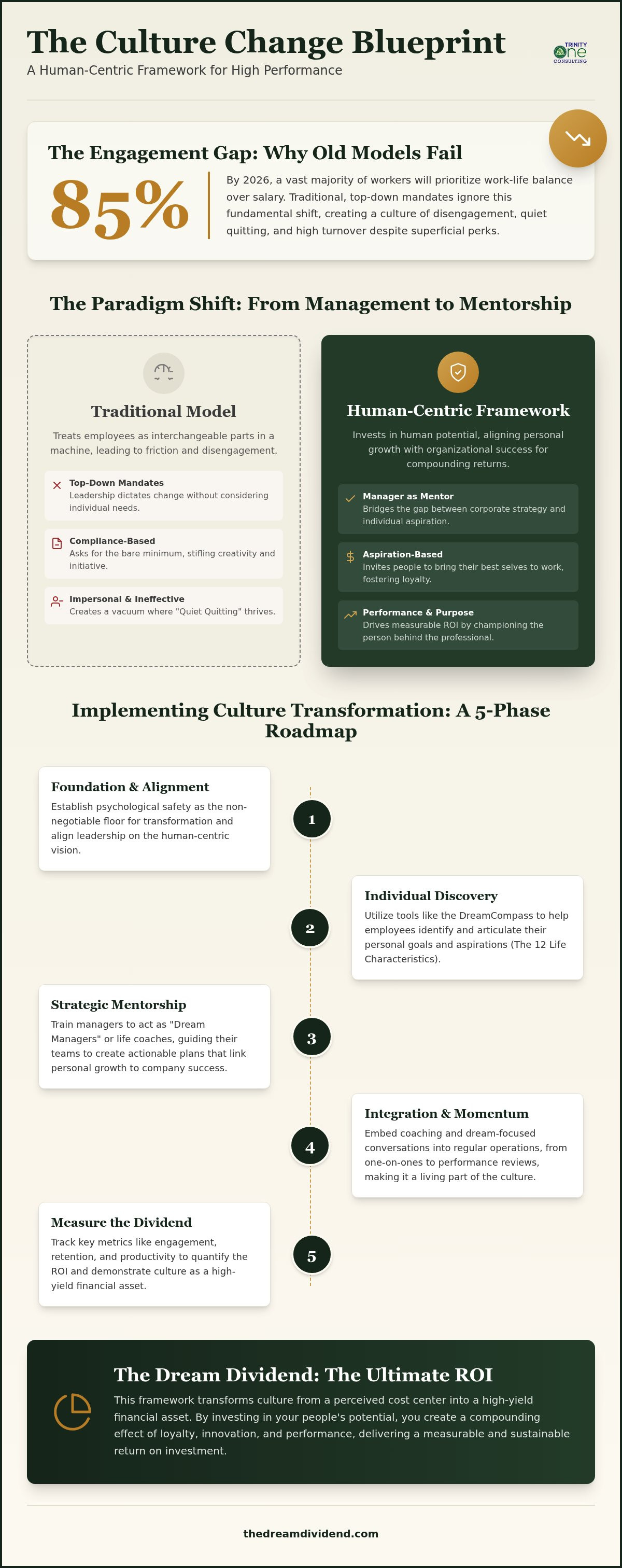
Implementation is the crucible where leadership intent is forged into organizational reality. To move beyond the sterile checklists of yesterday, your culture change management framework must act as a living system that evolves with your people. This isn't a linear sprint; it's a strategic marathon that requires patience, precision, and a commitment to human flourishing. By following a structured roadmap, you ensure that every cultural investment compounds into long-term value. The process follows five distinct phases of evolution:
- Phase 1: Diagnostic and Aspiration Mapping. We begin by using the DreamCompass to identify the gap between current employee engagement and future personal aspirations.
- Phase 2: Leadership Immersion. Executives must first embody the "Best Version of Yourself" philosophy to lead with authentic authority and confidence.
- Phase 3: The Pilot Program. You train your first internal Dream Managers to facilitate personal growth within a controlled, high-impact environment.
- Phase 4: Scaling the Dream Dividend. Personal growth goals are integrated into performance reviews, transforming the workplace into a vehicle for individual success.
- Phase 5: Sustainable Compounding. Leadership measures cultural ROI, adjusts the strategy based on real-time data, and solidifies the new behavioral norms.
Phase 1-2: Setting the Foundation
The architecture of change begins with an Aspiration Audit. This diagnostic process allows you to map the landscape of employee desires without appearing intrusive or overbearing. It requires a high level of executive vulnerability. When leaders share their own journey toward becoming their best selves, they give the rest of the organization permission to do the same. If you don't establish this trust early, your initiatives will feel like "corporate fluff" to a skeptical workforce. You can learn more about the specifics of how to implement a Dream Manager program to ensure your foundation is built on solid ground.
Phase 3-5: Driving Sustainable ROI
Moving from a pilot to a pillar requires making the framework part of the company's DNA. You aren't just adding a new program; you're redesigning the way you view your human assets. By using the 12 Life Characteristics to track cultural health, you create a holistic view of performance that includes physical, emotional, and intellectual well-being. You measure the Dream Dividend by tracking the direct correlation between the achievement of personal milestones and the steady increase in retention rates and engagement scores. This data-driven approach turns culture into a predictable financial asset. If you're ready to move beyond superficial fixes, consult with our team at The Dream Dividend to begin your strategic transformation.
The Dream Dividend: The Ultimate ROI of Culture Change
Culture is not a line item on an expense report. It is the engine of your enterprise. When you implement a robust culture change management framework that honors the individual, you are actually building a structural foundation for long-term financial health. By reframing cultural evolution as a strategic investment rather than a cost center, you unlock the "Dream Dividend," a measurable return on human potential. This isn't just theory; it's a pragmatic approach to building a resilient, high-performance organization that thrives on the compounding energy of its people.
The results of this shift are visible in the balance sheet. Organizations that prioritize human-centered transformation see a direct impact on their most significant costs: turnover and disengagement. When an employee feels that their company is a vehicle for their own personal growth, their loyalty isn't just bought; it's earned. This creates a compounding effect where individual excellence fuels team momentum, which then drives organizational success. You are no longer just managing a workforce; you are architecting a community of high achievers who are all pursuing the best version of themselves.
The Financial Case for Dreams
Consider the impact of turnover on a mid-sized company. Replacing a single mid-level employee can cost up to 150% of their annual salary when you account for recruitment, training, and lost productivity. If your culture change management framework reduces turnover by even 20%, the financial recovery is substantial. Beyond the immediate savings, there is a clear correlation between personal dream achievement and workplace innovation. People who feel supported in their personal lives bring a higher level of intellectual and emotional energy to their professional roles. You can listen to The Dream Dividend Podcast to hear real-world examples of how leading with purpose transforms the bottom line.
Becoming a Dream-Driven Organization
The vision for 2026 is clear: the most successful companies will be those that act as incubators for human potential. A dream-driven organization isn't a utopia; it's a high-stakes environment where mutual success is the only acceptable outcome. Getting started doesn't require an overnight overhaul. It begins with a single diagnostic audit or an inspiring keynote to shift the internal narrative. From there, you can begin the methodical work of aspiration mapping and leadership immersion. Your culture can be your greatest liability or your most significant asset. If you're ready to stop managing for compliance and start leading for excellence, consult with a Certified Dream Manager today to begin your journey toward a human-centered transformation.
Architecting a Culture of Human Flourishing
Sustainable excellence isn't found in a policy manual; it's forged in the hearts of your people. By shifting from a compliance-based mindset to one of personal aspiration, you transform your organization into a vehicle for collective growth. You've now seen how a human-centered culture change management framework bridges the gap between executive strategy and individual dreams. This alignment isn't just a moral choice; it's a strategic necessity that drives measurable ROI and secures your legacy in the 2026 talent market. It requires vision, precision, and a commitment to long-term growth.
Our methodology is based on Matthew Kelly’s best-selling framework and facilitated by Certified Dream Manager expertise. By utilizing proprietary DreamCompass assessment tools, we provide the navigation needed to move from disengagement to high-stakes loyalty. It's time to stop managing for the status quo and start architecting a future where your people and your profits thrive together. Invest in your culture and unlock the Dream Dividend today. The potential of your team is your greatest untapped asset, and the journey toward the best version of your organization starts now.
Frequently Asked Questions
What is a culture change management framework?
A culture change management framework is a structural roadmap designed to guide the behavioral evolution of an entire organization. It provides the architecture needed to align high-level business strategy with the daily actions of every team member. Unlike sterile process manuals, a modern framework acts as a bridge between corporate goals and individual flourishing. It turns the intangible concept of culture into a strategic asset that you can measure, manage, and scale for long-term health.
How does the Dream Manager framework differ from traditional models like ADKAR?
Traditional models like ADKAR focus on the mechanics of process transition and top-down alignment. The Dream Manager framework differs by acting as a strategic multiplier that prioritizes bottom-up aspiration. While ADKAR identifies desire as a key component, it often fails to provide a personal why. We bridge this gap by connecting organizational change to an employee's personal dreams. This shift transforms simple compliance into deep, intrinsic loyalty that traditional management systems often miss.
What are the 12 Life Characteristics in the context of business culture?
The 12 Life Characteristics serve as the structural foundation for personal and professional excellence within a workplace. They encompass a holistic range of human needs, including physical health, emotional stability, intellectual growth, and spiritual purpose. By integrating these characteristics into your culture change management framework, you move beyond basic wellness programs. You create an environment where employees are encouraged to become the best version of themselves, which naturally compounds into higher organizational performance.
Can a culture change framework really reduce employee turnover?
A well-executed framework significantly reduces turnover by increasing the switching cost for employees. When a company invests in an individual’s personal dreams, that employee no longer views their job as a mere paycheck. They see the organization as a vital partner in their life’s journey. This psychological bond creates a level of loyalty that competitors can't easily buy. It effectively transforms your culture from a potential liability into a primary driver of retention.
How long does it take to see results from a culture transformation strategy?
You'll likely notice immediate shifts in sentiment and engagement within the first 90 days of a pilot program. However, deep cultural transformation is a deliberate and methodical process. Significant financial returns, such as reduced turnover and increased productivity, typically compound over 12 to 18 months. Lasting change requires a commitment to sustainable growth rather than a search for an immediate, superficial fix. It's an investment in the long-term architecture of your firm.
What is the role of a Certified Dream Manager in an organization?
A Certified Dream Manager acts as a strategic architect and a compassionate guide for your workforce. Their role is to move beyond traditional supervision and focus on high-stakes mentorship. They utilize tools like the DreamCompass to help employees map out their personal aspirations. By facilitating this individual growth, they ensure that the company’s success is directly fueled by the personal fulfillment of its people. They are the frontline champions of your cultural evolution.
How do we measure the ROI of a culture change initiative?
Measuring ROI involves tracking the Dream Dividend through concrete engagement and retention metrics. You look at the direct correlation between the achievement of personal milestones and the reduction in recruitment costs. High-performance organizations also monitor productivity gains and innovation rates as indicators of cultural health. By treating culture as a financial asset, you can see the clear relationship between human flourishing and the bottom line. It turns soft data into hard strategic insights.
Is the Dream Manager framework suitable for small to mid-sized businesses?
Mid-sized companies are often the best candidates for this framework because they possess the agility that global conglomerates lack. They can implement a culture change management framework with a level of personal detail that larger firms find difficult to scale. This human-centric approach allows smaller businesses to win the war for talent by offering something more valuable than a high salary: a workplace that actually cares about the person behind the professional.