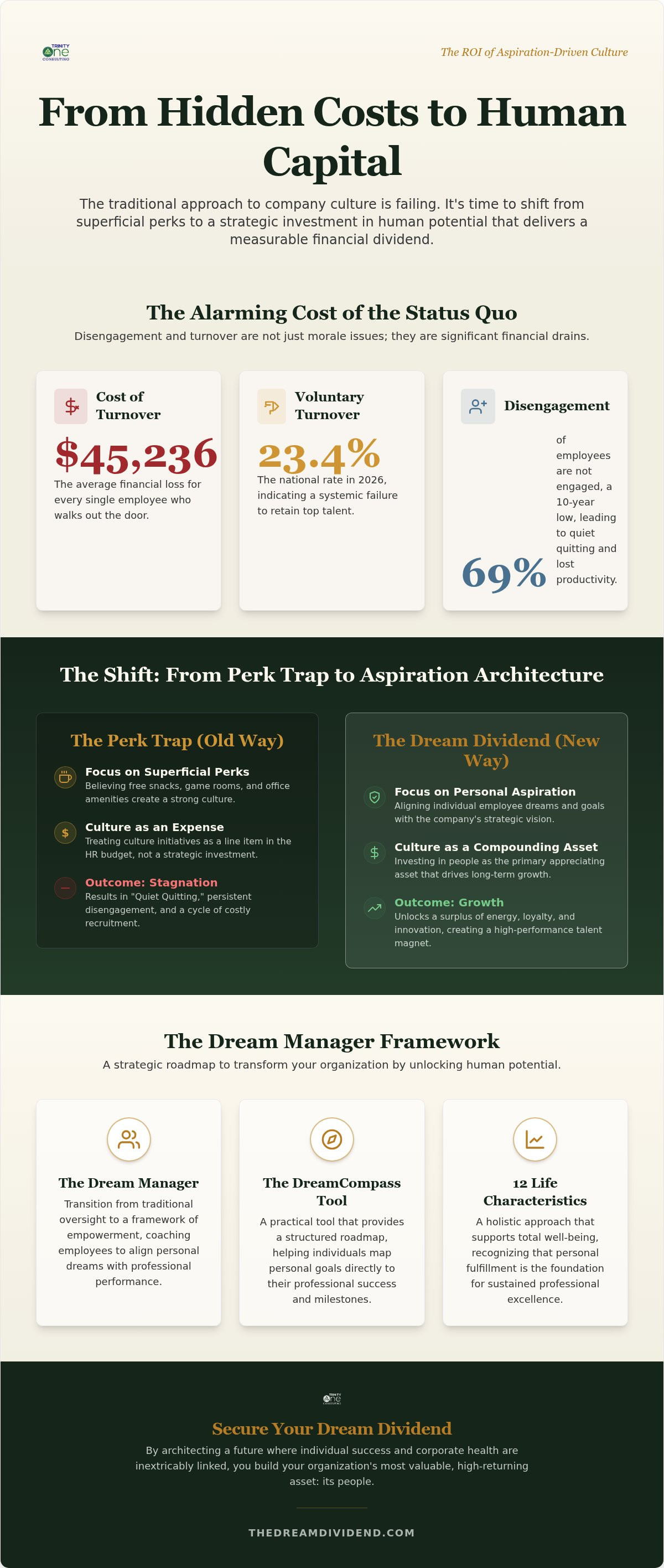
What if the $45,236 your firm loses for every employee who walks out the door wasn't an inevitable cost of doing business, but a failure of architectural design? In 2026, the voluntary turnover rate has climbed to 23.4%. Leaders are trapped in a cycle of expensive recruitment, a persistent "Quiet Quitting" epidemic, and stagnant engagement. You likely recognize that free snacks haven't solved the crisis. It's time to build a more robust business case for investing in company culture that treats human potential as a strategic, compounding asset.
This article reveals how shifting from superficial perks to aspiration-driven Dream Management creates a measurable financial dividend. You'll discover a clear ROI framework that aligns personal employee goals with corporate milestones to drive sustainable growth. We'll explore the mechanics of the Dream Manager framework, the power of the DreamCompass tool, and the strategic compounding of the 12 Life Characteristics. It's time to transform your organization into a high-performance talent magnet that pays dividends for years to come.
Key Takeaways
- Redefine your culture by moving beyond superficial perks toward a model that aligns individual aspirations with your organizational architecture.
- Build a data-driven business case for investing in company culture by quantifying the Retention Dividend and the true cost of disengagement.
- Transition from traditional management to the Dream Manager framework to unlock human potential and secure a measurable financial return.
- Implement a strategic roadmap for growth using the DreamCompass tool to map personal goals directly to professional success.
- Establish your firm as a high-performance talent magnet that compounds value through the 12 Life Characteristics and holistic employee well-being.
Table of Contents
- The Economic Reality of Culture: Why "Soft" Assets Drive Hard Returns
- The Anatomy of High-Performance Culture: Moving Beyond Perks to Aspiration
- Quantifying the ROI: The Financial Metrics of Culture Transformation
- The Dream Manager Framework: A Strategic Roadmap for Implementation
- Securing the Dividend: Transforming Your Organization into a Talent Magnet
The Economic Reality of Culture: Why "Soft" Assets Drive Hard Returns
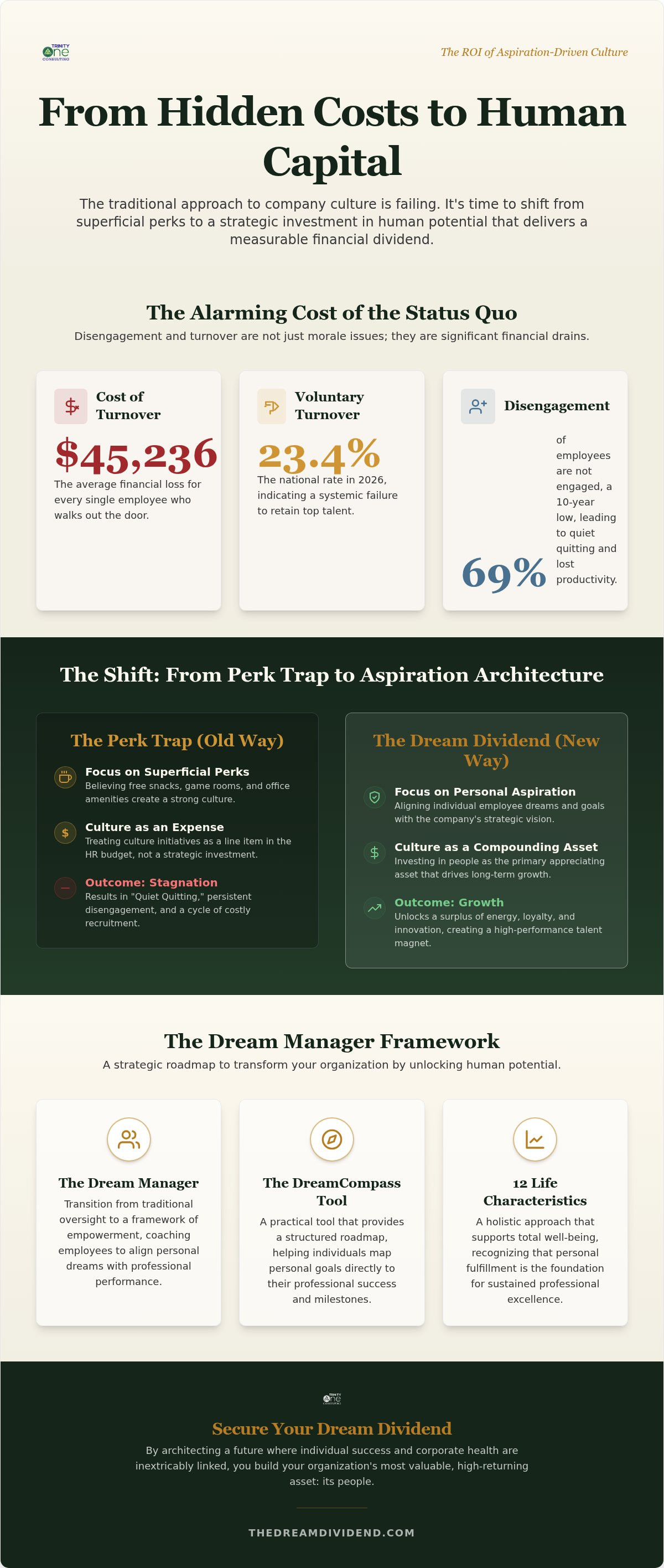
Culture in 2026 is no longer a nebulous "vibe" or a collection of office amenities. It's the strategic alignment of individual aspirations with corporate vision. When these two forces move in harmony, you unlock a measurable surplus of energy, loyalty, and innovation. We call this the Dream Dividend. It represents the returns generated when an employee realizes their personal growth is the fuel for the company’s success. Conversely, many leaders fall into the "Perk Trap." They mistake superficial amenities like free snacks or game rooms for a foundational culture. These are Band-Aids. Substantive culture is built on personal growth, structural support, and a deep understanding organizational behavior.
The hidden costs of "Culture Neglect" are no longer invisible. They're written in red ink on your balance sheet. With the average cost of turnover hitting $45,236 per employee in 2026, losing specialized talent is a luxury your organization can't afford. This isn't just about recruitment fees. It's about lost knowledge, broken momentum, and the high cost of retraining. When culture is neglected, your best people become your competitors' best assets. Building a business case for investing in company culture starts with acknowledging that your people are your only appreciating asset.
The Financial Impact of Quiet Quitting and Disengagement
Disengagement isn't just a morale issue; it's an operational tax. In 2026, with U.S. employee engagement at a ten-year low of 31%, the cost of apathy is staggering. Disengaged employees perform the bare minimum, creating a productivity gap that stalls momentum. This is why many leaders are seeking quiet quitting solutions for managers that go beyond surface-level incentives. An "aspiring" employee, one who sees their job as a vehicle for their dreams, outproduces a "disengaged" one by a significant margin. When you fail to bridge this gap, you're essentially paying a premium for mediocrity. High turnover, low engagement, and recruitment struggles are the symptoms of a foundation that's failed to support the weight of human ambition.
Culture as a Compounding Asset
Think of your organization as a building. Strategy is the blueprint, but culture is the foundation. If the foundation is cracked, the most brilliant strategy will eventually collapse. Investing in culture isn't a one-time expense; it's a compounding asset. Small, intentional shifts in how you support employee dreams yield exponential returns over time. This is the core of Human Capital ROI. When you invest in the person, the professional performance follows. It's a pragmatic business case for investing in company culture that moves beyond "feeling good" and focuses on performing well. You're not just managing people; you're architecting a future where individual success and corporate health are inextricably linked. By prioritizing these "soft" assets, you drive the hardest returns possible.
The Anatomy of High-Performance Culture: Moving Beyond Perks to Aspiration
Traditional management is evolving into something far more potent. In 2026, the psychological contract between employer and employee has fundamentally shifted. Workers no longer settle for a simple exchange of time for money; they demand a partner in their personal evolution. This shift represents the core of the business case for investing in company culture. When an organization commits to its people becoming the best version of yourself, it secures a level of loyalty that market-rate salaries alone cannot command. Visionary purpose acts as a stabilizer. It anchors a volatile workforce, provides a "why" that transcends the daily grind, and turns a job into a mission.
Executives often struggle to bridge the gap between "feel-good" initiatives and the cold reality of financial performance. Utilizing a structured approach, such as these 5 steps to building a business case for culture, helps translate human aspiration into executive-level logic. It's about shifting the narrative from oversight to empowerment. We aren't just managing tasks. We are managing dreams. By treating culture as a strategic asset rather than an HR expense, you build a foundation that can withstand the pressures of a competitive 2026 market.
The 12 Life Characteristics: A Holistic Approach
The 12 Life Characteristics provide a strategic blueprint for employee excellence. In this framework, we view physical, emotional, intellectual, and spiritual health as vital business metrics. Why? Because a depleted human cannot be a high-performing employee. Modern leadership requires a transition from "Manager" to "Life Coach." You aren't just overseeing a workflow; you're navigating a human journey and architecting an environment where people thrive. This holistic view ensures that the business case for investing in company culture is rooted in human reality, not just corporate rhetoric.
Mapping Dreams to Organizational Goals
Individual achievement is the primary fuel for collective momentum. The "Dream Mapping" process identifies what truly motivates your workforce, allowing you to align their personal finish lines with your corporate milestones. When an employee sees that hitting a quarterly target also brings them closer to their dream of debt freedom or world travel, their engagement skyrockets. Consider a mid-sized firm that recently replaced its expensive, underused coffee bar with a Certified Dream Manager program. They didn't just save on overhead; they saw a significant reduction in voluntary turnover within twelve months. They stopped buying premium beans and started investing in people. If you're ready to explore this architectural shift, The Dream Dividend offers the tools to begin your transformation.
Quantifying the ROI: The Financial Metrics of Culture Transformation
The transition from seeing culture as an expense to viewing it as a compounding asset requires a rigorous financial framework. While we established the high cost of neglect in earlier sections, the true power lies in the positive surplus generated by an engaged workforce. This is the essence of the Dream Manager ROI. By investing in the personal aspirations of your people, you secure a Retention Dividend that far exceeds simple turnover reduction. You save on the heavy costs of recruitment, the friction of onboarding, and the catastrophic loss of institutional knowledge.
Beyond retention, organizations reap a Performance Dividend. This manifests as increased discretionary effort; the extra mile an employee walks because they feel their personal goals are supported by the firm. Mental absence, or "presenteeism," is also mitigated as purpose replaces apathy. Finally, the Brand Dividend turns your staff into organic ambassadors. When your team speaks authentically about their growth, it lowers customer acquisition costs by building trust, authority, and market presence. This multifaceted return forms the strongest business case for investing in company culture.
Measuring the Intangible: The DreamCompass Tool
Traditional engagement surveys often fail because they measure past satisfaction rather than future intent. The DreamCompass tool shifts this focus toward aspiration tracking. It provides leaders with data-driven insights into how employee growth aligns with organizational health. When presenting to a skeptical Board of Directors, you aren't just showing "happiness" scores. You're demonstrating a clear trajectory of human capital development. These personal milestones act as lead indicators for corporate performance. This level of transparency transforms culture from a "soft" HR topic into a core pillar of strategic navigation.
Attrition vs. Attraction: The Talent Magnet Effect
A robust culture creates a "Talent Magnet" effect that fundamentally alters your recruitment math. Organizations recognized as premier places to work often spend 50% less on recruitment because they attract high-quality talent through organic reach and internal referrals. This isn't just about saving money on job boards. It's about the "Culture Premium" in salary negotiations. When candidates see a clear path to growth, purpose, and personal fulfillment, they're often willing to prioritize their evolution over a slightly higher base salary elsewhere. This strategic advantage is a central component of the business case for investing in company culture, ensuring your firm remains competitive without overextending its payroll.
The Dream Manager Framework: A Strategic Roadmap for Implementation
Implementation isn't an event; it's a structural renovation. To move from the theoretical ROI discussed previously to a living, breathing asset, you need a methodical blueprint. Learning how to implement a Dream Manager program begins with three distinct phases of architectural growth. Start small. Build momentum. Scale with intention. This structured approach solidifies the business case for investing in company culture by making growth both predictable and measurable.
Phase 1 focuses on Discovery through the DreamCompass assessment. This tool provides the baseline data needed to understand the collective aspirations of your workforce. Phase 2 involves training your leadership team in Aspiration-Based Management. We move away from corrective scorecards and toward a model of high-stakes mentorship. Finally, Phase 3 scales the initiative through internal certification, ensuring the philosophy is woven into the very fabric of the organization. By following this roadmap, you transform culture from a vague concept into a strategic engine of performance.
Building the Structural Foundation
Integrating dream management into your existing performance reviews is the first step toward institutionalizing this change. These reviews shouldn't just look back at KPIs; they should look forward toward personal milestones. This transition requires a high degree of psychological safety. If employees don't feel safe sharing their true aspirations, the data remains superficial. Set a realistic timeline for this transformation. Culture doesn't shift overnight. It compounds. It requires patience, precision, and persistence. Expect a foundational shift within six months, with measurable dividends appearing by the end of the first year.
Overcoming Common Implementation Hurdles
The most frequent objection from managers is a perceived lack of time. "I don't have time to manage dreams," they might say. The response is simple: you don't have time for the turnover and disengagement that occur when you don't. When we frame culture as a vital asset, the "time" spent on people becomes an investment in operational efficiency. It's the difference between reactive firefighting and proactive architectural planning. By addressing this hurdle early, you reinforce the business case for investing in company culture across all levels of leadership.
Managing legacy employees requires a compassionate, steady hand. Some may be skeptical of a shift away from traditional command-and-control styles. Show them the results. Demonstrate how their own growth is supported. Maintaining the program during economic shifts is equally critical. In a downturn, culture is your most resilient armor. It is the foundation that keeps the structure standing when the market shakes. If you're ready to begin this architectural journey, start your transformation with The Dream Dividend today.
Securing the Dividend: Transforming Your Organization into a Talent Magnet
In the high-stakes environment of 2026, culture has emerged as the ultimate competitive advantage. It is no longer a "soft" HR initiative; it is the structural integrity that determines whether an organization can withstand the pressures of market volatility. The business case for investing in company culture is now a fundamental requirement for any firm seeking long-term sustainability. When you shift your focus to the "Dream Dividend," you aren't just improving morale. You're building a resilient engine of growth, securing a loyal workforce, and driving measurable financial returns. This is the only sustainable strategy for a future where talent is the most valuable currency.
While many consultants offer generic advice on "improving relationships," they often lack a cohesive, data-driven coaching framework. This is where Dream Management Consulting provides a decisive strategic edge. It moves beyond superficial perks to address the underlying aspirations that drive human behavior. By aligning these individual dreams with your corporate vision, you create a workforce that is energized, loyal, and purpose-driven. You become a strategic architect, navigating the complexities of the modern market with a team that is truly invested in the organization's success.
The Path to Certification
Becoming a Certified Dream Manager allows you to bring this transformative power directly into your organizational structure. While external guidance provides initial momentum, internal certification builds long-term sovereignty. It ensures that the framework is deeply embedded in your daily operations rather than treated as a temporary project. Having an internal guide allows for real-time adjustments, constant support, and a more intimate understanding of your team's unique dynamics. It turns your culture into a self-sustaining asset that continues to compound in value year after year, protecting your foundation from external shocks.
Next Steps for Strategic Leaders
Your journey toward becoming a talent magnet begins with a critical audit of your current environment. Look at your offerings: are they superficial perks like free snacks, or are they substantive opportunities for personal growth? Listen to The Dream Dividend Podcast to hear real-world examples of how visionary leaders have navigated this transition. The business case for investing in company culture is undeniable when you see the results in recruitment, innovation, and profitability. Schedule a discovery call today to map your organization's potential and secure your financial dividend for 2026 and beyond. It's time to build a firm that people don't just work for, but believe in.
Architecting Your Organization’s Strategic Future
We've moved beyond the era of superficial amenities. In 2026, the most resilient firms are those that recognize human potential as a compounding asset. By shifting from traditional oversight to aspiration-driven leadership, you don't just reduce turnover; you unlock the Dream Dividend. This transition forms the definitive business case for investing in company culture, turning your organization into a high-performance talent magnet where every team member is personally invested in collective success.
Success requires more than good intentions. It demands a proven framework, a strategic roadmap, and the right navigational tools. Our methodology is built on Matthew Kelly's global bestseller and utilizes the proprietary DreamCompass tool to map individual growth with precision. With Certified Dream Manager expertise, we help you bridge the gap between employee fulfillment and organizational excellence. Unlock your organization’s potential with Dream Management Consulting and start building a structural foundation that pays measurable dividends for years to come. Your people are ready to evolve. It's time to become the mentor and architect they deserve.
Frequently Asked Questions
What is the "Dream Dividend" exactly?
The Dream Dividend is the measurable surplus of productivity, engagement, and loyalty generated when an organization actively supports the personal aspirations of its people. It is the financial manifestation of human potential realized. Instead of viewing employees as static units of labor, we treat them as compounding assets. When an individual’s personal mission aligns with the corporate vision, the resulting momentum creates a high-performance environment that traditional management simply cannot replicate.
How does investing in employee dreams help the company bottom line?
Investing in employee dreams serves the bottom line by directly mitigating the $45,236 average cost of turnover seen in 2026. This strategy builds a robust business case for investing in company culture by transforming your workforce into a talent magnet. You'll see decreased recruitment spend, higher levels of discretionary effort, and a significant reduction in the "Quiet Quitting" tax. It’s about shifting capital from reactive replacement to proactive architectural growth.
Isn't it risky to help employees achieve dreams that might take them away from the company?
The greater risk is not that employees leave to pursue their dreams, but that they stay while having none. Disengaged workers who remain act as a drag on every operational process. When you support an employee’s evolution, you gain their highest level of contribution during their tenure. Even if their journey eventually leads elsewhere, they depart as powerful brand ambassadors who drive high-quality referrals and organic market authority back to your firm.
How do you measure the ROI of a culture transformation program?
Measuring ROI requires moving beyond surface-level satisfaction scores toward data-driven aspiration tracking. By utilizing the DreamCompass tool, you can quantify the alignment between personal growth and professional KPIs. Strategic leaders monitor the Retention Dividend, the Performance Dividend, and the Brand Dividend to calculate a comprehensive return. This methodology provides the transparency needed to present culture metrics as a core pillar of organizational health to any executive board, ensuring long-term structural stability.
What is the difference between an HR manager and a Dream Manager?
While an HR manager focuses on the essential mechanics of compliance, benefits, and administration, a Dream Manager acts as a strategic architect for human evolution. The Dream Manager framework, based on Matthew Kelly’s proven methodologies, shifts the focus from managing tasks to mentoring people. This role is dedicated to helping employees achieve their personal goals, thereby securing the highest level of engagement and loyalty for the organization’s long-term success and collective health.
How long does it take to see financial results from culture investment?
Most organizations begin to see foundational shifts in team sentiment and psychological safety within the first six months of implementation. However, the true financial dividends typically manifest within a twelve-month cycle. This timeline allows the compounding effects of the 12 Life Characteristics to take root across the workforce. As voluntary turnover decreases and productivity stabilizes, the measurable ROI becomes a permanent feature of your financial landscape rather than a temporary, superficial spike.
Can a small or mid-size business afford a Dream Manager program?
Small and mid-size firms are often the best candidates for these programs because their structures are agile enough to support rapid culture transformation. The cost of a Certified Dream Manager program is frequently less than the financial damage caused by losing just two specialized employees. By investing early, smaller organizations can out-compete larger rivals for top-tier talent, effectively using their culture as a strategic lever to drive sustainable, long-term expansion and profitability.
How do I pitch the business case for culture to a skeptical CFO?
To convince a skeptical CFO, you must translate "soft" culture concepts into the language of financial risk and return. Present the 2026 voluntary turnover rate of 23.4% as a significant leak in the company’s capital. Frame the business case for investing in company culture as a strategy to optimize human capital ROI. Use the Dream Manager framework to demonstrate how proactive investment in people prevents the catastrophic costs associated with disengagement and recruitment.