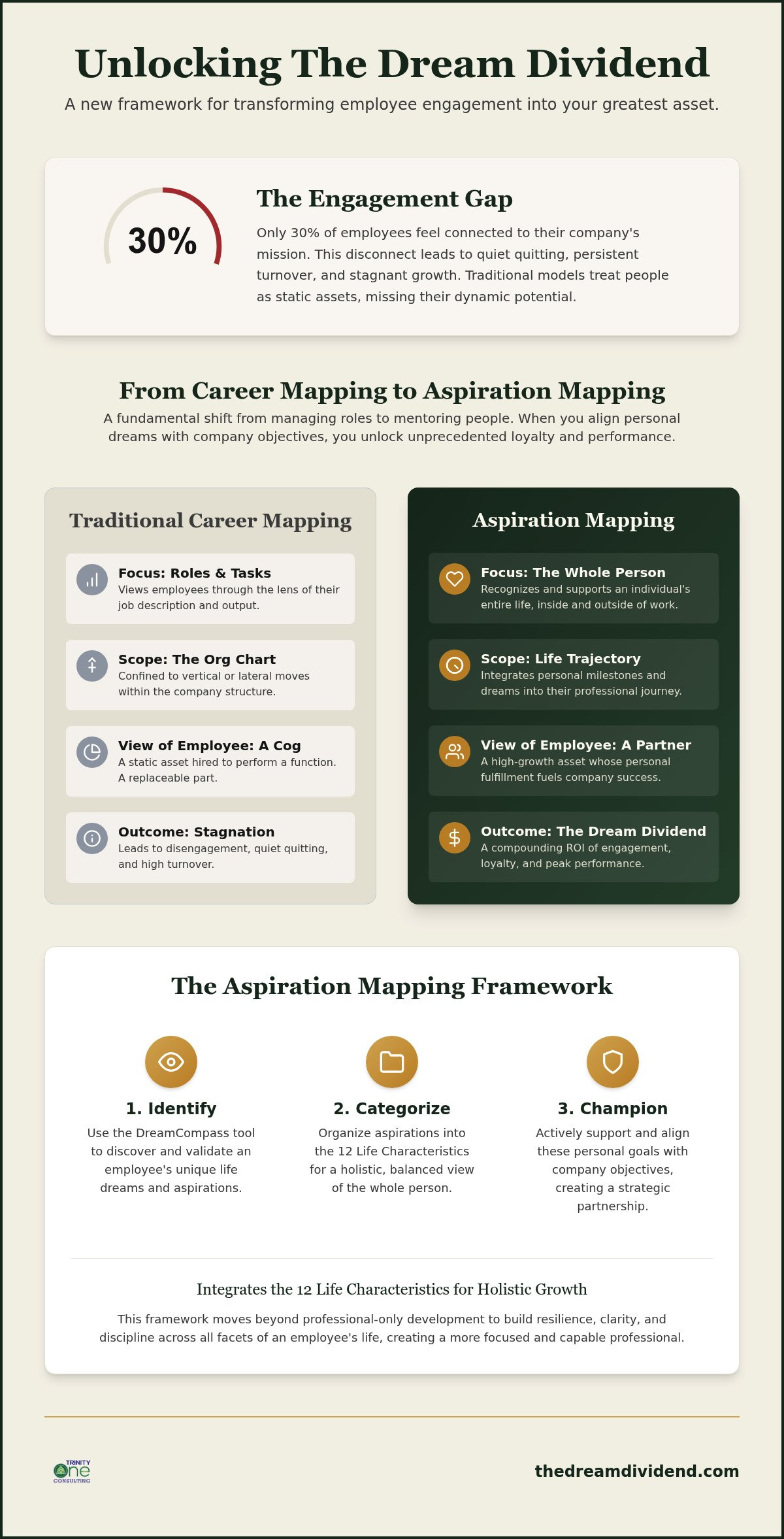
What if the primary obstacle to your organization's growth isn't a lack of talent, but a lack of alignment? You've likely seen the symptoms: persistent turnover despite competitive pay, stagnant engagement scores, and the heavy silence of quiet quitting. It's a frustrating reality when only 30% of employees feel connected to their company's mission. The traditional corporate model treats people as static assets, yet the most successful leaders know that humans are dynamic engines of potential. By focusing on aligning personal goals with company objectives, you transform a standard employment contract into a strategic partnership. This isn't just about morale; it's about building a foundation where individual aspirations fuel collective momentum.
We've found that when people see their work as a vehicle for their own dreams, their commitment becomes a compounding asset. You'll learn how to bridge the gap between individual fulfillment and corporate success to unlock a massive return on engagement. We'll explore the framework of Aspiration Mapping, a methodology designed to turn human-centric leadership into a tangible ROI. It's time to stop managing tasks and start architecting a culture where everyone wins.
Key Takeaways
- Discover how Aspiration Mapping moves beyond traditional management by supporting the "Whole Person" and their unique life dreams.
- Unlock a compounding ROI by aligning personal goals with company objectives, transforming passive workers into engaged partners.
- Contrast standard career mapping with a holistic framework that integrates the 12 Life Characteristics for sustainable professional performance.
- Gain a practical implementation strategy using the DreamCompass tool to identify, categorize, and champion your team's personal aspirations.
- Evolve into a visionary leader who mentors others toward becoming the best version of themselves, starting with your own strategic alignment.
Table of Contents
- What is Aspiration Mapping? Redefining Personal and Professional Alignment
- The Strategic ROI: Why Mapping Dreams Outperforms Mapping Roles
- Career Mapping vs. Aspiration Mapping: A Comparison of Scope
- The Implementation Framework: Tools for Aspiration Mapping
- Cultivating the Dream Dividend: Next Steps for Visionary Leaders
What is Aspiration Mapping? Redefining Personal and Professional Alignment
Aspiration mapping is the strategic process of identifying, validating, and supporting an employee's personal and professional dreams. It represents a fundamental shift from viewing staff as overhead to treating them as a portfolio of high-growth assets. While traditional management focuses on output, aspiration mapping focuses on the engine behind that output: the individual. We believe you hire the whole person, not just the worker. When a company ignores a person's life outside the office, they inadvertently create a "cog in the machine" culture that breeds resentment and attrition. By intentionally aligning personal goals with company objectives, you transform the workplace from a site of labor into a platform for growth.
This methodology produces what we call the Dream Dividend. It's the measurable byproduct of a culture that values individual aspirations. It manifests as a compounding return on engagement where employees aren't just working for a paycheck, but are working toward their own best future. When the company wins, the individual wins. This alignment creates a level of loyalty and momentum that traditional management styles simply cannot replicate.
The Shift from Career Mapping to Aspiration Mapping
Job titles don't inspire loyalty; purpose does. By 2026, top talent will prioritize environments that see them as more than a collection of skills. Career mapping often hits a ceiling because it only looks at vertical or lateral moves within an org chart. In contrast, aspiration mapping looks at the person's entire life trajectory. There's a profound psychological link between personal goal achievement and workplace productivity. When an employee feels their company is an advocate for their private dreams, they bring a level of energy and commitment that no salary can buy. This is the essential path to becoming the best version of yourself.
The Core Philosophy: People are the Ultimate Investment
Human potential is your organization's most valuable strategic asset. It requires the same level of rigorous management and intentional investment as any capital project. This is where the role of the Dream Manager becomes essential. Instead of merely overseeing tasks, the Dream Manager acts as a facilitator, mentor, and strategic architect. This approach evolves beyond the classic Management by Objectives (MBO) model by ensuring that the objectives aren't just corporate, but personal. Aspiration mapping serves as the bridge between personal fulfillment and organizational excellence. It's about building a foundation that supports aligning personal goals with company objectives to ensure long-term, sustainable success for everyone involved.
The Strategic ROI: Why Mapping Dreams Outperforms Mapping Roles
The Engagement Gap is the silent killer of corporate potential. When employees feel their personal lives are on hold to serve a corporate machine, they disengage. This disengagement often manifests as quiet quitting, a state where people do the bare minimum to avoid being fired. By aligning personal goals with company objectives, you close this gap. You turn a transactional relationship into a transformational partnership. This isn't a soft benefit; it's a structural upgrade to your business model.
Think of this as Compounding Human Capital. As individuals grow, your organizational capacity expands. A person who learns the discipline to run a marathon or the financial literacy to buy a home brings that newfound grit and clarity back to their desk. They become more capable, more resilient, and more focused. For those seeking the hard numbers, the Dream Manager ROI provides the financial justification for this human-centric investment. It proves that when you invest in the person, the professional performance follows as a natural consequence.
Slaying the Turnover Monster
Turnover is often a symptom of a deeper search for meaning. Competitive pay is a baseline, but it isn't a long-term strategy for retention. When a manager helps an employee navigate the path to their first home or a personal milestone, they cease to be a boss and become a mentor. This creates a loyalty dividend that no competitor can buy. It moves the culture beyond superficial perks and into deep-seated alignment. People don't leave companies that are actively helping them achieve their life's dreams. This level of commitment is what happens when you prioritize aligning personal goals with company objectives.
Innovation through Personal Growth
Confidence is the fuel for innovation. There is a direct link between achieving a personal dream and having the courage to suggest a bold new idea at work. When a culture celebrates personal growth, it fosters a psychological safety that encourages creativity. Research shows that employees with clearly defined goals are 3.6 times more likely to be committed to their organization. By implementing the dream manager framework, you're not just improving morale; you're building an engine for innovation. Discovering how other leaders apply these principles on The Dream Dividend Podcast can provide the spark your organization needs to begin this journey.
Career Mapping vs. Aspiration Mapping: A Comparison of Scope
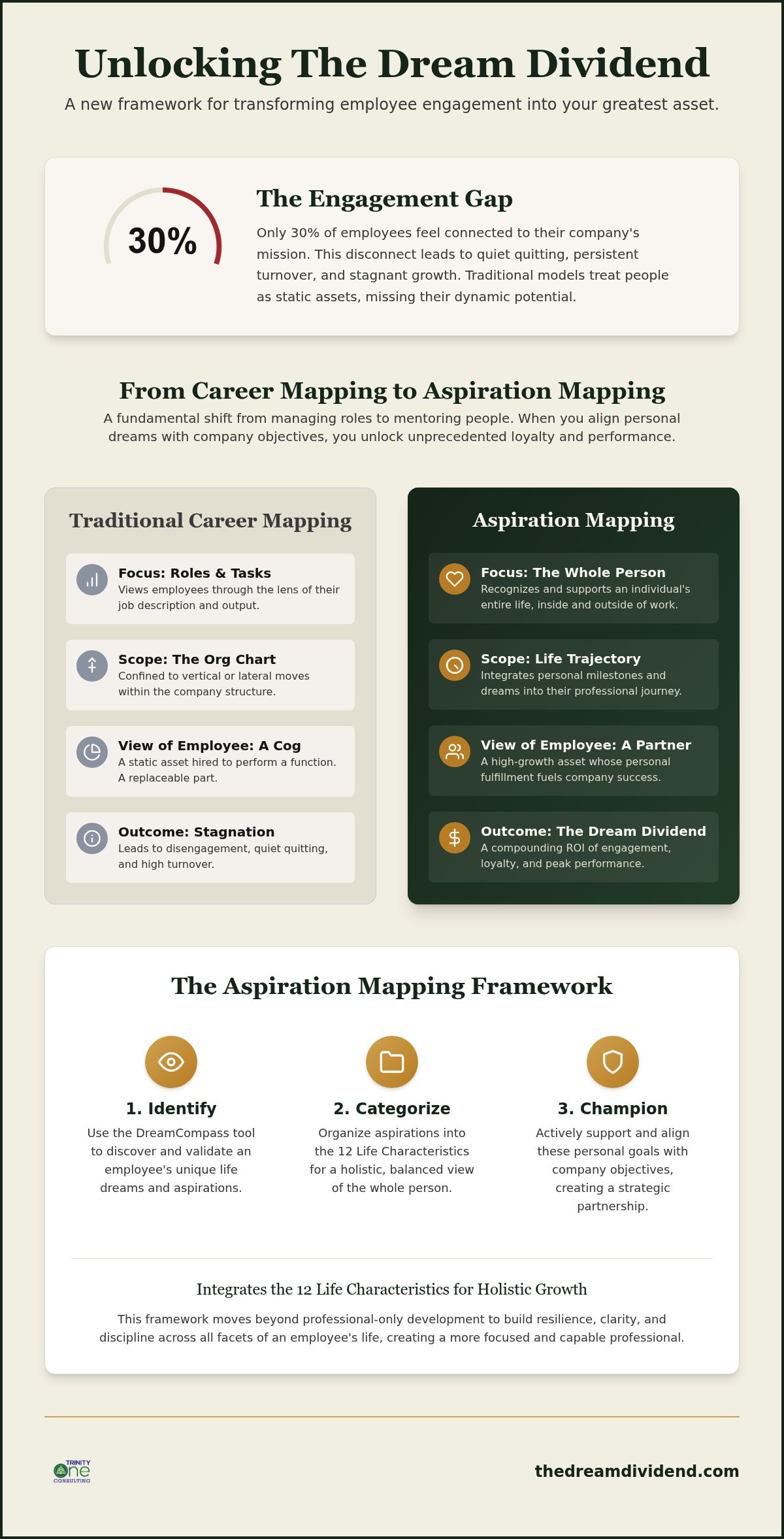
Career mapping is essentially a subset of a much larger strategic vision. It is a vital component, certainly, but it is not the whole picture. While career mapping focuses on professional skills and upward mobility, aspiration mapping encompasses the 12 Life Characteristics. These characteristics provide a holistic baseline that includes physical health, emotional stability, and financial well-being alongside professional growth. When leadership limits its focus to role-centric pathing, it creates a narrow transactional environment that eventually starves the organization of its most creative energy. By aligning personal goals with company objectives through this broader lens, you acknowledge that a person's professional output is inextricably linked to their personal flourishing.
This shift in perspective is the catalyst for a true organizational culture transformation. It moves the conversation from what an employee can do for the company to how the company can help that employee become the best version of themselves. It is a move from management to mentorship. It is a move from filling seats to fueling souls.
The Limitations of Role-Centric Thinking
Traditional career maps often feel like homework. They focus on the next title, the next pay grade, and the next set of responsibilities. But what happens when an employee hits the ceiling of their current path? If the only value the company offers is a vertical move, you risk losing high performers who feel pigeonholed by their current skill set. Role-centric thinking ignores the fundamental human need for variety and holistic growth. Aspiration maps, by contrast, feel like hope. They provide a framework for aligning personal goals with company objectives that transcends the org chart, ensuring that even if a promotion isn't immediate, the individual's growth remains a primary investment.
Visualizing the Strategic Difference
The difference between these two approaches is one of scope and ownership. Career mapping is typically HR-led and focuses on filling future roles within the organization. Aspiration mapping is employee-owned and focuses on individual flourishing. This shift toward employee ownership creates lateral agility. When people are encouraged to grow as whole individuals, they become more adaptable and more willing to pivot into new roles that serve both their dreams and the company’s mission.
- Focus: Career mapping targets specific skills; Aspiration mapping targets life-long dreams.
- Outcome: One aims for a promotion; the other aims for a meaningful and balanced life.
- Ownership: One is a corporate mandate; the other is a personal mission fueled by internal drive.
The Implementation Framework: Tools for Aspiration Mapping
Strategy without execution is merely a wish. To move from abstract support to measurable growth, visionary leaders need a structured methodology that bridges the gap between intent and outcome. This implementation framework isn't about micromanagement. It's about architecture, navigation, and structural foundations. By aligning personal goals with company objectives, you build a culture where individual growth and corporate success are mutually reinforcing. It's a rhythmic process of assessment, planning, and review that ensures no one is left behind.
The process follows five distinct steps:
- Step 1: Establish a holistic baseline using the 12 Life Characteristics assessment.
- Step 2: Identify and categorize specific aspirations with the DreamCompass Tool.
- Step 3: Facilitate quarterly Dream Conversations to maintain momentum and refine focus.
- Step 4: Develop a Dream Roadmap that synchronizes personal milestones with professional output.
- Step 5: Measure progress using the 'Best Version of Yourself' framework to track qualitative and quantitative growth.
The 12 Life Characteristics Assessment
Before an employee can reach for a significant dream, they must understand their current reality. The 12 Life Characteristics provide this essential baseline, covering dimensions such as physical health, emotional stability, and financial well-being. For a leader, this assessment acts as a vital diagnostic tool. It allows you to identify red flags in life balance, such as chronic stress or financial strain, before they manifest as burnout or disengagement. A healthy employee is a high-performing employee. When you invest in their stability, you're protecting the organization's most critical strategic asset.
The Power of the DreamCompass
The DreamCompass Tool serves as the primary navigational system for an employee's future. It helps individuals move from vague, floating desires to actionable, strategic plans. Many people have simply forgotten how to dream; they've been conditioned to think only in terms of the next fiscal quarter. This tool helps them categorize aspirations into short-term wins and long-term visions, creating a vivid picture of success. Your role as a mentor is to provide the resources, the time, and the encouragement needed to turn these blueprints into reality. This isn't a distraction from the work; it is the primary engine of the work. To begin installing these systems within your own leadership team, exploring Dream Management Consulting can provide the professional guidance needed for a sustainable rollout.
Cultivating the Dream Dividend: Next Steps for Visionary Leaders
The transition from a traditional manager to a mentor is the final, most critical step in this evolution. It requires a fundamental shift in how you perceive your role. You aren't just overseeing a series of tasks; you're architecting an environment where people can flourish. This leadership style demands authenticity above all else. Before you can guide your team in aligning personal goals with company objectives, you must first map your own aspirations. You can't lead others to a destination you haven't explored yourself. When leaders are vocal about their own pursuit of personal excellence, it grants permission for the entire organization to follow suit.
Scaling this process across a mid-size or large organization requires more than just a memo. It requires a structural commitment to the human engine. This is why many visionary organizations turn to the Certified Dream Manager program as their primary implementation vehicle. It provides a standardized, professional framework based on the Matthew Kelly methodology to ensure that aligning personal goals with company objectives isn't just a fleeting trend, but a permanent cultural foundation. Research shows that sharing goals with others increases the likelihood of success to 70%, making these structured conversations a powerful tool for organizational momentum.
The Manager as Strategic Architect
Leaders must design a culture where dreams are discussed as naturally as KPIs. This means building structural support for employees to pursue their personal excellence. With data indicating that 95% of employees don't understand their company's strategy, the role of the leader as an architect of clarity has never been more vital. Stop managing tasks. Start mentoring people. When you act as a strategic architect, you build a firm that doesn't just survive the market, but thrives because its people are thriving. This shift creates a compounding return on engagement that traditional management simply cannot reach.
Becoming a Certified Dream Manager
Professional training in the Matthew Kelly methodology empowers leaders to drive sustainable culture change. A Certified Dream Manager has the tools to navigate complex human aspirations while maintaining a focus on pragmatic business outcomes. This certification isn't just a title; it's an investment in the long-term health of your company. It provides the roadmap for turning personal fulfillment into professional performance. The greatest dividend a company can ever pay isn't found in a quarterly report. It's found in the success, fulfillment, and growth of its people.
Secure the Future of Your Human Capital
True organizational excellence isn't found in a spreadsheet. It lives in the hearts and minds of people who feel seen, valued, and supported. By moving beyond role-centric thinking and embracing the whole person, you build a foundation that can withstand any market shift. You've seen how Aspiration Mapping transforms disengagement into momentum. It replaces the hollow promise of a job title with the vibrant reality of personal flourishing.
The path forward requires intentionality. Utilizing the proven Matthew Kelly methodology and tools like the proprietary DreamCompass, you can begin aligning personal goals with company objectives to drive a compounding return on engagement. Our 12 Life Characteristics assessment ensures your team has the holistic stability required for high-stakes innovation. With expert guidance from Certified Dream Managers, you don't have to navigate this cultural shift alone.
It's time to stop managing tasks and start architecting a legacy of success. Transform your culture with Dream Management Consulting and discover the power of the Dream Dividend. Your people are ready to become the best versions of themselves. Let's help them get there.
Frequently Asked Questions
Is aspiration mapping too personal for the workplace?
No, aspiration mapping isn't an invasion of privacy; it's a strategic recognition of the whole person. While traditional boundaries remain, acknowledging that an employee's personal life drives their professional energy is vital. By aligning personal goals with company objectives, you create a culture of mutual respect. Leaders act as mentors who help remove the obstacles preventing people from being their best. This approach fosters trust rather than intrusion.
How does aspiration mapping differ from a standard career development plan?
A standard career plan focuses solely on the org chart and professional skills. Aspiration mapping has a much broader scope, incorporating the 12 Life Characteristics like financial health and physical well-being. It asks what the individual wants out of life, not just out of their next promotion. This holistic view ensures that the company becomes a vehicle for the employee's life dreams, which naturally increases long-term commitment and engagement.
Can a small company afford to implement a Dream Manager program?
Small companies can definitely afford this program because the cost of turnover and disengagement is often higher for smaller teams. Implementing these principles doesn't require a massive department. It starts with a single leader becoming a Certified Dream Manager. This investment pays for itself through reduced hiring costs and improved productivity. Small teams often see the fastest results because the cultural shift is more immediate and personal.
What happens if an employee's dream is to leave the company?
It's better to have an employee who is honest about their trajectory than one who is "quiet quitting" in secret. If an employee's dream involves moving on, a Dream Manager helps them reach that goal while ensuring they give their absolute best to the company in the meantime. Surprisingly, when employees feel supported in their ultimate exit, they often stay longer and work harder out of a sense of profound loyalty.
How do the 12 Life Characteristics impact daily job performance?
The 12 Life Characteristics are the structural foundations of high performance. If an employee is struggling with financial stress or poor physical health, they cannot bring their best version to work. By assessing these areas, leaders can identify red flags before they lead to burnout. Aligning personal goals with company objectives ensures that the employee has the energy, focus, and stability required to innovate and execute at a high level.
What is the ROI of investing in employee dreams versus traditional training?
Traditional training improves specific skills, but investing in dreams builds the internal drive to use those skills. The ROI of Aspiration Mapping is seen in lower turnover and higher engagement scores. While training has a linear return, the "Dream Dividend" is compounding. Employees who feel their company cares about their personal flourishing are 3.6 times more likely to be committed to the organization, creating a more resilient and innovative workforce.
How often should aspiration mapping sessions take place?
We recommend holding formal "Dream Conversations" at least once per quarter. This rhythm matches the standard business cycle and ensures that personal milestones stay top-of-mind alongside professional KPIs. Regular check-ins allow the Dream Manager to provide resources, offer encouragement, and adjust the Dream Roadmap as life circumstances change. This consistency signals to the employee that their growth is a permanent priority, not a one-time HR exercise.
Can I use the DreamCompass tool without a Certified Dream Manager?
You can certainly use the DreamCompass tool individually to begin identifying your aspirations. However, the full organizational benefit is realized when the tool is facilitated by a Certified Dream Manager. These experts are trained in the Matthew Kelly methodology to provide the necessary accountability and structural support. They bridge the gap between an individual's list of dreams and the strategic needs of the business, ensuring a sustainable culture of excellence.