What if the secret to your company's growth isn't hidden in a spreadsheet, but in the untapped potential of your people's personal lives? Most corporate cultures operate on the flawed assumption that professional output is a finite resource to be extracted rather than a garden to be cultivated. You've likely felt the friction of this approach. It shows up as a nagging sense of being a cog in a machine, a slow drift toward burnout, or a team that's emotionally checked out. Applying the 12 life characteristics at work isn't just a soft-skills exercise; it's a strategic investment in your organization's human architecture.
We agree that the boundary between work and home life is a fragile myth that often does more harm than good. When you neglect internal growth, you're essentially asking for a high-performance return on a depleted asset. This article provides a clear framework for whole-person development that turns personal fulfillment into professional ROI. You'll discover how to integrate these characteristics to drive engagement, reduce burnout, and become the best version of yourself. We'll explore a roadmap to professional wholeness, moving from philosophy to the practical application of the DreamCompass tool.
Key Takeaways
- Understand why traditional management fails by ignoring the "whole person" and how the 12 Life Characteristics offer a more resilient blueprint for excellence.
- Master the four human dimensions, physical, emotional, intellectual, and spiritual, to build a sustainable foundation for your daily professional output.
- Unlock the "Dream Dividend" by aligning individual aspirations with corporate objectives, creating a culture where high performance is a natural result of personal fulfillment.
- Start applying the 12 life characteristics at work by using the DreamCompass tool to pinpoint specific areas where your growth will yield the highest professional return.
- Learn how to scale these principles within your organization through Dream Management Consulting to move your team from high turnover toward high engagement.
Table of Contents
- Beyond Soft Skills: Understanding the 12 Life Characteristics Framework
- The Four Dimensions of Professional Excellence
- The ROI of Aspiration: Why Personal Growth is a Business Asset
- A Practical Roadmap: Applying the 12 Characteristics in Your Daily Workflow
- Scaling Excellence: Bringing Dream Management to Your Organization
Beyond Soft Skills: Understanding the 12 Life Characteristics Framework
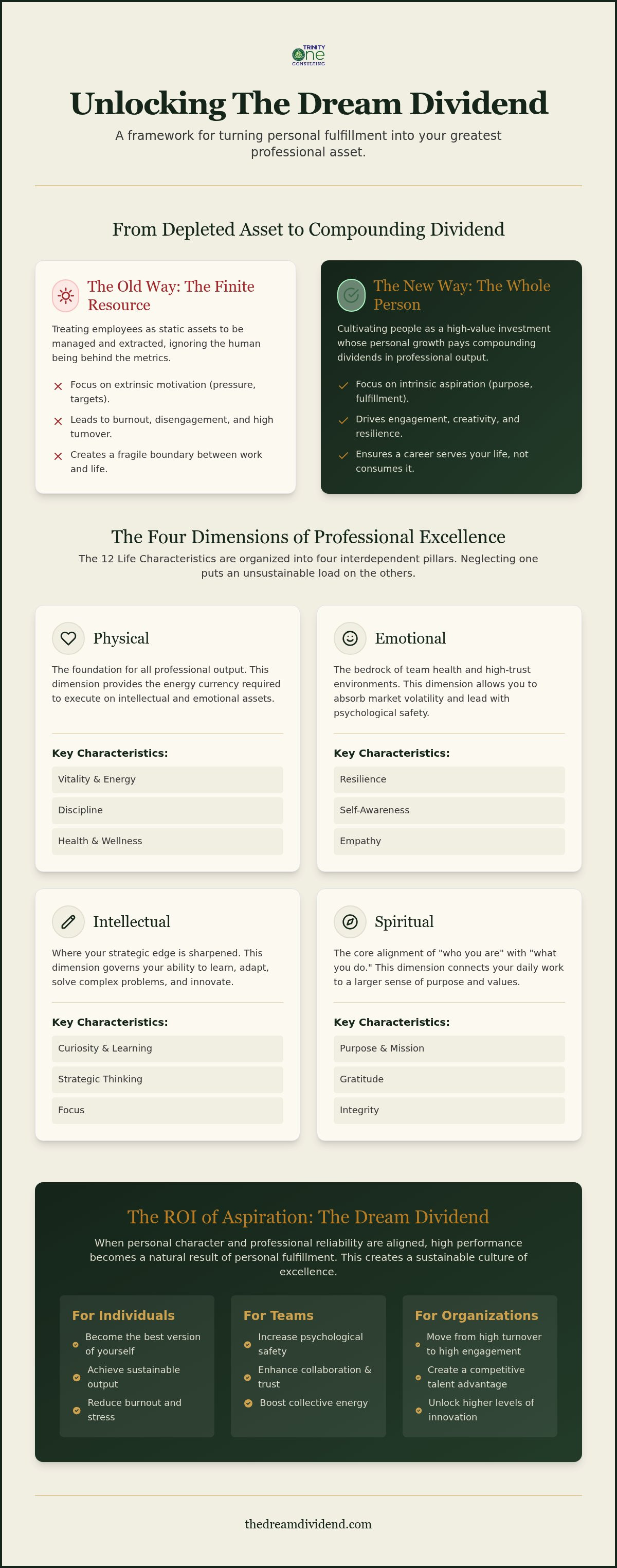
Traditional management often views employees as static assets, focusing solely on skill sets, output metrics, and quarterly targets. This narrow perspective is fundamentally broken because it ignores the human being behind the desk. When you treat people as mere cogs, you shouldn't be surprised when they eventually break. The 12 Life Characteristics offer a different path. They provide a holistic blueprint for personal and professional excellence that acknowledges the complexity of the human experience. By applying the 12 life characteristics at work, you stop treating yourself like a machine and start treating your growth like a high-value investment that pays compounding dividends over time.
This framework represents a vital shift from extrinsic motivation to intrinsic aspiration. Instead of pushing for results through pressure, we pull for results through purpose. This is the foundation of becoming the best version of yourself. It's a commitment to architectural integrity in your personal life that naturally supports your professional structure. When you are thriving as a person, you are inevitably more reliable, creative, and resilient as a professional.
The Origin of the 12 Characteristics
This methodology is deeply rooted in the philosophy of Matthew Kelly and the transformative Dream Manager framework. While 20th-century management was obsessed with efficiency and standardized output, The Dream Dividend adapted these principles for the modern, high-performance workplace. We have moved beyond the era of industrial compliance into an era of human potential. This evolution recognizes that an employee's personal dreams and internal character are the fuel for organizational success. Applying the 12 life characteristics at work is the strategic bridge that connects who you are with what you do, ensuring that your career serves your life rather than consuming it.
Why Wholeness is the New Professional Standard
Personal character and professional reliability are inseparable. If you have a "leak" in your personal discipline or physical health, that deficit will eventually flood your professional performance. You can't compartmentalize your way to greatness. The 2026 imperative for leadership is clear: humanize the workplace or lose your best talent to quiet quitting. This approach aligns with the principles of Positive Psychology, which suggests that human flourishing is the ultimate precursor to sustainable achievement. By focusing on the "whole person," organizations create a culture where engagement isn't a forced metric but a natural byproduct of personal growth. It's about building a foundation that is strong, balanced, and ready for long-term expansion.
The Four Dimensions of Professional Excellence
Professional excellence is not a destination. It's a state of structural integrity. We categorize the 12 Life Characteristics into four human dimensions: Physical, Emotional, Intellectual, and Spiritual. Applying the 12 life characteristics at work means recognizing that these pillars are interdependent. If one is neglected, the others must bear an unsustainable load. Think of these as the primary structural supports for your career. When you begin this integration, you're essentially performing a structural audit of your most valuable asset: yourself.
Physical and Emotional Foundations
The Physical dimension serves as the foundation for all professional output. Characteristics like Vitality provide the energy currency required to navigate a demanding schedule. Without this physical liquidity, your intellectual assets remain locked away. The Emotional dimension is equally critical for team health. Characteristics such as Resilience allow you to absorb the volatility of the market without losing your focus. High-trust environments are built on this emotional bedrock. They generate The Dream Dividend by replacing fear with psychological safety, transparency, and collective momentum. During high-stress projects, an emotionally intelligent leader doesn't just manage tasks. They manage the collective energy of the group. This ensures that the team crosses the finish line with their relationships intact and their spirits high.
Intellectual and Spiritual Alignment
The Intellectual dimension is where your strategic edge is sharpened. Characteristics like Inquisitiveness act as a catalyst for innovation and creative problem-solving. It's the commitment to continuous learning that prevents professional stagnation and keeps you relevant in a shifting economy. Yet, even the most brilliant mind requires the Spiritual dimension to find true fulfillment. In a corporate context, spiritual characteristics are about alignment, purpose, and meaning. When you connect your daily tasks to a larger workplace purpose, you stop feeling like a cog in a machine. This sense of meaning is the ultimate retention strategy. It reduces turnover, increases loyalty, and fosters a deep sense of belonging. Organizations that prioritize this alignment don't just hire employees. They attract partners in a shared mission. This holistic approach ensures you're not just successful on paper, but fulfilled in person, resilient under pressure, and aligned with your highest purpose.
The ROI of Aspiration: Why Personal Growth is a Business Asset
Management often views personal development as a "fringe benefit" or a soft cost. This is a strategic error. When an organization commits to its people, the people commit to the organization. Applying the 12 life characteristics at work creates a compounding effect where individual growth accelerates corporate progress. It isn't just about feeling good; it's about the bottom line. Data suggests that teams focusing on holistic development see significantly lower turnover rates. People simply don't leave environments where they are becoming better versions of themselves. This is the difference between a high-performance culture and a high-exhaustion culture.
Mapping Employee Dreams to Organizational Goals
Your employees have lives outside your office walls. They have aspirations, financial goals, and personal hurdles that don't disappear at 9:00 AM. A Dream Manager program acts as the strategic bridge between these personal desires and professional KPIs. It transforms a job from a place where time is traded for money into a vehicle for life transformation. Applying the 12 life characteristics at work ensures that personal growth and professional output are no longer in competition. In the 2026 labor market, the companies that win the war for talent won't just offer the highest salary. They will offer the most comprehensive path to human flourishing. When an employee sees their career as the engine for their personal dreams, their commitment becomes unshakable.
Calculating the Dividend
Measuring the impact of human potential requires looking beyond traditional balance sheets. We look at the surplus of engagement, the spark of creativity, and the surge of discretionary effort. The Dream Manager ROI is found in the reduction of "quiet quitting" and the increase in operational agility. When a worker knows their physical vitality or intellectual growth is supported by their employer, their output shifts from compliant to inspired. The Dream Dividend is the surplus value created when a person’s work fuels their life goals.
Case studies consistently show that dream-driven cultures outperform traditional models by significant margins. While traditional models focus on extraction, dream-driven models focus on investment. The result is a workforce that is resilient, innovative, and loyal. You aren't just paying for hours; you're investing in the future capacity of your organization. This is how you build a sustainable competitive advantage in an increasingly volatile world.
A Practical Roadmap: Applying the 12 Characteristics in Your Daily Workflow
Analyze your current state. Identify the gaps. Implement the solution. Most professionals wouldn't dream of running a high-stakes project without a real-time dashboard, yet they manage their personal growth through vague intentions and wishful thinking. Applying the 12 life characteristics at work requires the same level of analytical rigor you apply to your quarterly P&L statements. You can begin this process by using the DreamCompass tool to perform a comprehensive audit of your internal architecture. This isn't about adding another layer of complexity to your day. It's about identifying the "Lead Characteristic", which is the one area where a small investment in growth will yield the highest professional return in your current role.
Using the DreamCompass Tool at Work
Integrate your character goals directly into your professional workflow. Instead of treating these as extracurricular activities, set quarterly "character goals" alongside your standard performance reviews. This approach prevents "to-do list" fatigue by making personal growth a core component of your job description rather than an add-on. The DreamCompass allows you to visualize the balance between the four dimensions, helping you spot the structural weaknesses that lead to burnout before they become catastrophic failures. It's a system for navigation, alignment, and long-term sustainability.
The Daily Practice of Excellence
Execution is where the strategy meets the reality of the 9-to-5. Dedicate 15-minute "character blocks" in your professional calendar to focus on your lead characteristic. If your focus is Vitality, use this block for a restorative walk; if it's Inquisitiveness, use it to research a new industry trend; if it's Resilience, use it for a brief session of tactical breathing. When setbacks occur, don't view them as moral failings. Treat them as data points that reveal where your structural foundation needs reinforcement. This shift in perspective is the hallmark of Becoming the Best Version of Yourself in a corporate setting.
The role of the manager must evolve from taskmaster to life coach. By supporting these daily practices, leaders foster a culture built on peer accountability and shared aspirations. When your team knows you're invested in their wholeness, their loyalty isn't just purchased; it's earned. If you're ready to transform your leadership approach, our Dream Management Consulting provides the strategic roadmap you need to build an engaged, purpose-driven team.
Scaling Excellence: Bringing Dream Management to Your Organization
Individual mastery is the blueprint, but collective alignment is the structure. Once you've mastered the art of applying the 12 life characteristics at work personally, the next logical step is to scale that excellence across your entire organization. This isn't just about a one-off seminar or a temporary morale boost. It's about a fundamental shift in your human architecture. To move from personal practice to enterprise-wide transformation, many leaders turn to Dream Management Consulting. This strategic partnership helps you frame human potential as a vital asset, convincing even the most skeptical executive team that personal fulfillment is the ultimate driver of corporate health.
Transforming Organizational Culture
Traditional engagement surveys often measure the symptoms rather than the cause. They tell you people are unhappy, but they don't give you the tools to fix the foundation. By contrast, the 12 characteristics provide a common language for high-performing teams. When a group shares a framework for growth, they stop competing for resources and start compounding their collective strengths. Leadership must model this "Best Version" framework. If the C-suite isn't invested in their own vitality, resilience, and purpose, the rest of the organization won't buy into the vision. Authentic culture is built from the top down and the inside out.
For those ready to lead this movement from within, becoming a Certified Dream Manager is the path to professional mastery. This certification equips you with the methodologies to navigate complex human dynamics and build a culture of high-stakes mentorship. For teams just beginning their journey, The Dream Dividend Podcast serves as an invaluable resource for ongoing mentorship and strategic insight. It offers a steady stream of visionary thinking that keeps the philosophy of wholeness at the forefront of your daily operations. Applying the 12 life characteristics at work at scale requires both a bold vision and a steady, structured implementation.
Next Steps for Visionary Leaders
Start by assessing your organization's current "Dream Quotient." Are you extracting value from your people, or are you investing in their future capacity? If you're ready to move beyond the status quo, consider booking a keynote or a deep-dive consulting session to kickstart your cultural evolution. The status quo of corporate culture is a depreciating asset. It's time to invest in something that grows. You have the roadmap, the tools, and the philosophy. Now, you just need the courage to build something lasting. Transform your culture with Dream Management Consulting today.
Building Your Foundation for Long-Term Success
The transition from feeling like a cog to becoming a strategic architect of your own growth is the most significant investment you'll ever make. We've explored how professional excellence is the natural byproduct of personal wholeness. By focusing on the four dimensions of the human experience, you don't just survive the work week; you thrive, lead, and excel within it. Applying the 12 life characteristics at work isn't a luxury. It's a pragmatic necessity for anyone seeking to reduce burnout and drive meaningful engagement.
Founded by Kevin Patrick, a Certified Dream Manager, our approach is built on the globally recognized Floyd Consulting methodology. We have a proven track record of helping leaders transform their teams into purpose-driven powerhouses by reducing turnover and increasing engagement. You don't have to navigate this structural shift alone. You have the roadmap, the tools, and the support. Now, it's time to take the first step toward a more fulfilled professional life.
Master the 12 Life Characteristics with Dream Management Consulting
Your best version is waiting to be built. The architecture of your future starts with the choices you make today. We're here to help you design a career that fuels your life and a team that achieves the impossible.
Frequently Asked Questions
What are the 12 Life Characteristics defined by Floyd Consulting?
The 12 Life Characteristics are a comprehensive set of traits categorized into four human dimensions: physical, emotional, intellectual, and spiritual. These traits include qualities such as vitality, resilience, inquisitiveness, and purpose. They act as a structural blueprint for human flourishing. By focusing on these specific areas, you ensure that your personal foundation is strong enough to support your highest professional aspirations and long term goals.
How do the 12 Life Characteristics differ from standard soft skills?
Soft skills focus on what you do, while life characteristics focus on who you are becoming. Standard corporate training might teach you time management, but we focus on vitality to ensure you have the energy to manage that time effectively. These characteristics are foundational investments in your human capital. They create a compounding effect that influences every interaction, decision, and project you undertake throughout your career.
Can applying these characteristics really improve my productivity at work?
Yes, because high productivity is the natural byproduct of a high functioning human system. Applying the 12 life characteristics at work ensures your physical energy is high, your emotional resilience is steady, and your intellectual curiosity is sharp. When these internal assets are optimized, you naturally work with greater focus and efficiency. It is about moving from frantic activity to high impact output by strengthening your core capacity.
Is the DreamCompass tool available for individual use or only for companies?
The DreamCompass tool is designed for both individual reflection and organizational scaling. Individuals use it to audit their personal growth and identify structural leaks in their performance. Companies utilize it to align employee aspirations with corporate objectives. This versatility ensures that whether you are an independent professional or a seasoned CEO, you have a precise navigation system for your personal and professional development.
How does a Dream Manager help employees apply these characteristics?
A Dream Manager acts as a strategic architect and personal coach for your growth. They help you identify which characteristics require immediate investment and provide the accountability needed for long term compounding. By facilitating regular check ins, they ensure that your daily tasks remain aligned with your larger life goals. This high stakes mentorship transforms the workplace into a laboratory for personal and professional excellence.
What happens if my personal dreams don’t align with my current job?
Misalignment is often a signal for structural adjustment rather than an immediate exit. Applying the 12 life characteristics at work helps you clarify your values and determine if your current role can serve as a vehicle for your aspirations. Often, small shifts in perspective or responsibility can bridge the gap. If the gap remains unbridgeable, the framework provides the clarity and resilience needed to navigate a purposeful transition.
How long does it take to see results from applying the 12 Life Characteristics?
You can experience immediate shifts in energy and focus, but the most significant returns come from compounding over time. Initial adjustments to your lead characteristic often yield noticeable results within the first quarter. As you maintain these practices, the dividends of increased engagement and reduced stress begin to accumulate. True professional wholeness is a long term investment that rewards steady, intentional, and reflective practice.
Is there a certification for managers who want to lead this framework?
Yes, you can become a Certified Dream Manager to lead this transformation within your own organization. This program provides the rigorous training and strategic methodology required to implement the framework at scale. It is the logical next step for leaders who want to move beyond traditional management styles. By earning this certification, you position yourself as a visionary architect of human potential and organizational health.