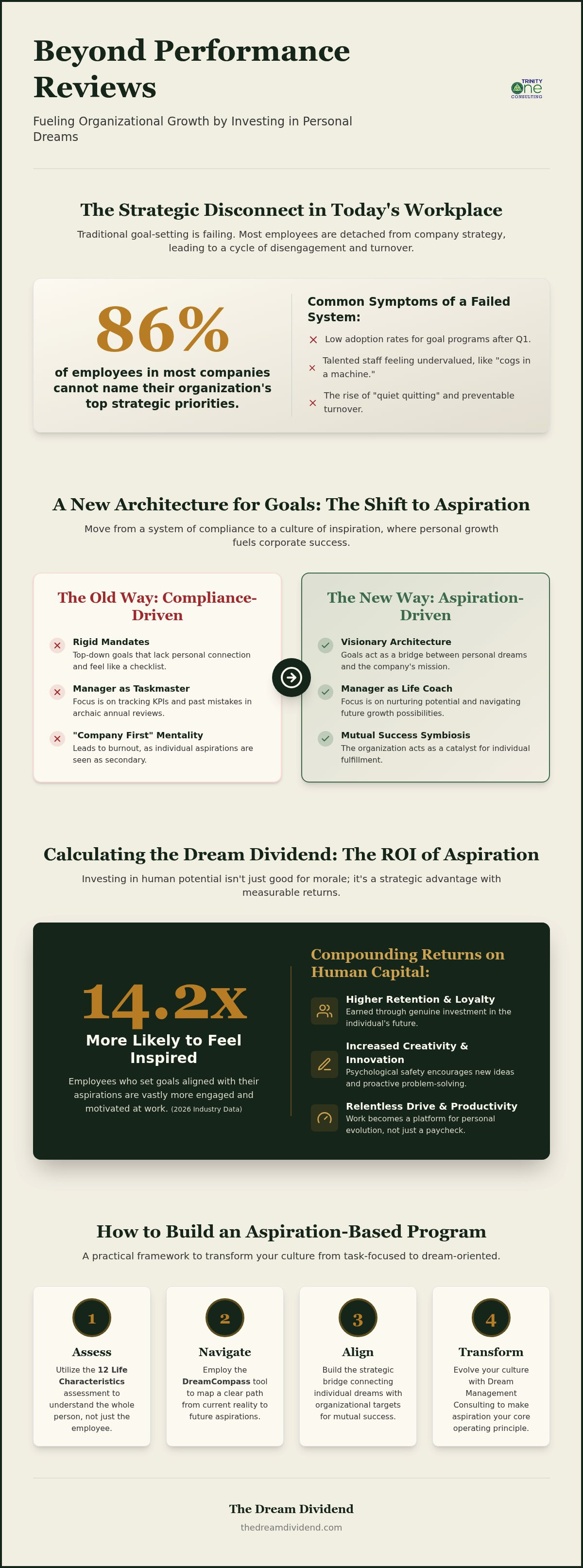
In 86% of companies, most employees can't name their organization's top strategic priorities. This disconnect suggests that traditional employee goal setting programs are failing to bridge the gap between corporate objectives and the people expected to achieve them. You've likely seen the symptoms of this failure: low adoption rates after the first quarter, talented staff feeling like cogs in a machine, and the creeping shadow of "quiet quitting." It's a cycle that drains productivity and leaves leadership wondering why even competitive salaries can't stem the tide of turnover.
You recognize that a company's greatest return on investment doesn't come from rigid mandates, but from the compounding energy of fulfilled individuals. This article will show you how to transform stagnant performance reviews into a high-octane growth engine by aligning organizational targets with individual employee aspirations. We'll examine the strategic architecture of the Dream Manager framework, explore the 12 Life Characteristics, and introduce the DreamCompass tool to help you build a culture where your team is truly "all in." By the end, you'll have a roadmap for a program that scales with professional rigor while protecting the human soul of your business.
Key Takeaways
- Shift your perspective from rigid compliance to a visionary architecture where personal aspirations act as the primary fuel for organizational health.
- Implement modern employee goal setting programs that leverage the Dream Manager philosophy to ensure that as your people grow, your business scales with them.
- Quantify the Dream Dividend by identifying how investing in human potential yields measurable returns in retention, productivity, and long-term innovation.
- Master a practical implementation process using the 12 Life Characteristics assessment and the DreamCompass to navigate the path toward individual fulfillment.
- Evolve your corporate identity from a task-focused entity into a dream-oriented organization through the specialized methodology of Dream Management Consulting.
Table of Contents
What is an Employee Goal Setting Program in 2026?
An effective employee goal setting program is no longer a simple administrative checklist. It's a strategic architecture designed for both human and organizational flourishing. While foundational Goal-setting theory has long emphasized the importance of specific and challenging targets, the modern era demands more than just mechanical precision. In 2026, we've moved past compliance-driven models that treat people like inventory. We've entered an age of aspiration-driven leadership where goals are the bridge between a person's private dreams and the company's public mission.
Traditional SMART goals often fail because they lack soul. They are technically sound but emotionally hollow. They don't ignite passion because they focus solely on what the employee can do for the firm, rather than what the firm can do for the human. When you shift this focus, you begin to collect the Dream Dividend. This is the compounding value of a workforce that isn't just working for a paycheck, but is actively pursuing their Best Version of Themselves. It's an investment in people that pays out in loyalty, creativity, and relentless drive. You aren't just managing tasks; you are nurturing potential, cultivating talent, and building a legacy.
The Shift from Performance Reviews to Personal Growth
The annual performance review is an archaic relic of the industrial age. It's a backward-looking autopsy of past mistakes rather than a forward-looking navigation of future potential. Modern employee goal setting programs replace the "Manager as Taskmaster" with the "Manager as Life Coach." This evolution recognizes that when an employee feels "seen" as a whole person, their psychological safety increases. They stop surviving and start thriving. This shift transforms the office from a place of work into a platform for personal evolution, creating a culture where people show up with their whole hearts.
Corporate Alignment vs. Individual Aspiration
The "Company First" approach is a fallacy that leads to burnout and quiet quitting. Real alignment happens when the organization acts as a catalyst for the individual's dreams. Research indicates that employees who set goals are 14.2 times more likely to feel inspired at work, according to 2026 industry data. By building a bridge between the company’s mission and the individual’s path toward Becoming the Best Version of Yourself, you create a symbiotic relationship. The employee achieves their dreams, and as a direct result, the organization achieves its targets. Implementing modern employee goal setting programs requires this fundamental rejection of the taskmaster mentality in favor of mutual success.
The Dream Manager Framework: A New Architecture for Goals
The Dream Manager framework represents a departure from the sterile mechanics of traditional corporate management. It's built on a singular, transformative philosophy: the company can only become the best version of itself if its employees are becoming the best versions of themselves. In this architecture, the manager evolves into a strategic mentor. They aren't just tracking KPIs; they're architecting human potential. This approach recognizes that in modern goal setting in dynamic work environments, the most valuable assets aren't the tasks completed, but the growing capabilities and engagement of the people completing them. Effective employee goal setting programs must move beyond the spreadsheet to embrace this role, where leaders stop being gatekeepers and start being catalysts for a culture that fuels itself from the inside out.
Investing in the Dreamer, Not Just the Doer
Retention isn't something you buy with a bonus; it's earned through genuine investment in the individual. When you use the dream manager framework to map your team's personal aspirations, you uncover hidden talents that traditional reviews overlook. This process creates a "Dream Dividend," a compounding return on human capital that manifests as lower turnover, higher innovation, and deeper loyalty. Think of it as human capital appreciation. Just as a well-maintained building grows in value, an employee who feels supported in their personal dreams becomes a more effective, committed professional. You can explore how to quantify these gains in our guide on Dream Manager ROI.
The 12 Life Characteristics: The Foundation of Excellence
True professional excellence requires a stable foundation across all areas of life. The 12 Life Characteristics serve as a holistic assessment tool to measure this foundation. By evaluating physical, emotional, intellectual, and spiritual health, leaders can support their teams in a way that goes beyond the superficial "work-life balance." This is work-life integration. It acknowledges that a person struggling with their physical health or intellectual growth cannot bring their best self to the office. When employee goal setting programs address these core pillars, they build a resilient, high-performing culture that survives any market shift. You aren't just setting goals; you're building a structural foundation for long-term excellence. This method ensures that growth is sustainable, personal, and profoundly impactful for the entire organization.
Calculating the Dream Dividend: The ROI of Aspiration
Investing in human potential isn't just a moral imperative; it's a strategic financial decision. When we talk about Dream Manager ROI, we're measuring the direct impact of personal fulfillment on retention, engagement, and innovation. While many organizations settle for compliance-based targets, visionary leaders look for the "ceiling" of excellence. They understand that a purpose-driven culture creates intangible assets that eventually manifest as tangible profits. By mapping individual aspirations, companies can drastically reduce the thousands spent on recruitment and onboarding every time a talented individual feels like a replaceable cog and decides to leave.
People don't quit companies; they quit a lack of purpose. If your employee goal setting programs focus exclusively on corporate KPIs, you're essentially asking for the bare minimum. When an employee sees their daily tasks as a vehicle to reach their own dreams, their perspective shifts. They stop watching the clock and start seeking ways to add value. This transformation turns a stagnant payroll expense into a compounding asset that fuels the entire organization's growth. You aren't just paying for hours; you're investing in a legacy of shared success.
Slaying the Giant of Quiet Quitting
Quiet quitting is the silent killer of productivity. It happens when employees feel their personal growth has hit a dead end within the corporate structure. Discretionary effort is the first thing to vanish when employee goal setting programs ignore the human soul. However, when you integrate dream management, you see a noticeable drop in absenteeism and burnout. Employees who feel "seen" are more resilient. They bring more energy to their roles because they know the company is an active partner in their journey toward Becoming the Best Version of Yourself. This alignment is the ultimate antidote to disengagement.
The Financial Case for Human-Centered Leadership
Consider the staggering cost of high turnover. Between lost knowledge, recruitment fees, and the inevitable dip in team morale, the price of replacing a single mid-level specialist can be astronomical. Recent 2026 data from Betterworks indicates that two in three managers need more support with performance management, yet only 21.2% of organizations mandate training for goal setting. Bridging this gap with a Certified Dream Manager program is a fraction of the cost of losing your best talent. Beyond just saving money, these initiatives drive customer satisfaction. Fulfilled employees provide better service, think more creatively, and represent the brand with genuine pride. This is the compounding effect of cultural excellence. It builds a structural foundation where long-term value is prioritized over immediate, superficial fixes.
How to Build an Aspiration-Based Goal Setting Program
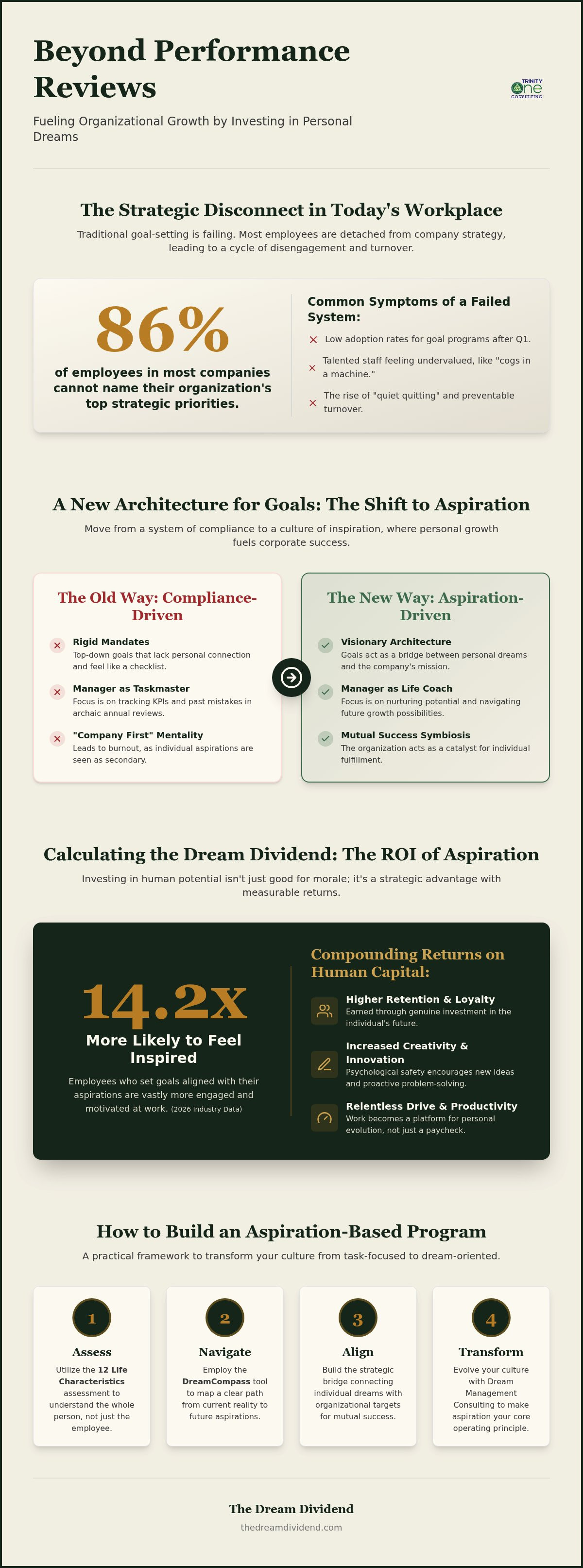
Designing effective employee goal setting programs requires more than a software subscription; it requires a structural overhaul of how you view your people. To move from a culture of compliance to one of high-octane growth, you must follow a methodical framework that prioritizes the human soul. This isn't a weekend project. It's a strategic architecture that requires five distinct phases of implementation.
- Step 1: Conduct a Life Characteristics assessment to identify the current "baseline" of the team. This identifies where your people are thriving and where they are struggling.
- Step 2: Deploy the DreamCompass tool. This proprietary instrument helps employees map their top 100 dreams, turning abstract desires into a concrete inventory of potential.
- Step 3: Train your leadership through a Certified Dream Manager program. This ensures your managers have the skills to guide their teams toward personal and professional excellence.
- Step 4: Integrate personal dreams into quarterly professional check-ins. Alignment happens when the company's mission and the individual's aspirations are discussed in the same breath.
- Step 5: Celebrate "Dream Wins" publicly. Recognizing personal achievements reinforces a culture where aspiration is the primary currency.
Utilizing the DreamCompass Tool
The DreamCompass tool serves as the navigational instrument for this journey. It facilitates the transition from vague, fleeting desires to actionable, measurable goals. By tracking progress across all 12 Life Characteristics, employees see that their physical health, emotional stability, and intellectual growth are valued just as much as their financial output. This tool allows every team member to create a "Strategic Life Plan." It provides the clarity needed to pursue the Best Version of Themselves while contributing to the organization's collective success. It's about building a life, not just a career.
The Role of the Certified Dream Manager
Internal advocates are far more effective than any external "goal software" because they provide the human connection that technology cannot replicate. You don't need to look outside your organization; you can identify potential Dream Managers within your existing leadership team. These individuals are natural mentors who possess empathy and strategic foresight. The certification curriculum focuses on active listening, strategic life coaching, and the architecture of human potential. When you empower a leader to become a Certified Dream Manager, you aren't just improving a department; you're transforming the very DNA of your culture. If you're ready to start this evolution, you can begin your consulting journey today to see how these frameworks apply to your unique organizational needs.
Transforming Your Culture with Dream Management Consulting
Shifting from a task-oriented company to a dream-oriented organization is a profound evolution that requires a fundamental change in perspective. It demands moving beyond the mechanical nature of traditional employee goal setting programs to embrace a more holistic, visionary architecture. This transformation isn't merely a policy update; it's a strategic realignment of your organization's soul. Through Dream Management Consulting, leaders gain a strategic partner who understands the deep relationship between personal aspiration and corporate health. This guidance helps you navigate the complexities of cultural change, providing the structural foundation needed to scale these programs from small leadership teams to vast, global enterprises without losing the human connection.
Keynote Speaking as a Catalyst for Change
Keynote Speaking acts as the vital catalyst for this shift, serving as the spark that ignites organizational change. It breaks the ice by disrupting the status quo and introducing a shared language of aspiration that resonates at every level. A powerful speaker can demonstrate why traditional employee goal setting programs often fall flat and how a dream-centric approach creates a resilient, high-performing culture. When you center your corporate identity on the principle of Becoming the Best Version of Yourself, you create a unifying purpose that bridges individual growth with collective success. This isn't just about a single day of inspiration; it's about launching a multi-year cultural strategy. You move from temporary excitement to a sustainable system where the potential of every employee is treated as a vital, strategic asset.
Next Steps: The Dream Dividend Podcast and Beyond
Excellence is not a destination but a continuous process of refinement and growth. To maintain momentum, leaders must commit to ongoing education and the exploration of new leadership paradigms. The Dream Dividend Podcast serves as a weekly resource for this journey, offering insights into the intersection of human fulfillment and business performance. By engaging with these concepts regularly, you ensure that your leadership style remains relevant, compassionate, and professionally rigorous. Leadership is an investment that compounds over time, and the resources you consume today dictate the returns you see tomorrow. If you're ready to stop managing tasks and start architecting dreams, the path is open. Schedule a consultation to begin your culture transformation today.
Architecting a Culture of Aspiration
The era of treating talent as a static line item has come to a close. Throughout this exploration, we've seen that the most resilient employee goal setting programs don't just track professional output; they actively fuel the personal dreams of every individual. By shifting your focus toward the 12 Life Characteristics and the proprietary DreamCompass methodology, you move beyond the surface-level compliance of traditional reviews. You begin to collect the Dream Dividend, where personal fulfillment and organizational excellence become a single, compounding asset that secures your company's future.
Founded by Kevin Patrick, a Certified Dream Manager, our approach is built upon the transformative principles of Matthew Kelly’s best-selling book, "The Dream Manager." We provide the strategic architecture needed to navigate the complexities of modern leadership while protecting the human soul of your business. If you're ready to evolve from a task-oriented manager into a strategic mentor, the next step is clear. Book a Dream Management Strategy Session today to start your culture transformation. Your people are your greatest investment. When they thrive, your organization finally becomes the best version of itself.
Frequently Asked Questions
What is the difference between an OKR program and a Dream Management program?
OKR programs focus on organizational metrics and strategic alignment. In contrast, Dream Management focuses on the personal aspirations of the individual. While OKRs manage the "doer," Dream Management invests in the "dreamer." By integrating these frameworks, you ensure that corporate success is a byproduct of individual fulfillment. It's a shift from tracking tasks to architecting lives, creating a more sustainable and high-performing culture than traditional metrics alone can achieve.
Can a small business afford an employee goal setting program focused on dreams?
Small businesses often have the most to gain from modern employee goal setting programs because they can't afford the high cost of turnover. The investment in a Dream Manager program is typically a fraction of the recruitment fees for a single replacement. By helping your team achieve their personal dreams, you build a level of loyalty that a standard paycheck can't buy. It's a strategic move that protects your most valuable human capital.
How do we handle employees who are hesitant to share their personal dreams?
Trust is the structural foundation of any aspiration-based program. If employees are hesitant, it's often because they don't yet feel safe sharing their private goals in a professional setting. Start by modeling vulnerability from the top down. Use the DreamCompass tool to keep the process structured and professional. As people see the organization genuinely supporting their peers' dreams, the cultural barriers naturally dissolve and participation increases across the board.
Does dream management actually improve professional performance and KPIs?
Professional performance is a direct reflection of personal well-being. When an employee sees their job as a vehicle for achieving their own dreams, their discretionary effort increases. Recent industry data indicates that employees who set and track goals in employee goal setting programs are over 14 times more likely to feel inspired at work. This inspiration translates into higher productivity, better customer service, and more creative problem solving. The Dream Dividend is a measurable financial return.
What are the 12 Life Characteristics and how do they relate to work goals?
The 12 Life Characteristics are a holistic framework covering physical, emotional, intellectual, and spiritual health. These pillars provide the baseline for an individual's ability to perform. If an employee is struggling with their physical health or intellectual growth, they can't bring their best self to their role. By aligning work goals with these characteristics, you create a structural support system that ensures your team remains resilient, balanced, and capable of long-term excellence.
How long does it take to see an ROI from a Dream Manager program?
While every organization is unique, many see a spike in engagement within the first quarter. Retention gains often manifest as soon as employees feel their personal growth is a corporate priority. Long-term ROI, such as reduced recruitment costs and increased innovation, compounds over the first 12 to 18 months. It's an investment in human capital that yields steady, sustainable returns rather than a temporary, superficial fix for deep cultural issues.
Is a Certified Dream Manager the same as an HR professional?
An HR professional typically focuses on administrative compliance, payroll, and organizational risk. A Certified Dream Manager, however, acts as a strategic mentor and architect of human potential. This role is the evolution of the "Manager as Coach" trend. While HR ensures the company follows the rules, a Dream Manager ensures that the people within the company are becoming the best versions of themselves through personalized guidance and the Dream Manager framework.
What happens if an employee's dream is to leave the company?
If an employee's dream leads them elsewhere, it's an opportunity for an honest and supportive transition. Protecting the "Best Version of Yourself" culture means supporting the individual's path, even if it's outside your walls. This level of integrity builds a powerful employer brand that attracts top-tier talent. Additionally, knowing an employee's plans in advance allows for better succession planning and reduces the disruptive impact of a sudden, unexpected resignation.