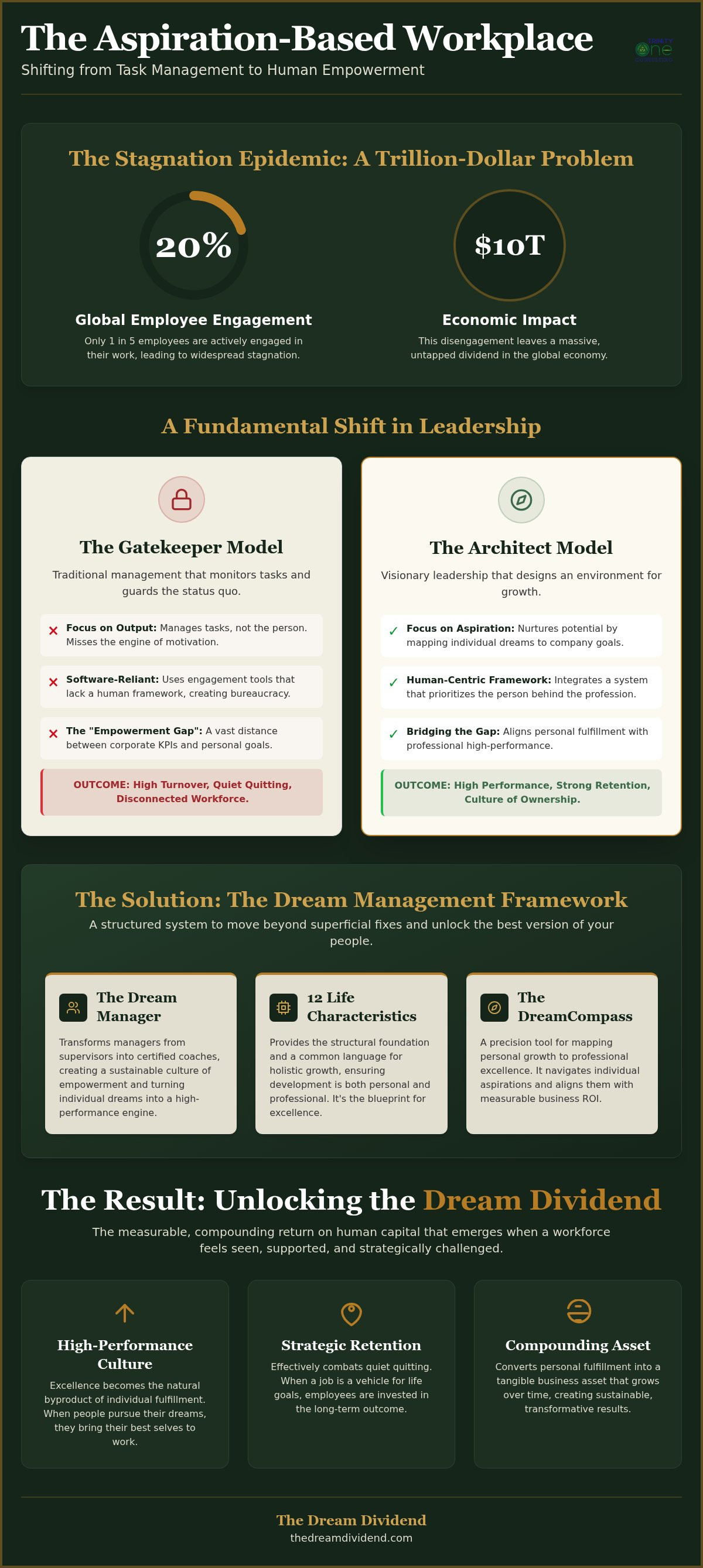
Global employee engagement has plummeted to just 20 percent, leaving a $10 trillion hole in the global economy that represents a massive, untapped dividend. You've likely felt this stagnation in your own halls, watching high turnover persist despite your investment in the latest tools for employee engagement. It's frustrating to see managers act as gatekeepers rather than catalysts, while your workforce remains disconnected from the very purpose that drives your brand. You know that software alone cannot fix a culture that lacks a soul.
We're here to show you that true empowerment isn't about better delegation; it's about strategic investment in the individual. This article reveals how to move beyond superficial fixes and leverage an aspiration-based framework to unlock the best version of your people. We'll explore the architecture of the Dream Manager program, the precision of the DreamCompass tool, and the structural foundation of the 12 Life Characteristics. By the end, you'll understand how to transform managers into coaches, bridge the gap between personal fulfillment and professional excellence, and turn individual dreams into a high-performance culture that yields a compounding return on your human capital.
Key Takeaways
- Transition your leadership style from a restrictive gatekeeper to a strategic architect. This shift ensures individual aspirations are the primary fuel for organizational health.
- Evaluate why conventional tools for employee engagement often fall short of expectations. The DreamCompass framework provides a structural foundation for mapping personal growth to professional excellence.
- Move beyond the sterile nature of "Management by Objective" by adopting an aspiration-based system. This approach converts personal fulfillment into a compounding asset for your business.
- Master the implementation of an Aspiration Audit to identify the specific drivers of your workforce. Upskilling through the Certified Dream Manager program creates a sustainable coaching culture.
- Secure a tangible Dream Dividend by leveraging the 12 Life Characteristics. These principles bridge the gap between individual well-being and high-performance business outcomes.
Table of Contents
- Redefining Employee Empowerment Tools for the 2026 Workplace
- The Dream Management Framework: A New Category of Empowerment
- Comparing Traditional Management Tools vs. Aspiration-Based Systems
- How to Implement an Aspiration-Based Empowerment Strategy
- Maximizing Your ROI: The Dream Dividend Consulting & Certification
Redefining Employee Empowerment Tools for the 2026 Workplace
Management isn't what it used to be. The days of watching clocks and monitoring keystrokes are over, replaced by a need for deeper, more meaningful connection. We've reached a point where the sterile coldness of traditional corporate consulting no longer suffices. True empowerment is not a gift bestowed by a supervisor. Instead, What is Employee Empowerment? represents the strategic alignment of individual aspirations with organizational goals. It's the realization that when an employee grows, the company thrives in tandem.
Many firms rely on automated SaaS platforms as their primary tools for employee engagement. While these systems provide data, they often fail to empower because they lack an underlying human framework. Software doesn't build trust; people do. Without a visionary leadership style, your technology becomes another layer of bureaucracy. The traditional manager acts as a gatekeeper, a sentry who monitors tasks and guards the status quo. In contrast, the 2026 visionary is an architect. They design, build, and sustain environments where personal growth and corporate success occupy the same structural foundation. We call the measurable ROI of this human-centric investment the "Dream Dividend." It is the compounding value created when a workforce feels seen, supported, and strategically challenged.
The Evolution from Task Delegation to Aspiration Mapping
Leadership in 2026 requires more than simply giving permission to act. It demands a shift from task delegation to aspiration mapping. If you only manage an employee's output, you're missing the engine that drives it. There's a direct, undeniable link between personal fulfillment and professional high performance. By mapping individual dreams, you create a strategic retention tool that effectively combats quiet quitting. When people see their job as a vehicle for their own life goals, they don't just show up; they excel. They become invested in the outcome because the outcome serves their own narrative of success.
Why Traditional Engagement Software Is Only Half the Battle
Automated pulse surveys and digital rewards are useful, but they're only half the battle. They lack the genuine human connection required to sustain long-term commitment. We see a growing "Empowerment Gap" in modern business. This is the distance between cold corporate KPIs and the deeply personal life goals of your workforce. Bridging this gap requires moving beyond generic tools for employee engagement toward a more intentional approach. To create a culture of ownership, you must integrate a proven Dream Manager framework that prioritizes the person behind the desk. When you invest in the whole person, the returns are not just financial; they are cultural, sustainable, and transformative.
The Dream Management Framework: A New Category of Empowerment
While many organizations search for the latest digital tools for employee engagement, they often overlook the most powerful engine of productivity: the human heart. The Dream Manager methodology represents a new category of empowerment, one that transcends simple software by providing a structured framework for cultural transformation. This approach is rooted in the belief that a company can only reach its full potential when its people are actively pursuing their own. It's a strategic shift from managing output to nurturing potential.
At its core, this philosophy centers on helping individuals become the "Best Version of Yourself." This isn't just a corporate platitude; it's a rigorous standard for excellence. When an organization adopts the 12 Life Characteristics, it establishes a blueprint for holistic growth. These characteristics provide a common language for accountability, ensuring that development isn't just professional, but deeply personal. By treating human potential as a strategic asset, you create an environment where excellence becomes the natural byproduct of individual fulfillment.
The DreamCompass Tool: Navigating Aspiration and ROI
The DreamCompass tool functions as the navigational system for this journey. It allows employees to identify, track, and achieve their personal aspirations, creating a tangible record of where they are and where they want to go. This isn't just about "feeling good" at work. There is a direct, measurable relationship between supporting these dreams and organizational health. In fact, these frameworks have slashed turnover in organizations by creating a bond of loyalty that money alone cannot buy.
When a leader asks, "What is Employee Empowerment?", they must look beyond simple task delegation. Empowerment occurs when a company acts as a catalyst for an individual's personal success. By integrating the DreamCompass, managers move from being mere supervisors to becoming strategic mentors. This shift creates a compounding return on human capital that traditional management tools simply cannot replicate. If you're ready to build this architecture in your own firm, you might start by exploring how Dream Management Consulting can help you design a culture of aspiration-driven excellence.
The 12 Life Characteristics as a Performance Standard
Sustainable performance requires a whole-person approach. The 12 Life Characteristics serve as holistic empowerment metrics that prevent burnout by addressing the physical, emotional, and intellectual needs of the workforce. They provide a structural foundation for growth, ensuring that employees have the resilience to meet high-stakes challenges. When you use these characteristics as a standard, you aren't just checking boxes. You're building a high-standard culture where accountability, fulfillment, and excellence coexist. This framework ensures that the pursuit of corporate KPIs doesn't come at the expense of human well-being, but rather is fueled by it.
Comparing Traditional Management Tools vs. Aspiration-Based Systems
Traditional management often treats engagement as a transaction. You provide a task; the employee provides labor. You offer a bonus; they offer temporary loyalty. This "Management by Objective" (MBO) approach is structurally sound for tracking output, but it's insufficient for building a legacy. To achieve compounding growth in your human capital, you must pivot toward Management by Aspiration. While MBO focuses on the "what," Management by Aspiration addresses the "why." It treats the individual's internal growth as a vital, strategic asset rather than a line-item expense. This shift transforms your workforce from a collection of workers into a community of stakeholders.
Extrinsic Rewards vs. Intrinsic Aspiration
Most tools for employee engagement rely on extrinsic rewards like gift cards, "points" marketplaces, or public shout-outs. These methods provide a short-term boost, but they fail to generate long-term loyalty because they don't touch the core of human motivation. They're the corporate equivalent of a sugar high. Intrinsic Empowerment is the fuel for high-stakes mentorship, creating a culture where employees are driven by their own desire for excellence. When you invest in an employee's personal dreams, you earn a Dream Dividend. This is the moment when company success directly fuels employee life goals, turning a professional obligation into a personal mission. This alignment is the most effective hedge against quiet quitting ever designed.
SaaS Efficiency vs. Human Transformation
Technology has its place, but it's a tool, not a strategy. You use software for tracking and reporting; you use consulting for transformation. In 2026, visionary leaders are shifting their budgets away from surveillance-based tools toward development frameworks. They recognize that an organizational culture transformation cannot be automated. It requires a deliberate architecture of trust, mentorship, and accountability. While recognition software might capture a moment of success, an aspiration-based system captures the trajectory of a career. It solves the problem of disconnection by replacing it with a sense of shared purpose. If your current systems focus more on monitoring than on mentoring, you're merely managing decline rather than architecting growth.
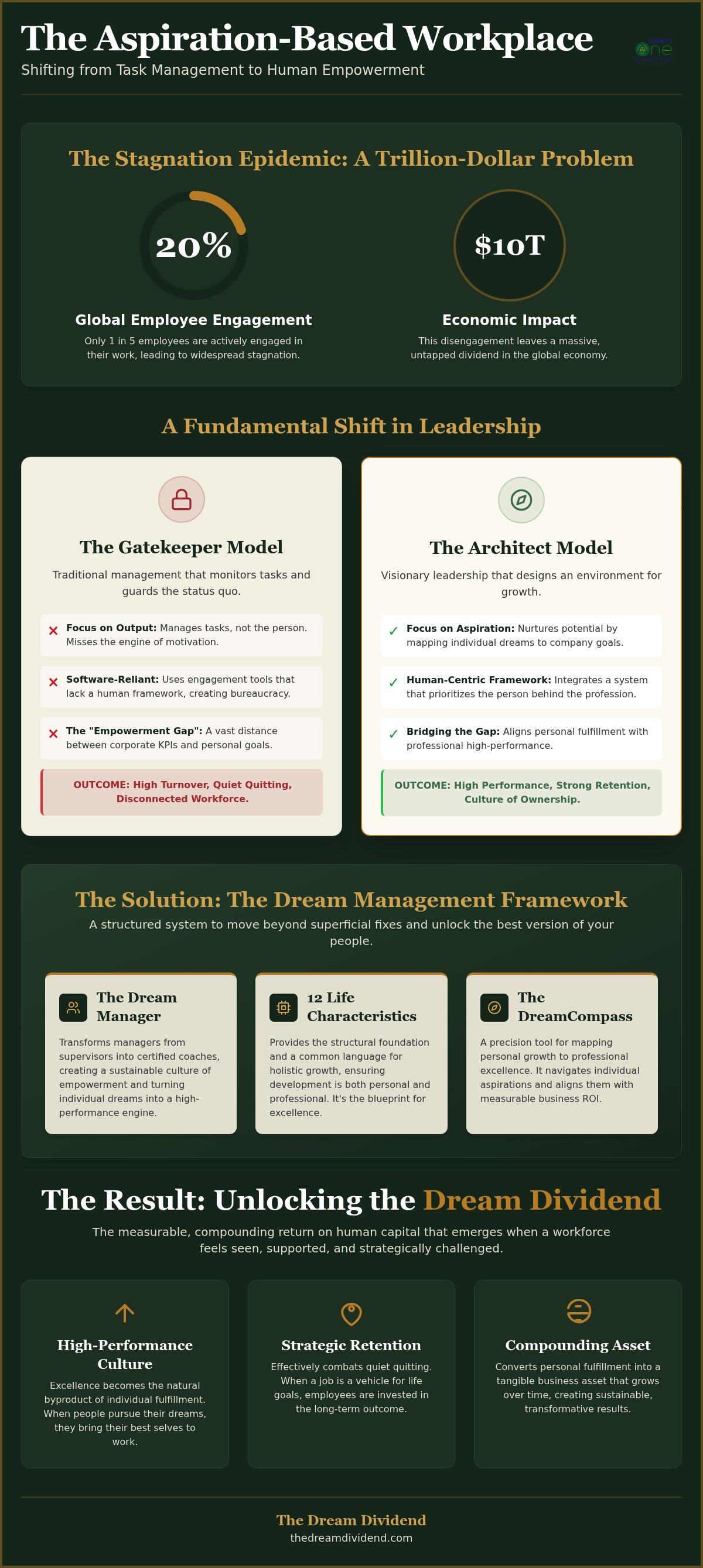
How to Implement an Aspiration-Based Empowerment Strategy
Implementation is where visionary concepts meet pragmatic business reality. While many firms purchase tools for employee engagement and hope for the best, true transformation requires a deliberate four-step architecture. You're not just installing software; you're building capacity within your people. This process moves the organization from a collection of isolated workers to a unified force of individuals pursuing a shared excellence.
- Step 1: Conduct an Aspiration Audit. Use the DreamCompass tool to identify the specific, personal drivers of your workforce. This initial assessment uncovers the internal motivations that traditional pulse surveys often miss.
- Step 2: Upskill your leadership. Enroll your key influencers in the Certified Dream Manager program. You cannot expect managers to coach effectively if they've only been trained to supervise tasks and monitor deadlines.
- Step 3: Integrate dream-tracking. Embed aspiration-based conversations into your regular 1-on-1 cadences. This ensures that personal growth remains a consistent priority, creating a rhythmic focus on long-term value.
- Step 4: Measure the Dividend. Correlate the achievement of personal goals with professional KPIs. When you see absenteeism drop and productivity rise, you're witnessing the tangible ROI of a human-centric investment.
If you're ready to begin this transition, explore our Dream Management Consulting services to architect your custom strategy.
Manager as Life Coach: The Next Evolution of Leadership
The role of the manager is evolving from a gatekeeper of information to an enabler of dreams. In an empowered organization, leadership is about high-stakes mentorship. It requires a sophisticated balance of professional authority and compassionate guidance. To succeed, managers must follow the Dream Manager ethics, focusing on support without overstepping personal boundaries. This transition allows leaders to stop managing decline and start architecting growth. When a manager becomes a coach, they don't just assign work; they help their team members identify the path toward the best version of themselves.
Scaling Empowerment Across Mid-Size and Enterprise Teams
Maintaining a personal touch in a large organization is a structural challenge, but it's not an impossible one. Scaling this culture requires the development of internal Certified Dream Managers who can sustain the framework across different departments. These internal advocates serve as the navigational guides for the culture, ensuring that the human element isn't lost in the machinery of the enterprise. By integrating aspiration-based tools into your existing HR tech stack, you can track progress seamlessly without adding administrative friction. This allows you to maintain a unified vision of excellence, regardless of head count or geographic distance.
Maximizing Your ROI: The Dream Dividend Consulting & Certification
Engagement is not a static data point; it is a dynamic investment. While many advisory firms provide data-heavy analytics that lack a personal development core, our approach focuses on the structural health of your human capital. Our consulting approach acts as the architect for your new culture, moving beyond superficial tools for employee engagement to build a foundation of mutual growth. We help you transition from a model of reactive management to one of strategic investment, where every individual's success contributes to the organizational bottom line. By treating human potential as a compounding asset, you secure a future that is both profitable and purposeful.
The Path to Our Aspiration Leader Certification
True cultural transformation requires internal champions who understand the blueprint of human aspiration. Our Aspiration Leader Certification program, built on our proprietary framework and proven methodologies, equips your leaders with the skills to become "Aspiration Architects" within your organization. This certification isn't just a credential. It is a comprehensive training that covers the psychological drivers of performance, the practical application of our proprietary tools, and the navigation of key success principles. This certification provides the tools to identify, track, and achieve a higher standard of excellence. If you want to test the efficacy of this framework, we recommend starting with a pilot program in a single department. This allows you to witness the compounding returns on a smaller scale before expanding the architecture across the entire enterprise.
Strategic Keynotes and Culture Consulting
Sometimes, a culture needs a spark to ignite the "Aspiration Fire" within its people. Our Keynote Speaking engagements serve as that catalyst, challenging your team to rethink the relationship between their personal dreams and their professional excellence. We move from the high-level inspiration of a keynote to the grounded reality of customized consulting roadmaps. These roadmaps guide your long-term transformation, ensuring that your empowerment strategy remains steady and intentional. To hear real-world application stories and strategies for leading with purpose, listen to The Dream Dividend Podcast. These narratives illustrate how visionary leadership can bridge the gap between individual well-being and high-stakes performance.
Empowerment is not a tool you buy; it's a culture you build. It requires a commitment to the long-term value of your people, a willingness to challenge the status quo, and a vision for a sustainable future. By shifting your perspective, you can transform your culture from a cost center into a dividend-paying asset. Start your journey toward unlocking the full potential of your organization and its people today. The returns are worth the investment.
Architecting a Future of Sustainable Human Growth
The sterile coldness of traditional consulting is a relic of the past. Today, your organization’s health depends on your ability to act as a strategic architect of human potential. You now have the blueprint to move beyond basic delegation software and toward a culture that prizes the individual. By integrating the 12 Life Characteristics, you turn disengagement into a compounding asset. True tools for employee engagement must empower the person, not just the process.
Master the art of aspiration-driven leadership with the Certified Dream Manager program. This framework is based on the principles of Matthew Kelly’s "The Dream Manager" and utilizes the proprietary DreamCompass tool to drive proven ROI in turnover reduction. It’s time to stop acting as a gatekeeper and start serving as a catalyst for growth. When your employees thrive, your business follows. The future of your organization is waiting to be built.
Frequently Asked Questions
What are the most effective employee empowerment tools in 2026?
Effective tools bridge the gap between corporate goals and personal aspirations. In 2026, the most impactful tools for employee engagement include the DreamCompass for goal tracking and the 12 Life Characteristics for holistic development. These aren't just software solutions; they're structural foundations that support the whole person. By aligning individual dreams with organizational success, you create a culture of ownership that outlasts any superficial reward program.
How do you measure the ROI of employee empowerment programs?
You measure ROI by correlating personal goal achievement with tangible business metrics. Look for the "Dream Dividend" in reduced turnover rates, lower absenteeism, and increased productivity per employee. When your workforce sees the organization as a vehicle for their own success, their commitment compounds. This transformation turns human potential into a strategic asset, providing a measurable return on your investment in culture and personal development.
Can employee empowerment tools help reduce turnover and quiet quitting?
Yes, these tools directly address the root causes of disengagement by fostering a sense of purpose. Quiet quitting occurs when employees feel their personal lives are disconnected from their professional roles. By using frameworks that support their "Best Version of Yourself," you build a bond of loyalty that transcends a paycheck. This strategy transforms the workplace into a supportive community, making it the most effective hedge against the modern turnover crisis.
What is the difference between empowerment software and empowerment frameworks?
Software is a mechanism for tracking; a framework is an architecture for transformation. While SaaS platforms provide data on employee sentiment, they don't offer a roadmap for growth. Frameworks like the Dream Manager methodology provide the philosophical and practical foundation needed to change behavior. You use software to monitor the process, but you use a framework to build the culture and navigate the complexities of human motivation.
How does the Dream Manager program function as a leadership tool?
The Dream Manager program functions as a high-stakes mentorship tool that evolves managers into coaches. It provides a structured way for leaders to engage with their teams on a deeper level without overstepping professional boundaries. By focusing on the 12 Life Characteristics, leaders help employees build resilience and excellence. This shift from gatekeeper to enabler of dreams creates a high-performance culture driven by mutual respect and shared success.
Is focusing on employee dreams appropriate for a professional workplace?
It's not only appropriate; it's a strategic necessity for organizational health. A workforce that is achieving its personal dreams is more energized, focused, and loyal. When you help an employee buy their first home or run a marathon, you're building the character traits required for professional excellence. This human-centric approach bridges the gap between personal fulfillment and corporate performance, proving that the best version of the individual is the best version of the employee.
How do I train my managers to use empowerment tools effectively?
Effective training requires a shift in perspective from supervision to coaching. The Certified Dream Manager program is the gold standard for this transition, equipping leaders with the Floyd Consulting methodologies needed to drive engagement. Managers learn to use tools for employee engagement to facilitate meaningful growth conversations. This upskilling ensures that your leadership team can architect a culture of aspiration while maintaining the professional standards required for enterprise success.
What is the DreamCompass tool and how does it work?
The DreamCompass is a proprietary navigational tool designed for personal goal tracking and aspiration mapping. It works by helping employees identify their specific dreams across various areas of life and creating a clear path to achieve them. By providing a structural foundation for these goals, the tool allows managers to support their team's growth in a structured, professional manner. It turns abstract aspirations into a tangible roadmap for becoming the best version of oneself.