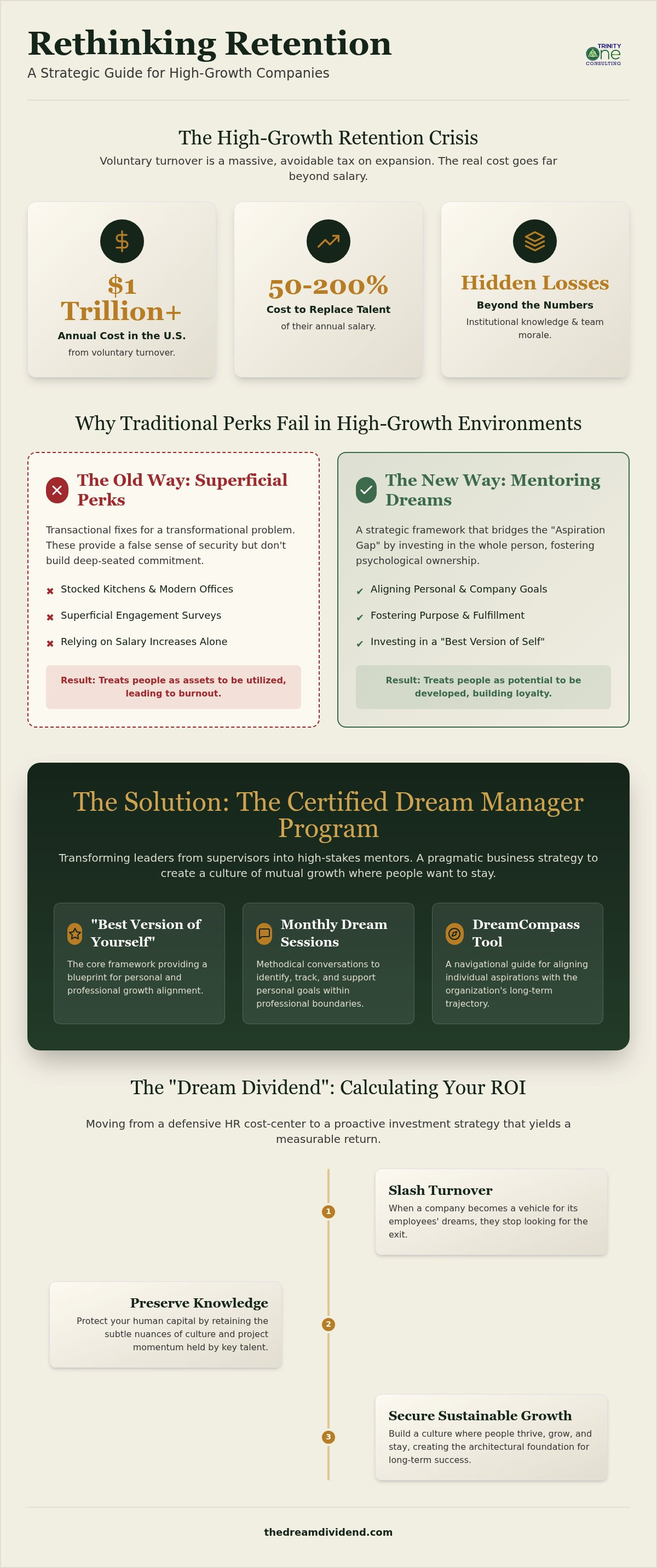
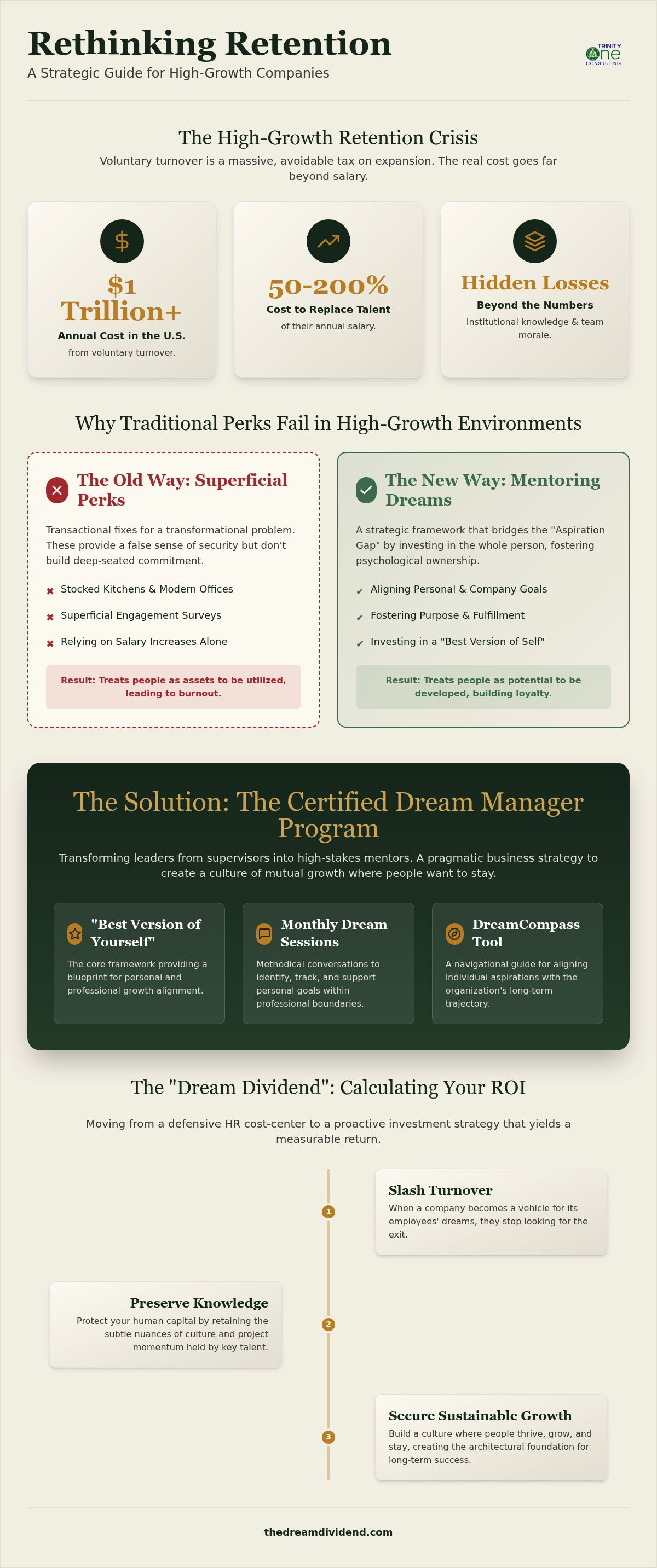
Voluntary turnover costs U.S. businesses over $1 trillion annually, a staggering figure that represents a massive, avoidable tax on rapid expansion. When you're scaling at speed, the cost of replacing specialized talent often ranges between 50% and 200% of their annual salary. It's a high-stakes drain on your resources. You've likely seen the symptoms of this struggle: cultural dilution during hiring sprints, the quiet exit of top performers, and the creeping shadow of burnout. Mastering employee retention strategies for high-growth companies is no longer a secondary HR task. It's a core architectural requirement for any organization that intends to sustain its trajectory.
You recognize that your people are the engine of your success, yet maintaining their fire is difficult when global engagement metrics continue to slide. We're here to change that narrative. In this guide, you'll discover how to transform your organizational culture and slash turnover by investing in the personal aspirations of your talent. We will examine the compounding returns of the Dream Manager framework, the utility of the DreamCompass tool, and the practical steps to secure a measurable ROI on your leadership development. It's time to build a culture where your people don't just work; they thrive, grow, and stay.
Key Takeaways
- Move beyond the superficial allure of office perks to address the structural fragility that rapid scaling creates within your team's culture.
- Identify why the most successful employee retention strategies for high-growth companies focus on the "Best Version of Yourself" framework to foster deep, psychological ownership.
- Learn how to deploy the DreamCompass tool as a navigational guide for aligning individual aspirations with your organization's long-term trajectory.
- Master the transition from traditional HR defense to a proactive investment strategy that yields a measurable Dream Dividend through the Certified Dream Manager program.
- Gain a clear roadmap for 2026 that scales your leadership development and secures the high-stakes mentorship your specialized talent demands.
Table of Contents
- The High-Growth Retention Crisis: Why Traditional Perks Fail
- What is the Certified Dream Manager Program?
- Comparing Retention Frameworks: Dream Management vs. Traditional HR
- Implementing Dream Management: A Strategic Roadmap for 2026
- The Dream Dividend: Calculating the ROI of Aspiration-Based Leadership
The High-Growth Retention Crisis: Why Traditional Perks Fail
Many leaders believe a stocked kitchen or a modern office acts as a shield against turnover. It doesn't. These are transactional fixes for a transformational problem. When exploring the nuances of understanding employee retention, it becomes clear that perks are merely the facade of a building. They cannot compensate for a crumbling foundation. Rapid expansion often creates a structural fragility where the individual is sacrificed for the sake of the scale. Robust employee retention strategies for high-growth companies must bridge the "Aspiration Gap" by treating personal growth as a strategic asset rather than a line-item expense. You must move from managing tasks to mentoring dreams. It's a shift that requires you to integrate, inspire, and invest in the whole person.
The Failure of Superficial Engagement Strategies
Engagement surveys often provide a false sense of security. They measure superficial satisfaction, not deep-seated commitment. An employee might be pleased with their benefits while simultaneously updating their resume. This disconnect occurs because traditional management treats people as assets to be utilized rather than potential to be developed. In high-pressure environments, the feeling of being a "cog in the machine" accelerates burnout and resentment. If your retention plan relies on salary increases alone, you're competing in a race with no finish line. True loyalty is built on purpose, progress, and personal fulfillment. It requires a leadership model that recognizes, respects, and rewards the individual's unique journey toward their best self.
The High Cost of Talent Churn in 2026
The financial impact of churn is well-documented, with replacement costs often reaching up to 200% of an annual salary. However, the loss of institutional knowledge is even more damaging to your long-term health. When a mid-level leader exits, they take with them the subtle nuances of your culture, the hard-won trust of their team, and the momentum of their specific projects. This often triggers a "Quiet Quitting" contagion. One departure signals to others that the grass might be greener elsewhere, leading to a chain reaction of disengagement across the department. To sustain growth, you must protect your human capital with the same architectural rigor you apply to your financial capital. Investing in employee retention strategies for high-growth companies isn't just about keeping seats filled; it's about preserving the very soul of your organization.
What is the Certified Dream Manager Program?
Traditional management models are often built on the premise of oversight, regulation, and compliance. While these elements provide order, they rarely inspire the deep-seated loyalty required to sustain a scale-up. The Certified Dream Manager program offers a radical alternative, transforming your leadership team from mere supervisors into high-stakes mentors. This architectural framework, designed to foster deep engagement, encourages investment in the personal aspirations of your workforce, thereby creating a culture of mutual growth. This isn't a soft HR initiative; it's a pragmatic business strategy. When your people see that the company is a vehicle for their own dreams, they stop looking for the exit. This shift is essential for any leader refining their employee retention strategies for high-growth companies.
Core Pillars of the Certification
The certification equips leaders with a structured methodology to navigate the complex intersection of personal fulfillment and professional performance. Central to this is the Dream Manager framework, which provides the blueprint for "Becoming the Best Version of Yourself." Leaders learn to facilitate "Dream Sessions," which are monthly, methodical conversations designed to identify and track personal goals. These sessions are carefully calibrated to maintain professional boundaries while fostering genuine human connection. By mastering this process, managers become strategic architects of their team's future. For those looking to implement these tools, the next certification training is scheduled for October 22-23, 2026, in North Palm Beach, FL.
The 12 Life Characteristics Assessment
To provide a structural foundation for this growth, the program utilizes the DreamCompass tool and the 12 Life Characteristics assessment. This assessment moves beyond the standard 9-to-5 performance metrics. It evaluates holistic well-being across several dimensions:
- Physical and Emotional health: Ensuring the stamina and resilience needed for high-growth environments.
- Intellectual and Spiritual growth: Fostering a sense of purpose that transcends daily tasks.
- Financial and Professional stability: Aligning personal security with organizational success.
This assessment provides a clear, data-driven blueprint for individual excellence. When a manager understands the specific aspirations of their team, they can offer more than just a paycheck; they offer a partnership. You can explore these concepts further by tuning into The Dream Dividend Podcast, where we discuss the compounding returns of aspiration-based leadership.
Comparing Retention Frameworks: Dream Management vs. Traditional HR
Traditional HR often views retention through a defensive lens. It focuses on exit interviews, competitive benchmarking, and reactive salary adjustments. While these tactics are necessary, they are fundamentally defensive; they aim to prevent loss rather than inspire gain. In contrast, the most effective employee retention strategies for high-growth companies treat retention as a strategic investment. Dream Management, powered by Floyd Consulting methodologies, shifts the focus from the "worker" to the "human." It acknowledges that an employee’s professional output is inextricably linked to their personal fulfillment. When you invest in the person, you secure the professional. This creates a compounding effect where personal clarity leads to professional excellence, organizational stability, and long-term loyalty.
Transactional vs. Aspirational Leadership
Performance reviews often fail because they are backward-looking and transactional. They focus on what was done rather than what could be. To build a scalable culture of loyalty, you must replace generic goal-setting with a more visionary approach. The DreamCompass tool serves as a navigational guide in this process. It allows leaders to move beyond the superficial and understand the deep-seated aspirations of their team. If an employee knows their manager cares about their life outside the office, their psychological ownership of their role intensifies. They aren't just working for a paycheck; they're working within a partnership that supports their total well-being.
Metrics of Success: Beyond the Turnover Rate
Success in a high-growth environment shouldn't be measured solely by the absence of departures. Instead, look for the "Dream Dividend." This is the tangible return on your investment in human potential. It manifests as higher innovation, increased energy, and a surge in discretionary effort. Aspiration-based management reduces the need for constant supervision because employees are self-motivated by their own growth. You move from a "Compliance Culture," where people do just enough to get by, to a "Contribution Culture," where they strive to excel. This transformation is the hallmark of sophisticated employee retention strategies for high-growth companies. It turns your workforce into a vibrant ecosystem of high-performers who are anchored by a shared sense of purpose and progress.
Implementing Dream Management: A Strategic Roadmap for 2026
Execution is the bridge between a visionary concept and a scalable reality. While the philosophy of aspiration-based leadership is compelling, its success depends on a methodical rollout. For organizations refining their employee retention strategies for high-growth companies, the implementation must be as rigorous as a financial audit. You cannot simply announce a new culture; you must build the infrastructure to sustain it. This roadmap moves from initial assessment to rhythmic integration, ensuring that the human element becomes a permanent part of your organizational architecture. It's about creating a system where personal growth and professional performance compound over time.
Building the Infrastructure for Dreams
Introducing human-centric initiatives to a high-pressure workforce often meets with skepticism. High-performers may view "dream management" as a distraction from their immediate KPIs. To counter this, frame the program as high-octane fuel for their personal and professional engines. You must set clear boundaries from the start. A Dream Manager is a strategic guide, not a micromanager or a therapist. Their role is to provide the structural foundation for growth, not to intrude on private lives. Integrating the Dream Manager program for scale within your existing HR systems ensures that personal development is tracked with the same precision as revenue targets. When you align these systems, you eliminate friction and foster trust.
The Role of the Certified Dream Manager
The Certified Dream Manager acts as the strategic architect of your team's potential. They facilitate monthly dream sessions that are designed to drive professional accountability through personal fulfillment. By using the 12 Life Characteristics, they coach employees through the personal roadblocks that often manifest as professional stagnation. Whether it's financial planning, physical health, or intellectual growth, the Dream Manager helps the individual navigate their path to excellence. This process culminates in the creation of a "Dream Map." This document aligns the individual’s personal trajectory with the company’s growth goals, creating a powerful synergy. When an employee sees their daily work as a direct contribution to their own future, their commitment becomes unbreakable. If you're ready to begin this transformation, consider engaging with Dream Management Consulting to design your custom rollout strategy.
The final phases of the roadmap involve launching the DreamCompass tool to the wider workforce. This tool provides a digital framework for tracking progress and celebrating wins. Integration is the final step. You must weave personal aspirations into the professional rhythm of the company. This means celebrating personal milestones during team meetings and acknowledging that a win for the individual is a win for the collective. By the end of 2026, your organization shouldn't just be a place where people work; it should be the place where they become the best version of themselves.
The Dream Dividend: Calculating the ROI of Aspiration-Based Leadership
Calculating the ROI of employee retention strategies for high-growth companies often begins with a narrow focus on the "cost of turnover." While quantifying the loss is a necessary starting point, it's only half of the architectural equation. To truly understand the value of your team, you must look toward the Dream Dividend. This is the positive, compounding return that occurs when an organization aligns its mission with the personal dreams of its people. It's the difference between a workforce that simply shows up and one that is deeply invested in the collective success of the enterprise. The Dream Manager ROI represents the most sustainable asset for scaling because it transforms human potential into a measurable strategic advantage.
The financial case is clear and compelling. If you reduce voluntary turnover by just 20%, the impact on your bottom line is immediate and profound. You're not just saving on the high cost of replacement; you're preserving the momentum of your growth. Beyond the balance sheet, you'll see the Innovation Dividend. Aspirational employees are high-energy problem solvers. They don't just execute tasks; they find better ways to work, they solve complex issues faster, and they innovate with a frequency that stagnant cultures cannot match. This energy creates a Brand Dividend, turning your employees into passionate ambassadors who attract top-tier talent through genuine advocacy. Your culture becomes your most effective recruiting tool.
Tangible vs. Intangible Returns
The tangible returns are easy to track through direct savings on recruitment, onboarding, and training. However, the intangible returns are often where the greatest value lies. We call this the "Vibrancy Factor." It's the measurable increase in team morale, the depth of collaboration, and the resilience of your workforce during high-pressure sprints. Insights from companies utilizing the Floyd Consulting methodology show that when employees feel their personal growth is a priority, their discretionary effort surges. They aren't just working for your company; they're working for their own future, which happens to be inextricably linked to yours. This alignment creates a structural foundation that can withstand the turbulence of rapid scaling.
Securing the Future of Your Talent
The Dream Dividend is a compounding asset. The more you invest in the personal aspirations of your talent, the more valuable that talent becomes to your organization. In the competitive landscape of 2026, being a "Dream-Friendly" employer is a significant competitive advantage. It signals to the market that you are a seasoned, wise leader who understands that people are not just resources to be used, but individuals to be championed. When you build a culture of loyalty through high-stakes mentorship, you secure the future of your organization. It's time to move beyond superficial fixes and embrace a strategy that delivers long-term value. To protect your trajectory, you must invest in your people to secure your scale.
Securing Your Scale Through Human Potential
Scaling a business is a high-stakes endeavor that requires more than just capital; it demands a foundation of human commitment. You've seen how traditional perks fail to stop the drain of talent and why the "Aspiration Gap" is the greatest threat to your trajectory. To truly master employee retention strategies for high-growth companies, you must shift your focus from defensive management to visionary investment. When you champion the potential of the individual, you secure the health of the entire organization. This isn't just about keeping seats filled. It's about building a culture where your people become the best version of themselves while driving your mission forward.
The path to this transformation is paved with proven methodologies. Based on the principles of the best-selling book "The Dream Manager" and led by veteran Certified Dream Manager Kevin Patrick, our framework utilizes the proprietary DreamCompass tool and the 12 Life Characteristics assessment to create a structural foundation for growth. It's time to move beyond superficial fixes and start earning your Dream Dividend. You have the vision to grow; now build the culture that sustains it. Transform your culture with the Certified Dream Manager Program and watch your collective potential compound into lasting success.
Frequently Asked Questions
How does the Certified Dream Manager program differ from traditional leadership coaching?
The Certified Dream Manager program differs by shifting the focus from professional output to personal fulfillment. Traditional coaching often targets specific skill gaps or leadership behaviors. This program transforms managers into life coaches who help employees achieve their personal dreams. By investing in the human behind the title, you foster a level of loyalty that standard professional development cannot reach. It's about building a partnership that supports the individual’s total well-being.
Is the Dream Manager framework suitable for small, high-growth startups or just large corporations?
The Dream Manager framework is exceptionally effective for small, high-growth startups because it establishes a human-centric culture early. In rapid scale-ups, cultural dilution is a major risk. Implementing these employee retention strategies for high-growth companies at the seed or Series A stage ensures your foundation is built on mutual growth. Large corporations also benefit by revitalizing disengaged teams, but for startups, it's a preventative measure against future turnover crises.
What is the typical timeframe to see a measurable "Dream Dividend" in retention rates?
You will often notice an immediate shift in team energy, but a measurable "Dream Dividend" in retention rates typically matures over six to twelve months. This timeframe allows the compounding effect of personal growth to manifest as professional stability. Initial gains appear in engagement scores and discretionary effort. As employees achieve personal milestones through the program, their commitment to the organization solidifies, resulting in a significant reduction in voluntary churn.
How do we handle employees who are hesitant to share their personal dreams at work?
We handle hesitation by establishing radical trust and clear professional boundaries. It's natural for some to feel guarded, so we encourage managers to lead with vulnerability and start with smaller, less private goals. The process is never forced; it's an invitation to grow. Once team members see the tangible support provided for their colleagues' aspirations, their skepticism usually dissolves into active participation and psychological ownership of the process.
What are the specific requirements to become a Certified Dream Manager in 2026?
To become a Certified Dream Manager in 2026, candidates must complete a rigorous two-day in-person training session followed by a year of remote coaching and support. For instance, a certification training is scheduled for October 22-23, 2026, in North Palm Beach, FL. The program focuses on mastering the 12 Life Characteristics and learning how to facilitate monthly dream sessions. This certification ensures leaders can navigate personal growth conversations with professional excellence.
Can the DreamCompass tool be integrated with our existing HR software and performance metrics?
The DreamCompass tool is designed to provide a structural foundation that complements, rather than replaces, your existing HR software. It tracks the progress of personal goals which can be mapped against professional performance metrics to show a clear ROI. By integrating these insights, you gain a multi-dimensional view of your talent. This data helps leadership understand the direct relationship between personal fulfillment and the success of your employee retention strategies for high-growth companies.
How does the 12 Life Characteristics assessment improve daily employee performance?
The 12 Life Characteristics assessment improves performance by addressing the holistic needs that drive daily energy and focus. When an employee improves their physical health, financial stability, or emotional resilience, they bring a higher level of vibrancy to their work. It reduces the friction caused by personal stress, allowing for clearer thinking and faster problem-solving. This assessment provides a blueprint for becoming the best version of yourself, which naturally elevates professional output.
What is the cost of implementing a Dream Management program compared to traditional retention perks?
Implementing a Dream Management program is a strategic investment in human capital, whereas traditional perks are often transactional expenses with diminishing returns. While free lunches or nap pods might provide temporary satisfaction, they don't address the root causes of turnover. The cost of certification and consulting is significantly lower than the 50% to 200% salary cost of replacing a single specialized employee. You're trading superficial fixes for a scalable culture of loyalty.