What if the most effective way to protect your profit margins wasn't a leaner budget, but a deeper investment in your employees' personal aspirations? You've likely watched brilliant culture initiatives get dismissed as "fluff" or seen high-performers depart despite your best traditional engagement efforts. It's frustrating to be viewed as a cost center when you're actually the architect of the company's future. Understanding how to get executive buy-in for HR programs requires a shift from defending costs to presenting a strategic roadmap for compounding growth.
If you can connect personal fulfillment to professional performance, you move from the sidelines to the center of the C-suite's strategy. This guide provides the framework to master that translation, turning human potential into measurable corporate ROI. We'll explore how to frame your vision as a strategic asset, utilize the DreamCompass to track growth, and secure the budget needed to build a high-performance culture that lasts. By the end of this guide, you'll have the tools to transform HR into a vital revenue driver that earns unanimous support from your leadership team.
Key Takeaways
- Bridge the communication gap, align personal aspirations with corporate goals, and transform HR from a cost center into a strategic revenue driver.
- Discover exactly how to get executive buy-in for HR programs by framing human potential as a vital asset that compounds in value over time.
- Utilize the DreamCompass tool and the 12 Life Characteristics assessment to provide the C-suite with the tangible data they require for budget approval.
- Master the "Calculated Optimism" formula to present a business case that balances a transformative vision with a rigorous analysis of organizational health.
- Move beyond isolated initiatives by scaling your culture through the Certified Dream Manager path for internal leaders.
Table of Contents
The Language Gap: Why HR Programs Fail at the C-Suite Level
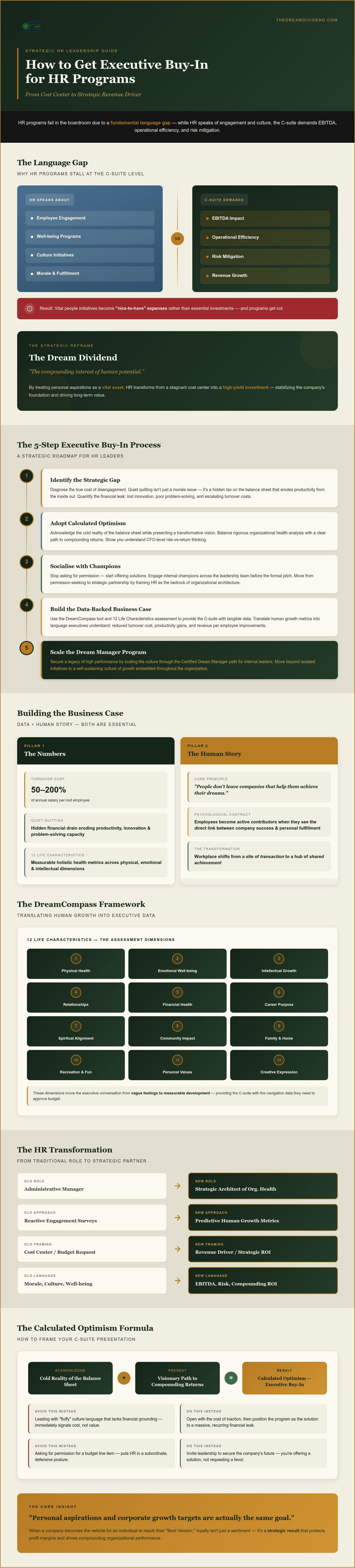
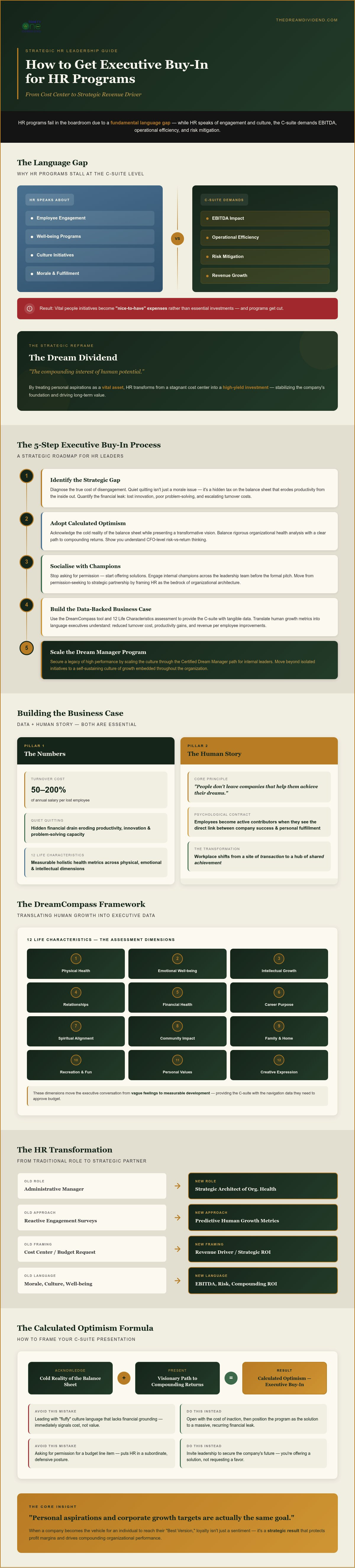
HR programs often stall in the boardroom because of a fundamental linguistic disconnect. It's a failure of translation. While you speak of engagement, well-being, and culture, the C-suite is scanning the horizon for EBITDA, operational efficiency, and risk mitigation. This gap transforms vital people initiatives into "nice-to-have" expenses rather than essential investments. Understanding how to get executive buy-in for HR programs requires a shift from defending costs to presenting a strategic roadmap for growth. You must move beyond being an administrative manager to becoming a strategic architect of organizational health. Traditional engagement surveys often fail to move the C-suite needle because they are reactive, superficial, and disconnected from the bottom line. They capture how people feel today, but they don't predict how those feelings will impact tomorrow's revenue.
The CFO Perspective: Risk vs. Return
To win over the finance department, you must adopt a stance of calculated optimism. This means acknowledging the cold reality of the balance sheet while presenting a visionary path forward. Quiet quitting isn't just a morale issue; it's a hidden tax on your balance sheet that erodes productivity from the inside out. When employees disengage, they stop innovating, they stop solving problems, and they eventually stop staying. You aren't just pitching a culture program; you're pitching a solution to a massive, recurring financial leak. We define the Dream Dividend as the compounding interest of human potential. By treating personal aspirations as a vital asset, you transform a stagnant cost center into a high-yield investment. Your presentation should focus on how this investment stabilizes the foundation of the company and drives long-term value.
From Permission-Seeking to Strategic Partnership
Stop asking for permission and start offering solutions. When you approach the executive suite as a strategic partner, you position HR as the bedrock of organizational architecture. You're not looking for a "yes" to a budget request; you're inviting the leadership team to secure the company's future. Utilizing the Dream Manager Framework allows you to bridge the gap between individual fulfillment and corporate excellence. This methodology provides a structured, pragmatic way to align what your people want with what the business needs. It's about building a culture where personal growth fuels professional performance. By showing how to get executive buy-in for HR programs through this lens, you demonstrate that you understand the high stakes of 2026. You are identifying the strategic gap, socialising the solution with champions, and securing a legacy of high performance.
Aligning Employee Aspirations with Corporate Strategy
While abstract values often fail to inspire, personal dreams provide a tangible target. Executives care about 2026 growth targets, but employees care about their own futures. The secret of how to get executive buy-in for HR programs lies in proving that these two goals are actually the same. When a company becomes the vehicle for an individual to reach their "Best Version," loyalty isn't just a sentiment; it's a strategic result. You aren't just asking for a budget; you're proposing a partnership where personal growth fuels corporate excellence.
The Dream Manager principles operate on a simple but profound truth: people don't leave companies that help them achieve their dreams. This psychological contract creates a powerful counter-force to quiet quitting. Instead of doing the bare minimum, employees become active contributors because they see the direct relationship between the company's success and their personal fulfillment. This alignment transforms the workplace from a site of transaction into a hub of shared achievement.
The 12 Life Characteristics as a Business Metric
We view personal excellence as the fuel for professional high performance. By utilizing the 12 Life Characteristics, you can measure holistic employee health across physical, emotional, and intellectual dimensions. This isn't just about wellness; it's about ensuring your team has the capacity to execute at a high level. You can use the DreamCompass tool to track this progress, providing the C-suite with the navigation data they need to see real human growth. It moves the conversation from vague feelings to measurable development.
Case Study: The Financial Case for Dreams
The numbers tell a compelling story. Data based on Matthew Kelly principles shows that Dream Management has the power to slash turnover by as much as 40% in high-churn environments. Consider the replacement cost tax. Every time a high-performer walks out the door, the company loses between 50% and 200% of their annual salary in lost productivity, recruitment fees, and institutional knowledge. By mapping employee dreams, you aren't just being nice; you're protecting the bottom line. You can explore the Dream Manager ROI to find the hard data required to satisfy even the most skeptical CFO. If you're ready to start building this foundation, Dream Management Consulting can help you architect a strategy that clarifies how to get executive buy-in for HR programs by aligning these aspirations with your corporate mission.
Building the Business Case: Data vs. Human Story
The boardroom demands a synthesis of logic and inspiration. To master how to get executive buy-in for HR programs, you must employ the formula of calculated optimism. This approach combines the cold precision of hard data with the warmth of a transformative vision. If you present only spreadsheets, you risk being ignored as a technician; if you present only a vision, you are dismissed as a dreamer. You must be the strategic architect who builds a bridge between today’s metrics and tomorrow’s potential. By using people analytics to predict the cost of inaction, you illustrate that maintaining the status quo is not a safe choice, but a documented risk to the organization's health.
Effective storytelling acts as your most potent strategic tool. You aren't just sharing anecdotes; you're narrating the "Dream Dividend" and showing how it compounds over time. This narrative balances the sterile corporate requirements for efficiency with the holistic mentorship your people crave. It's about proving that when you invest in the individual, the entire organization reaps the rewards of increased agility, deeper commitment, and sustainable growth. This dual approach ensures your proposal resonates with the analytical mind of the CFO and the visionary spirit of the CEO simultaneously.
Quantitative Metrics: The CFO’s Toolkit
When speaking to finance, focus on the variables that drive the bottom line. You must provide clear visibility into retention rates, recruitment costs, and productivity multipliers. Calculating the dividend of a fully engaged, purpose-driven workforce reveals the hidden revenue currently being lost to disengagement. Presenting Dream Management Consulting as a financial hedge against turnover allows you to frame human potential as a protected asset class. It’s a pragmatic move to stabilize your human capital and ensure that the organization’s most valuable resources don't walk out the door for a slightly higher salary elsewhere.
Qualitative Impact: The CEO’s Vision
For the CEO, the business case should focus on culture transformation and long-term brand reputation. Positioning your company as a "Best Place to Work" isn't about vanity; it’s about becoming a recruiting magnet in a hyper-competitive talent market. The "Best Version of Yourself" framework serves as the foundation for this transformation, offering a clear path for personal and professional evolution. Implementing whole person leadership development demonstrates that the company values the individual beyond their job description. It creates a culture of stability, a magnet for talent, and a foundation for innovation that competitors simply cannot replicate.
The 5-Step Buy-In Process for 2026
Securing a mandate for cultural transformation requires a methodical approach that mirrors a high-stakes product launch. You're not just presenting an idea; you're deploying a strategic asset. To master how to get executive buy-in for HR programs, you must move from a general desire for better culture to a disciplined, five-step execution roadmap. This journey begins with identifying the strategic gap in your current human capital strategy. If your 2026 growth targets require innovation but your team is stuck in survival mode, that's a gap that only a deep, human-centric shift can bridge. Identify the gap, build the coalition, and prove the value.
- Step 1: Identify the Strategic Gap. Audit your current retention and engagement data to find where human potential is being left on the table.
- Step 2: Socialise the Concept. Build a coalition of champions by having one-on-one conversations that focus on their specific departmental pain points.
- Step 3: Develop a Pilot Program. Test the Dream Manager framework in a controlled environment to generate proof of concept.
- Step 4: Present the ROI Model. Take your early data to the finance team and show how the Dream Dividend offsets the cost of turnover.
- Step 5: Launch with Momentum. Use a high-impact keynote to signal that this isn't a temporary initiative, but a permanent cultural shift.
Socialising the Dream
You'll likely encounter traditionalists who believe that personal aspirations have no place in the office. Address the "it's too personal" objection by reframing the conversation. Remind them that an employee's personal life doesn't stay at home; it either fuels their work or drains their energy. Building a coalition of leaders who value purpose-driven performance is essential for long-term success. You can use The Dream Dividend Podcast as a powerful internal education tool to help skeptical executives hear real-world success stories. It shifts the perspective from administrative management to visionary leadership.
The Pilot Program Framework
Don't try to boil the ocean on day one. Start by implementing Dream Manager Consulting in a single department where the impact can be clearly measured. Use the DreamCompass baseline assessment to track where your people are today versus where they aspire to be. This creates a data-rich environment where you can gather testimonials that speak to both personal fulfillment and professional growth. When you can show that a specific team became more productive while simultaneously lowering their stress levels, the path of how to get executive buy-in for HR programs across the entire organization becomes clear. If you're ready to design your own roadmap, contact our team today to begin your strategic architecture session.
Securing the Future: Scaling the Dream Manager Program
Scaling is the final frontier of organizational transformation. It represents the transition from a pilot project to a foundational pillar of your company's architecture. While the initial buy-in gets you through the door, the long-term mandate depends on your ability to embed these principles into the very fabric of the business. You aren't just running a program; you're architecting a culture. When you demonstrate how to get executive buy-in for HR programs at this level, you're offering the C-suite a legacy of sustainable growth. Integrating aspiration-based management into your 2027-2030 strategic plan ensures that human potential remains a top-tier priority. It moves the conversation from "what we are doing this quarter" to "who we are becoming as an organization."
Sustainability is achieved through the rigorous application of the 12 Life Characteristics. These metrics provide a common language for growth that survives leadership changes and market shifts. By making personal excellence a permanent corporate value, you ensure that the momentum generated during the launch phase continues to compound. This is the strategic shift from reactive management to proactive mentorship. It requires a commitment to long-term value over immediate, superficial fixes.
The Certified Dream Manager Path
Internal leadership is your most valuable asset. Training your own team to become Certified Dream Managers is significantly more cost-effective and culturally impactful than relying on external coaches indefinitely. It empowers your managers to act as holistic mentors who truly understand the personal and professional drivers of their teams. This internal capability ensures the philosophy persists and evolves with the company. It transforms the management role from a transactional supervisor to a strategic guide. You can explore the Certified Dream Manager Program to learn how to build this infrastructure within your own walls. This investment creates a ripple effect of engagement that touches every level of the hierarchy.
The Perpetual Dividend
A dream-driven culture eventually becomes a self-sustaining recruitment engine. In the hyper-competitive talent market of 2026, being known as the organization that helps people reach the "Best Version of Yourself" is an unbeatable advantage. It's a perpetual dividend. You'll find that you spend less on recruitment because your reputation does the heavy lifting for you. High-performers are naturally drawn to environments where their personal aspirations are viewed as strategic assets. This is the ultimate answer to how to get executive buy-in for HR programs: show the leadership team a future where the culture itself drives retention and attracts elite talent. If you're ready to ignite this shift, Book a Keynote Speaker on Employee Retention to kickstart the transformation and align your executives around this visionary roadmap.
Architecting a Culture of Compounding Value
The transition from a traditional HR function to a strategic partnership requires a fundamental shift in how you frame the human element of your business. By bridging the language gap and aligning personal aspirations with corporate growth, you secure more than just a budget; you secure a competitive advantage for 2026 and beyond. We've explored the necessity of translating human potential into measurable ROI and the disciplined 5-step process required to move from a pilot program to a scaled, self-sustaining culture. Mastering how to get executive buy-in for HR programs transforms you from a cost-center manager into a strategic architect of organizational health.
Sustainable success isn't found in superficial fixes, but in a commitment to the whole person. Our Certified Dream Manager expertise provides the framework to slash turnover and drive performance through the proven Dream Dividend methodology. If you're ready to move beyond the status quo and build a workplace where personal fulfillment fuels professional excellence, it's time to act. Transform your culture with Dream Management Consulting and begin your journey toward becoming the best version of your organization. Your people are your greatest asset; it's time to invest in their dreams.
Frequently Asked Questions
How do I handle a CFO who only cares about immediate financial metrics?
Speak the language of the balance sheet by framing engagement as a hedge against turnover. A CFO responds to the "Calculated Optimism" formula where human potential is presented as a strategic asset. Use the DreamCompass tool to show the direct correlation between personal growth and productivity. When you quantify the Dream Dividend, you move from requesting a budget to offering a financial solution that protects the organization's long-term health.
What is the most common reason HR programs fail to get buy-in?
The primary disconnect is usually a failure to translate humanistic goals into pragmatic business outcomes. Executives often view HR as a cost center rather than a revenue driver because initiatives are presented in "people language" instead of "business language." Learning how to get executive buy-in for HR programs requires shifting your role to a strategic architect. You must prove that employee fulfillment is the foundation of corporate excellence, not just a peripheral benefit.
How much data is "enough" to present a new people initiative?
You need enough data to prove the cost of inaction alongside a baseline of current organizational health. Utilize the DreamCompass tool to gather initial metrics on employee aspirations and engagement levels. Combine this with specific turnover costs and recruitment fees to build a rigorous business case. While data is essential, it must be balanced with a transformative vision that illustrates the compounding returns of a fully aligned, high-performance workforce.
Can a "Dream Manager" program work in a highly technical or sterile industry?
High-performance culture is universal, regardless of the industry's technical nature. In sterile or high-pressure environments, the 12 Life Characteristics provide a structured framework to prevent burnout and maintain operational efficiency. Technical teams often find the logic-based approach of the Dream Manager framework refreshing because it offers a pragmatic roadmap for personal and professional development. It humanizes the workplace without sacrificing the rigorous standards required in your specific field.
How do I align personal employee dreams with corporate KPIs?
Alignment happens when the company becomes the vehicle for the employee to reach their "Best Version." When you help an individual achieve a personal goal, their loyalty and productivity naturally increase as a byproduct. This psychological contract ensures that as the employee succeeds, the company’s KPIs are met through increased innovation and commitment. It’s about creating a culture where personal growth and corporate excellence are inextricably linked.
What happens if an executive thinks the program is "too personal" for the workplace?
Address this by explaining that an employee’s personal life doesn’t stay at the door; it either fuels their performance or drains it. Reframing the workplace as a site of holistic mentorship allows you to support the individual while protecting the organization’s productivity. Understanding how to get executive buy-in for HR programs involves demonstrating that personal growth is the fuel for professional success. It's a strategic investment in the company’s most valuable asset.
How long does it typically take to see an ROI from a Dream Manager initiative?
Tangible shifts in retention and engagement metrics are typically visible within six to twelve months of implementation. While cultural transformation is a long-term play, early wins often appear in reduced absenteeism and improved team morale. The Dream Dividend compounds over time as more employees utilize the DreamCompass and move toward their goals. Consistency is the key to ensuring these initial results evolve into a permanent, self-sustaining high-performance culture.
Is it better to hire an external consultant or train internal Dream Managers?
Internal certification is the superior path for long-term sustainability and cultural integration. While external consultants can provide an initial spark, a Certified Dream Manager within your organization understands the unique nuances of your architecture. Training internal leaders empowers them to act as compassionate guides for their own teams, creating a ripple effect of engagement. This approach is more cost-effective and ensures the philosophy remains a permanent part of your corporate identity.