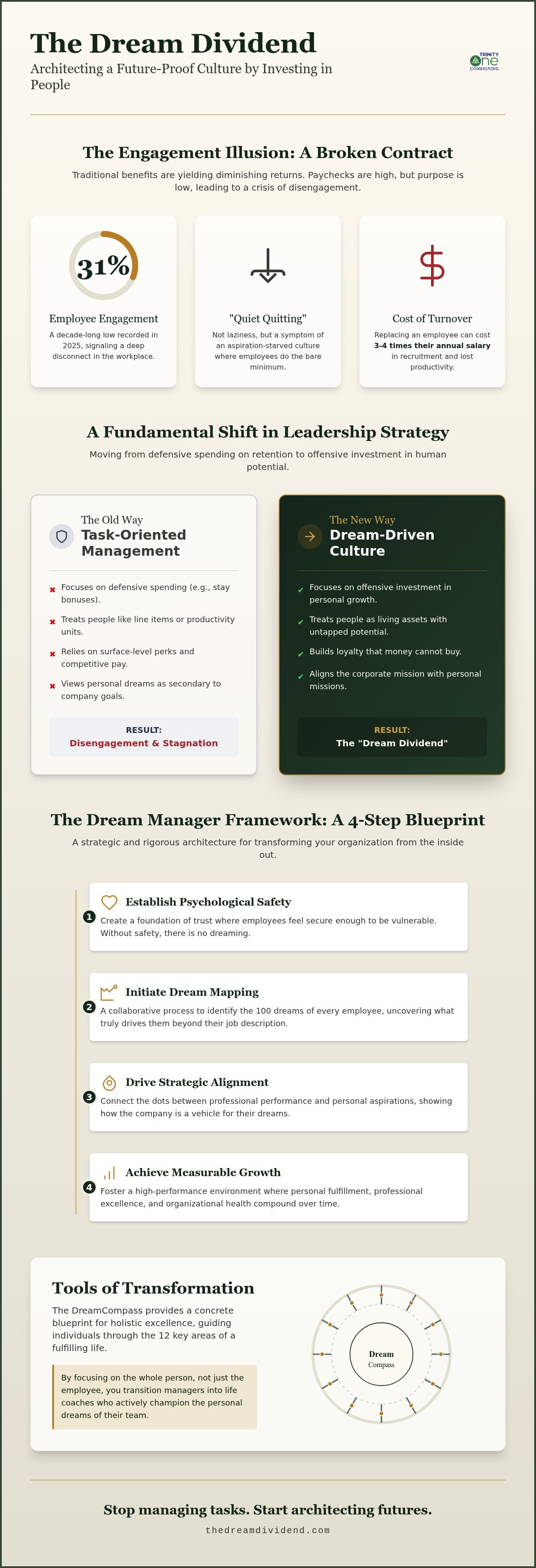
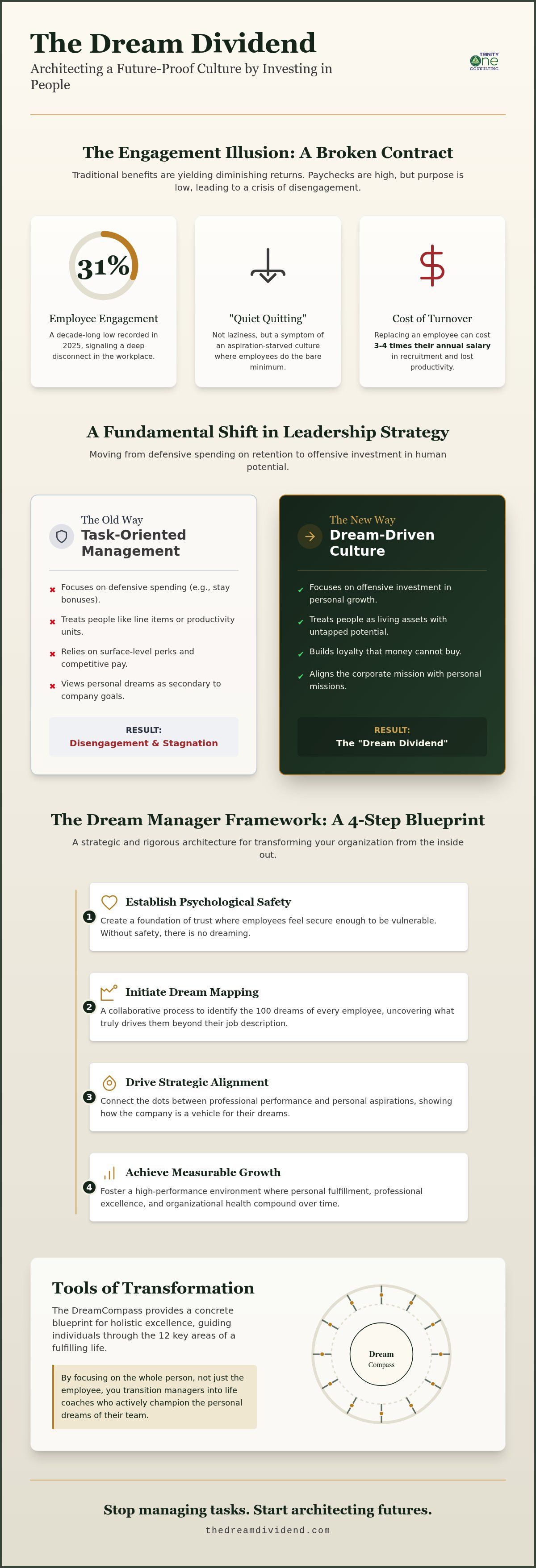
Why are your most talented people walking out the door when their paychecks have never been higher? With U.S. employee engagement hitting a decade-long low of 31 percent in 2025, it's clear that the traditional contract between employer and employee is fractured. You've likely felt the sterile coldness of management styles that treat people like line items rather than living assets. It's time to stop managing tasks and start architecting futures. Understanding how to build a dream-driven culture is no longer a soft-skill luxury; it's a strategic imperative for any leader who wants to see their organizational health compound over time.
You know that competitive pay is just the baseline for retention. You want a team that shows up with purpose, passion, and a sense of legacy. If you invest in their personal growth, they'll invest in your corporate vision. This article promises to reveal how you can transform organizational engagement by leveraging the Dream Manager framework to support your people's personal aspirations. We'll examine the 12 Life Characteristics that drive holistic success, the tangible ROI of human-centric leadership, and the specific steps you can take to foster a culture where everyone thrives.
Key Takeaways
- Understand why traditional benefits are yielding diminishing returns and how to bridge the gap between surface-level perks and deep-seated employee purpose.
- Master the strategic roadmap on how to build a dream-driven culture by prioritizing psychological safety as the foundation for individual and organizational growth.
- Utilize the DreamCompass and the 12 Life Characteristics to provide a concrete blueprint for your team's holistic excellence and personal fulfillment.
- Transition your leadership team from task-oriented managers to life coaches who actively champion the personal dreams of their employees.
- Discover how to scale your cultural transformation and secure a tangible "dream dividend" through the Certified Dream Manager program.
Table of Contents
The Engagement Illusion: Why Traditional Culture Strategies Fail
Many leaders believe they've solved the retention puzzle with competitive salaries and flexible hours. This is the "Engagement Illusion." It's the gap between surface-level perks and deep-seated purpose. While a polished office or a remote work policy might attract talent, it won't keep them. In 2026, the traditional levers of management are losing their grip. Pay and benefits are now entry stakes, not differentiators. If you want to understand how to build a dream-driven culture, you must first recognize that people aren't looking for a job; they're looking for a life. They want an environment where their professional efforts fuel their personal aspirations.
Quiet quitting isn't a sign of laziness. It's a symptom of an aspiration-starved workplace. When employees feel their personal dreams are secondary to the company's quarterly goals, they disengage. They do the bare minimum. They wait for a better offer. This lack of alignment creates a vacuum where Organizational culture becomes a hollow shell of corporate buzzwords. To fix this, we must shift our focus to the "Dream Dividend." This is the strategic return realized when an organization invests in the personal potential of its people. It's the compounding interest of human fulfillment, where personal growth, professional excellence, and organizational health thrive together.
The ROI of Aspiration vs. Traditional Retention
The math of turnover is brutal. Replacing a single employee can cost three to four times their annual salary when you factor in recruitment, training, and lost momentum. Traditional retention strategies focus on defensive spending, such as matching salary offers or adding "stay bonuses." In contrast, dream-driven development is an offensive investment. When you help an employee achieve a personal goal, you build a bond of loyalty that money cannot buy. This isn't just theory. You can explore the data in our guide on Dream Manager ROI: The Strategic Financial Case. Personal growth initiatives don't just reduce turnover; they accelerate performance and drive long-term value.
Quiet Quitting Solutions for Managers in 2026
High-pressure productivity hacks won't solve disengagement. In fact, demanding "more work" often accelerates the exit. The modern manager must evolve from a taskmaster into a mentor. This requires a psychological shift from viewing employees as productivity units to seeing them as individuals on a journey of becoming the best version of themselves. Learning how to build a dream-driven culture requires you to ask a different set of questions. Instead of asking how this person can do more for the company, ask how this company can help this person achieve their dreams. When the corporate mission fuels the personal mission, engagement isn't just high; it's unstoppable. It's about creating a culture of investment, growth, and mutual success.
The Dream Manager Framework: A Step-by-Step Architecture
Matthew Kelly’s "The Dream Manager" isn't a collection of soft-hearted suggestions. It's a rigorous, strategic blueprint for organizational health. The core philosophy is simple yet transformative: your organization’s potential is capped by the potential of your people. If your employees are disengaged, your company is stagnant. By investing in employees dreams, you create a symbiotic relationship where personal achievement fuels professional excellence. This framework is the architecture of that relationship. It requires a methodical approach to transform a sterile workplace into a high-performance environment.
The roadmap for this transformation follows a logical sequence. It starts with trust, moves toward discovery, and ends in measurable growth. To master how to build a dream-driven culture, leaders must commit to these four foundational steps:
- Establishing Psychological Safety: This is the bedrock. Employees must feel secure enough to be vulnerable. Without trust, there is no dreaming.
- Dream Mapping: This involves identifying the 100 dreams of every employee. It's about uncovering what truly drives the individual beyond their job description.
- Strategic Alignment: Here, the manager connects the dots. They show how professional performance provides the resources and discipline to achieve personal milestones.
- Accountability: The organization provides the structure. It offers the tools, the time, and the mentorship required for the individual to pursue their aspirations.
Facilitating Comprehensive Dream Mapping
The "100 Dreams" exercise is the engine of this framework. It pushes people beyond professional milestones into the 12 Life Characteristics, covering everything from financial stability to legacy. Understanding how to build a dream-driven culture begins with this deep dive. You might encounter "unrealistic" dreams, like an employee wanting to travel to space. Don't dismiss them. A dream of space travel is often a desire for adventure or discovery. Map the underlying value to a manageable step, such as a skydiving trip or a specialized course. This process creates a holistic roadmap for growth. If you're ready to start this journey, consider exploring Dream Management Consulting to guide your leadership team through the mapping process.
Bridging Dreams to Professional Performance
A dream-driven culture requires a new kind of performance review. Instead of just reviewing KPIs, discuss the progress of personal milestones. The manager becomes a catalyst, a guide, and a strategic partner in the employee's life. When people see their job as the vehicle for their personal success, they don't just work. They perform with purpose. For a deeper dive into these tactics, read The Dream Manager Framework: A Strategic Guide. This alignment ensures that as the individual grows, the organization thrives.
Tools of Transformation: DreamCompass and the 12 Life Characteristics
Transitioning from philosophical theory to practical application requires more than just good intentions. It requires a precise set of instruments. If you are serious about how to build a dream-driven culture, you must have a way to measure the intangible. Culture often feels like a vague, shifting concept that is difficult to pin down. However, with the right tools, it becomes a measurable asset that yields a predictable return. The DreamCompass and the 12 Life Characteristics provide the navigation and the destination for your organizational transformation. These aren't just HR checklists. They are strategic assets that help you track the compounding growth of your people.
Mastering the 12 Life Characteristics
The 12 Life Characteristics serve as a comprehensive blueprint for human excellence. They provide a structured way to look at the whole person, covering essential domains such as Physical, Financial, Intellectual, and Emotional health. They also delve into Spiritual, Psychological, Creative, and Professional growth, alongside Adventure, Legacy, Character, and Social well-being. By breaking down human potential into these specific categories, managers can move beyond generic encouragement. They can identify exactly where an employee feels stuck. Is a lack of financial stability causing stress that bleeds into their work? Does a lack of creative outlet lead to burnout? When you address these specific areas, you empower employees to become the best version of themselves. This holistic approach identifies cultural gaps that traditional engagement surveys often miss. It turns the workplace into a laboratory for personal and professional flourishing.
Implementing the DreamCompass Tool
The DreamCompass Tool is the primary instrument for tracking these aspirations within a professional setting. It serves as a visual roadmap for the individual and a strategic dashboard for the manager. For this tool to be effective, it must be integrated into the rhythm of the business. Managers should use the DreamCompass during regular 1-on-1 sessions to facilitate structured conversations about personal progress. This moves the dialogue from a narrow focus on task completion to a broader discussion of life trajectory. It changes the fundamental question from "What did you do for the company today?" to "How are you progressing toward your own goals?"
This shift in focus is the primary engine of the Dream Dividend. By visualizing the progress of personal dreams, managers can see the direct correlation between an employee's personal wins and their professional output. Integrating this tool into the Best Version of Yourself Framework ensures that your culture transformation is sustainable, scalable, and deeply human. It provides the data needed to prove that engagement initiatives aren't just "nice to have" perks. They are high-stakes investments in the future of the organization.
Scaling the Culture: The Manager as Life Coach
Leadership in 2026 has moved beyond the era of the taskmaster. To scale a truly resilient organization, you must empower your mid-level leaders to become strategic architects of human potential. This is the ultimate evolution of leadership: moving from a manager who monitors output to a mentor who cultivates growth. When your managers understand how to build a dream-driven culture, they stop managing spreadsheets and start mentoring people. This shift requires training, patience, and a fundamental belief that an employee’s personal success is the fuel for organizational excellence. You aren't just overseeing a workforce; you're guiding a community toward its highest potential.
The most common objection we hear from executives is a fear of loss: "What if I help them follow their dream and they leave?" This perspective is a scarcity mindset that ignores the high cost of stagnation. If you don't invest in your people, they stay disengaged, underperform, and eventually leave anyway. If you do invest in them, they become more capable, more loyal, and more productive during their tenure. You aren't just training them for their next role; you're building a legacy of excellence that attracts the next wave of top talent. This creates a cycle of high-performance that far outweighs the risk of individual departures.
Whole Person Leadership Development
Modern management demands a "whole person" approach. This means recognizing that an individual's physical energy, emotional health, and intellectual curiosity are vital business assets that require regular investment. When managers transition from evaluation to mentorship, team cohesion skyrockets. This approach builds a culture of mutual investment where the team’s success is inextricably linked to the individual’s growth. It turns a group of employees into a unified force committed to collective achievement and personal excellence. By learning how to build a dream-driven culture, your leaders become the primary drivers of this holistic development.
Overcoming Common Implementation Challenges
Implementation often hits two primary roadblocks: time constraints and employee skepticism. Managers often claim they don't have time for "dream conversations," yet these dialogues save time by reducing the friction of disengagement and turnover. Skepticism is also a natural reaction. If employees aren't used to corporate interest in their personal lives, they may be guarded. Consistency is the cure. When the leadership team demonstrates a genuine commitment to the 12 Life Characteristics across all departments, trust begins to compound. If you want to equip your leaders with the skills to bridge this gap, explore our Certified Dream Manager training options to ensure your culture transformation is built on a solid foundation.
Securing the Dividend: Certification and Consulting
Achieving a momentary spike in engagement is easy, but sustaining it is a matter of strategic architecture. If you want to know how to build a dream-driven culture that survives leadership changes and economic shifts, you must move from inspiration to institutionalization. This is where many organizations falter. They read the book, they host a single workshop, and they expect the culture to transform overnight. True transformation requires a certified internal advocate who can navigate the nuances of human aspiration with professional precision. By investing in the Certified Dream Manager Program, you aren't just buying a training course; you're installing a permanent engine for organizational growth.
Dream Management Consulting provides the initial momentum required to break through years of corporate inertia. It offers the external perspective needed to identify the friction points in your current management style. This partnership allows you to secure the "Dream Dividend," which is the compounding return on engagement, retention, and performance. Over time, this dividend manifests as a workforce that is more resilient, more innovative, and more committed to the collective mission. You stop fighting the talent wars and start winning them by default because your reputation as a dream-driven employer becomes your greatest recruiting asset.
Why Certification Matters for Organizational Scale
There is a profound difference between reading about a philosophy and running a program with clinical accuracy. For mid-size companies, certification provides the necessary standardization to ensure that every department, from accounting to sales, experiences the same level of investment. A certified Dream Manager becomes a beacon for top talent. They signal to the market that your company is a place where personal excellence is the standard, not the exception. This internal expertise allows you to scale the culture without diluting the underlying philosophy, ensuring that the human-centric focus remains sharp as the company grows.
Next Steps: Auditing Your Current Culture
The journey toward a dream-driven future begins with a simple, challenging question: Do you actually know what your people want? Most leaders know their employees' professional goals, but they're blind to their personal aspirations. To bridge this gap, consider these immediate steps:
- Conduct an Aspiration Audit: Use anonymous surveys or structured 1-on-1s to gauge the level of personal fulfillment within your teams.
- Leverage Professional Insights: Utilize Keynote Speaking events to launch your culture shift and align your leadership team around a shared vision.
- Stay Informed: Subscribe to The Dream Dividend Podcast to hear real-world stories of how other leaders are mastering how to build a dream-driven culture.
Your people are your most valuable asset, but their potential is only unlocked when their personal dreams are aligned with their professional reality. Start building that alignment today. The return on this investment isn't just a better workplace; it's a better life for everyone involved.
Architecting the Future of Organizational Excellence
The bridge between competitive survival and true organizational flourishing is built on the personal aspirations of your people. You've seen why traditional perks fail and how a structured framework like the 12 Life Characteristics provides a concrete roadmap for holistic growth. Mastering how to build a dream-driven culture is about moving beyond surface-level engagement to create a workplace where personal and professional success are inextricably linked. This isn't a temporary fix; it's a long-term investment in your most vital strategic asset.
The path forward requires a fundamental shift in leadership, a commitment to standardized certification, and a relentless focus on the whole person. Our methodology is rooted in Matthew Kelly's proven framework and led by Certified Dream Manager expertise to ensure your transformation is both deep and durable. Transform your culture today with Dream Management Consulting. It's time to stop managing tasks and start investing in the dreams that fuel your company's compounding success. Your people are waiting for a leader who sees their potential. Be the architect of that vision and watch your organization thrive.
Frequently Asked Questions
What exactly is a dream-driven culture?
It's an organizational environment where the company's mission is fueled by the personal aspirations of its employees. Instead of viewing workers as mere productivity units, the business actively invests in their holistic growth. This alignment creates a powerful dream dividend where individual fulfillment drives corporate performance. Understanding how to build a dream-driven culture requires moving beyond surface-level perks toward a deep-seated sense of purpose and mutual investment.
Is dream management too personal for the workplace?
No, because personal fulfillment and professional performance are inextricably linked. If an employee is struggling with financial stress or health issues, their work inevitably suffers. Dream management creates a safe space to address these areas through the 12 Life Characteristics. It isn't about prying into private lives; it's about providing the tools and mentorship that help individuals become the best version of themselves within a supportive professional framework.
How do I measure the ROI of a dream-driven culture?
You measure ROI through tangible metrics like reduced turnover rates, higher engagement scores, and increased productivity. When you factor in that replacing an employee can cost three to four times their annual salary, the savings from retention alone are significant. Additionally, companies utilizing this framework often see improved team cohesion and a stronger employer brand. These factors contribute to a compounding return on your human capital investment over the long term.
What happens if an employee's dream is to leave the company?
This is a common fear, but the reality is that people leave disengaged workplaces far more often than supportive ones. If an employee's dream involves a different career path, helping them achieve it builds immense goodwill and legacy. They'll be highly productive during their tenure and become a powerful brand ambassador afterward. It's better to have a motivated person for two years than a disengaged one for five.
How long does it take to implement a Dream Manager program?
Initial implementation typically begins with a two-day certification or keynote event, followed by twelve months of ongoing coaching and integration. While you'll see an immediate shift in team energy, building a sustainable culture is a long-term architectural project. It takes consistent effort over several months to fully integrate tools like the DreamCompass into your standard operating procedures. Culture transformation is a marathon that requires steady, intentional leadership.
Can small or mid-size companies afford dream management consulting?
Yes, because the program is designed to scale based on organization size. Small and mid-size companies often see the fastest results because they have less corporate inertia to overcome. The investment is relative to the dream dividend you expect to receive. By reducing the high costs associated with disengagement and turnover, the program often pays for itself through improved operational efficiency and higher talent retention rates.
Does every manager need to be a Certified Dream Manager?
While not every supervisor needs certification, having at least one internal Certified Dream Manager is vital for scaling the culture effectively. This person acts as the strategic architect and advocate for the program within the company. They ensure the methodology remains consistent across all departments. Other managers can be trained in whole person leadership without undergoing the full certification process, provided they have a certified mentor to guide them.
What is the DreamCompass tool?
The DreamCompass is a strategic instrument used to track and visualize an individual's progress across the 12 Life Characteristics. It moves aspiration mapping from a vague conversation to a structured, measurable roadmap for excellence. Managers use this tool during 1-on-1 sessions to bridge the gap between personal goals and professional performance. It provides the data needed to show how to build a dream-driven culture that delivers consistent results for both the individual and the organization.