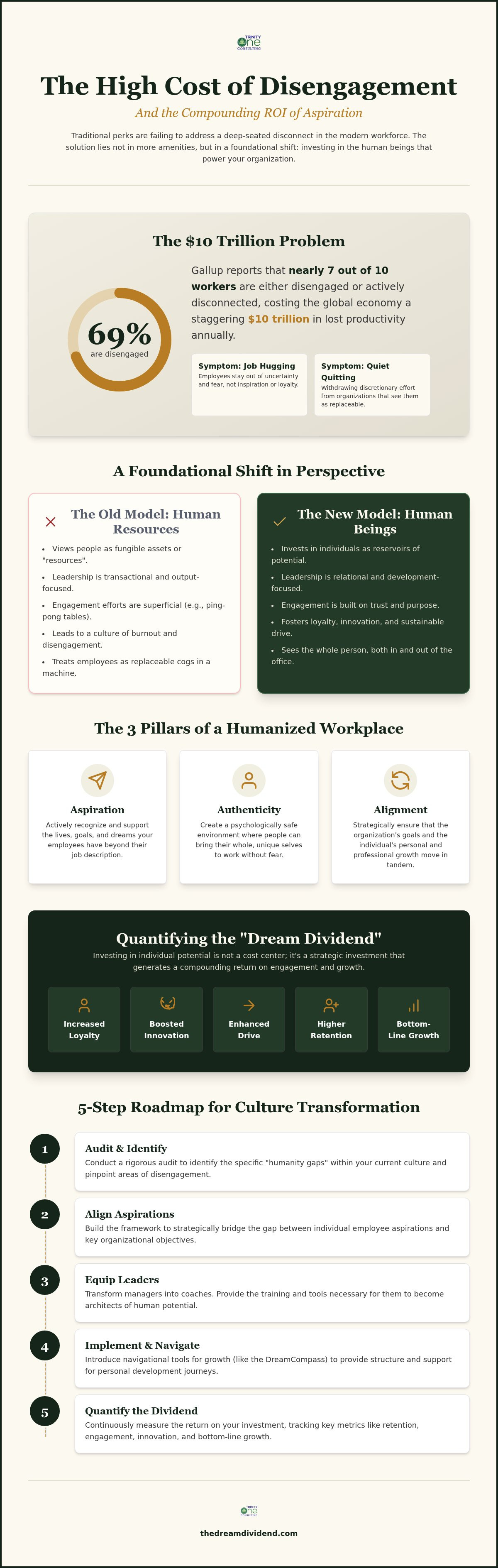
What if the most significant asset on your balance sheet isn't the proprietary technology you've scaled, but the dormant dreams of the people currently sitting in your meetings? With 69% of the global workforce currently disengaged or actively disconnected, the cost of lost productivity has reached a staggering $10 trillion annually. You likely recognize the symptoms of "job hugging" in your own halls, where employees stay out of uncertainty rather than inspiration. The traditional approach of humanizing the workplace through superficial perks like ping-pong tables has failed to stop the bleed of talent to more purpose-driven competitors.
If you're tired of culture initiatives that feel like expensive window dressing, you're in the right place. We believe that when you invest in the individual's journey toward becoming the best version of themselves, the organization receives a compounding dividend of loyalty, innovation, and drive. This guide outlines a pragmatic strategy to align personal aspirations with professional performance. We will explore a concrete framework for cultural transformation, introduce the DreamCompass as a navigational tool for growth, and demonstrate how to build a workplace where employees are self-motivated by their own unfolding potential.
Key Takeaways
- Shift your perspective from managing "Human Resources" to investing in "Human Beings" to build a foundation of genuine trust and performance.
- Explore how neuroinclusion and the "Manager as Life Coach" philosophy provide the structural support needed for a modern, cognitively diverse workforce.
- Discover the strategic advantage of humanizing the workplace by using the Dream Manager framework to bridge the gap between employee aspirations and organizational excellence.
- Quantify the "Dream Dividend" to understand how investing in individual potential creates a compounding return on retention and bottom-line growth.
- Follow a five-step architectural roadmap for culture transformation, beginning with a rigorous audit to identify and close your organization's humanity gaps.
Table of Contents
What Does Humanizing the Workplace Mean in 2026?
The sterile corporate model of the early 2000s has reached its expiration date. In 2026, humanizing the workplace is no longer a soft HR initiative. It's a foundational business strategy. We've moved past the era where a company was viewed as a collection of functions or a machine designed for maximum extraction. Today, high-performance organizations operate as communities of people. They've traded the outdated concept of "Human Resources," which implies people are raw materials to be used up, for the "Human Being" model. This approach views each individual as a reservoir of untapped potential waiting for the right investment.
This transformation is built upon three strategic pillars. First is Aspiration, which involves recognizing that employees have lives and dreams beyond the office walls. Second is Authenticity, which means creating a space where people can bring their whole selves to work without fear of judgment. Third is Alignment, which ensures the company's goals and the individual's growth move in the same direction. When these pillars are solid, the organization doesn't just function. It thrives.
Beyond the Slack Profile: Seeing the Whole Person
Relational leadership is the new standard. In a digital-first world, your team members are often reduced to a Slack profile or a line item in a performance review. This transactional approach is a recipe for talent loss. Employees have a deep psychological need to be seen, heard, and valued as whole individuals. If you only interact with them when a task is due, you're missing the human element that drives extraordinary effort. You must transition from a manager who tracks output to a leader who understands the person behind the screen.
The 2026 Engagement Crisis: Why Surface Fixes Fail
The data is clear. Gallup reports that 69% of workers are currently disengaged, costing the global economy $10 trillion in lost productivity. This isn't just a morale problem. It's a massive financial drain. Many leaders try to bridge this gap with superficial perks like catered lunches or mandatory diversity training, but these often fail because they don't address the structural "humanity gap." The rise of "quiet quitting" suggests that people are withdrawing their hearts from organizations that treat them as replaceable parts.
True inclusion and engagement come from a culture of continuous growth. Much like the Kaizen philosophy of continuous improvement, humanizing the workplace requires a commitment to steady, incremental progress in how we value people. A humanized culture isn't built with a ping-pong table. It's built by investing in the individual's journey toward becoming the best version of themselves.
The Strategic Trends Driving Workplace Transformation
Modern leadership is undergoing a structural renovation. We're moving beyond the era of performance-based management where individuals are judged solely by their quarterly output. In its place, aspiration-based management is emerging as the superior model for 2026. This shift recognizes that when you fuel an employee's personal dreams, you ignite a level of professional commitment that no salary increase can match. By humanizing the workplace through this lens, organizations transform from stagnant hierarchies into dynamic ecosystems of growth. This evolution requires a new set of tools, a fresh perspective on cognitive diversity, and a deep commitment to the "Whole Person" development trend.
Manager as Life Coach: The New Leadership Standard
The traditional manager is becoming an architect of human potential. The Certified Dream Manager Program is central to this evolution, equipping leaders with the coaching skills necessary to facilitate holistic growth. Leaders are no longer just checking off task lists. They're navigating the complexities of their team members' lives and helping them clear the path toward their future. Whole Person Leadership is the strategic balance of professional output and personal fulfillment that ensures sustainable organizational health. If you want to see how this philosophy scales, you might explore our Dream Management Consulting services for your leadership team.
Neurodiversity and the Culture of Contribution
As AI continues to automate technical functions, the value of unique human cognitive styles is skyrocketing. Neuroinclusion isn't just about accommodations; it's about leveraging the creativity, empathy, and intuition that machines simply cannot replicate. High-performance teams create relational space for deep dialogue about purpose and contribution. This organizational culture transformation allows diverse thinkers to feel secure in their unique contributions, turning cognitive diversity into a competitive advantage. When we prioritize the human element, we integrate physical vitality, emotional resilience, and intellectual curiosity into a single, high-performing asset.
Success in this new era depends on how well you align individual well-being with collective objectives. If an employee feels their physical and emotional health is a priority for the company, their loyalty becomes a compounding asset. We're seeing a move toward "human-centric powerhouses" where the workplace serves as a platform for people to become the best versions of themselves. This isn't just good ethics. It's a pragmatic business strategy that delivers a tangible return on aspiration.
The Dream Dividend: Calculating the ROI of Aspiration
Aspiration is the most undervalued asset in the modern enterprise. While traditional consulting focuses on optimizing processes, humanizing the workplace requires us to optimize for the human spirit. This is where we find the Dream Dividend. It's the tangible, financial return an organization receives when it stops treating employees as fixed costs and starts treating their personal dreams as strategic investments. When you align an individual's private hopes with their professional responsibilities, you create a compounding effect of loyalty, energy, and innovation that no salary increase can replicate.
Many leaders hesitate here. They ask a common, fear-based question: "If I help them achieve their dreams, won't they leave?" The reality is that the opposite occurs. When an employee realizes they don't have to leave your company to live the life they want, they stay. They don't just stay; they engage. They don't just engage; they excel. The fear of attrition is a phantom of the old management style. In the new economy, the greatest risk isn't that people will leave once they're empowered. The risk is that they'll stay while they're disengaged, draining your resources and stagnating your culture.
Dreams as the New Currency of Engagement
Personal fulfillment is the fuel for professional performance. If an employee is struggling with a personal goal, whether it's buying a first home, running a marathon, or mastering a new language, that stress follows them into the office. By implementing the Dream Manager framework, you provide the structural support they need to succeed in all areas of life. This direct investment in the person leads to a massive dream manager ROI that manifests in slashed recruitment costs and higher productivity. It's much more cost-effective to reinvigorate an existing team member than it is to source, hire, and train a replacement in a volatile labor market.
The 12 Life Characteristics: A Blueprint for Excellence
To scale this transformation, we must move beyond vague "wellness" initiatives. We use the 12 Life Characteristics as a navigational tool to assess holistic health across the organization. This framework allows leaders to identify specific "humanity gaps" in their teams. A physically vibrant, emotionally resilient, and intellectually curious employee is naturally a high-performer. When you integrate these characteristics into your corporate DNA, you aren't just humanizing the workplace. You're building a "Best Version of Yourself" culture that attracts top-tier talent and drives long-term value. This is the architecture of a high-performance culture: it's built on the foundation of individual excellence.
- Reduced turnover as employees find purpose within the organization.
- Increased discretionary effort driven by personal gratitude and growth.
- A magnetic employer brand that attracts "purpose-driven" competitors' talent.
How to Implement a Humanized Framework in 5 Steps
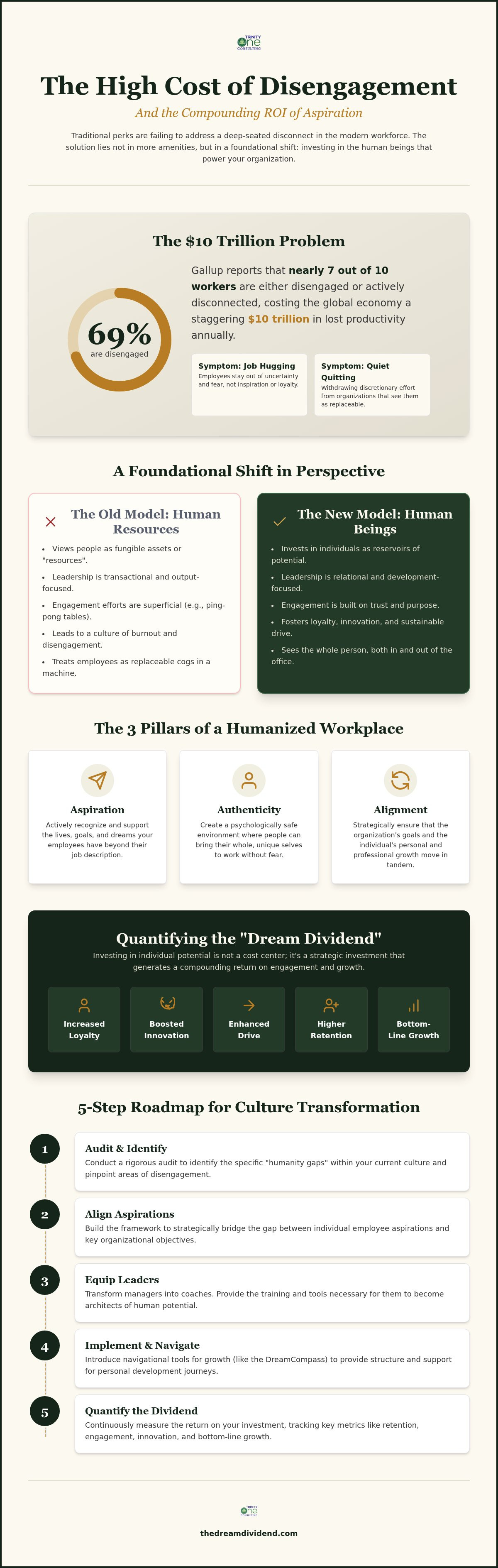
Transforming a sterile corporate structure into a human-centric powerhouse requires more than good intentions. It demands a rigorous, architectural approach to culture. You can't just wish for engagement; you must build the infrastructure that makes it inevitable. By humanizing the workplace through a structured framework, you move from the abstract "culture" talk to a measurable strategy that drives high performance. This process is about alignment, investment, and compounding returns on human potential. Follow these five steps to begin your organization's transformation.
- Step 1: Conduct a Culture Audit. You must first identify your "humanity gaps." Use data-driven surveys and deep-dive interviews to discover where the organization is failing to see the person behind the function.
- Step 2: Train Your Leaders. Leadership is the catalyst for change. Equip your management team with the Dream Manager Framework to shift their focus from mere task oversight to holistic coaching.
- Step 3: Deploy the DreamCompass Tool. Provide every employee with a navigational tool for their own growth. This helps them map out their personal aspirations and see how their professional role supports those dreams.
- Step 4: Align Individual and Organizational Missions. Find the intersection between what the company needs and what the individual wants. When these two forces move in the same direction, you achieve peak productivity.
- Step 5: Measure and Celebrate. Track the "Dream Dividend." Look for lower turnover, higher engagement, and increased innovation. Celebrate the personal wins of your team as if they were corporate milestones.
Using the DreamCompass Tool for Alignment
The DreamCompass isn't a tracking device for management. It's a navigational asset for the employee. It allows individuals to visualize their personal goals, track their progress, and identify the resources they need to succeed. The manager's role is to act as a supportive architect, helping the employee clear obstacles without intruding on their privacy. This creates a culture of mutual accountability where both parties are invested in the employee's holistic success. If you're ready to start this journey, you can book a consultation with our Dream Management team to see how these tools fit your specific needs.
From Performance Reviews to Dream Conversations
The traditional performance review is often a post-mortem on past failures. To truly succeed in humanizing the workplace, you must replace these sterile sessions with forward-looking Dream Conversations. Restructure your 1-on-1 meetings to focus on the human, not just the spreadsheet. Use prompts like, "What is one personal goal you're working toward this year?" or "How can your current role better support your life outside of work?" While some may initially resist this vulnerability, leading with authenticity breaks down barriers. It's about building a relationship that values personal excellence as much as professional output.
Leading the Best Version of Your Organization
Leadership is ultimately an architectural challenge. Building a high-performance culture isn't a quick fix or a temporary morale boost. It's a long-term strategic play that requires patience, vision, and a deep commitment to the person over the process. When you prioritize humanizing the workplace, you aren't just checking a box for employee engagement. You're building a "Magnet Brand" that naturally attracts the industry's most talented, purpose-driven individuals. This is how you secure your legacy. You're building an organization that doesn't just produce results; it changes lives.
Scaling this vision across a complex organization requires a structured approach. This is where Dream Management Consulting serves as a critical strategic partner. We help you bridge the gap between high-level philosophy and daily operational excellence. By integrating the Dream Manager framework into your existing systems, you create a compounding return on every human interaction. You transition from a culture of extraction to a culture of investment. In the final analysis, humanizing the workplace is about creating a foundation where personal growth and professional excellence are inseparable.
The Role of Visionary Keynotes in Sparking Change
Executive teams are often the hardest to shift because they're rightfully focused on the bottom line. However, a visionary keynote can act as the spark that ignites a new perspective. It challenges leaders to see employee dreams as the ultimate driver of financial ROI. To maintain this momentum after the initial spark, The Dream Dividend Podcast offers a continuous stream of strategic insights. It helps your team stay aligned, inspired, and focused on the long-term value of human-centric leadership. Taking the first step toward a purpose-driven culture starts with a message that resonates at the highest levels of management.
Your Invitation to Transformation
The journey from a sterile corporate structure to a humanized powerhouse is the most important transition a leader can make. It's a bold move. It's a challenging path. But the rewards are unparalleled. A dream-driven culture is a competitive moat that no rival can easily cross. When your people are self-motivated by their own growth, your organization becomes unstoppable. We invite you to lead the best version of your organization. Whether you're seeking Dream Management Consulting to transform your entire enterprise or looking to become a Certified Dream Manager, the opportunity to redefine your culture is here. The future of your legacy starts with a single, human-centric decision.
Your Roadmap to a Human-Centric Legacy
The transition from a sterile corporate structure to a high-performance powerhouse is not a matter of luck. It is a matter of intentional design. By humanizing the workplace, you move beyond the limitations of traditional management to unlock a compounding return on human potential. We've explored how shifting from value extraction to potential investment creates a magnetic brand that attracts the industry's best talent. This transformation requires a commitment to seeing the whole person, utilizing tools like the DreamCompass for alignment, and capturing the tangible Dream Dividend that follows.
Founded by Kevin Patrick, a Certified Dream Manager, our approach is rooted in the proven principles of Matthew Kelly’s "The Dream Manager." We provide the strategic frameworks necessary to bridge the gap between individual aspiration and organizational ROI. If you're ready to lead the best version of your organization, the path is clear. Unlock your organization’s potential with Dream Management Consulting and start building a legacy that truly changes lives. Your people are waiting for a leader who believes in their future as much as their output. It's time to build something extraordinary together.
Frequently Asked Questions
What does "humanizing the workplace" actually mean in a business context?
It means treating the organization as a community of people rather than a collection of functions. In a pragmatic business sense, humanizing the workplace involves aligning individual aspirations with organizational goals to drive engagement. It's the shift from extracting value as "Human Resources" to investing in potential as "Human Beings." This approach creates a culture where employees feel seen, heard, and valued, which directly correlates to higher productivity and innovation.
Is humanizing the workplace the same as being "soft" on performance?
Absolutely not. In fact, it's a high-performance strategy that demands more accountability, not less. When you focus on humanizing the workplace, you're building a foundation of trust, candor, and excellence. By helping employees achieve their personal dreams, you create a reciprocal relationship where they're self-motivated to deliver their best work. It’s about achieving professional excellence by fostering personal fulfillment, ensuring that the standards for both remain exceptionally high.
How can a Dream Manager help with employee retention?
A Dream Manager acts as a strategic architect for your team’s personal and professional growth. By helping employees identify and achieve their personal dreams, the Dream Manager creates a deep bond of loyalty between the individual and the organization. Retention improves because employees no longer feel they have to leave the company to live the life they want. This framework slashes recruitment costs by turning your workplace into a destination for top talent.
What is the DreamCompass tool and how does it work?
The DreamCompass is a navigational tool designed to help employees visualize, track, and achieve their life goals. It works by breaking down personal aspirations into actionable steps across various life dimensions. In the workplace, it provides a structured way for managers to support their team's growth without being intrusive. By using this tool, employees gain clarity on their direction, while the organization benefits from a more focused, energized, and purpose-driven workforce.
Can humanizing the workplace help solve "quiet quitting"?
Yes, because "quiet quitting" is often a symptom of chronic disengagement and a lack of purpose. When you focus on humanizing the workplace, you address the root cause by reconnecting the employee’s daily tasks to their larger life goals. When people feel that their work is a bridge to their dreams, they naturally move from doing the bare minimum to providing discretionary effort. This transformation replaces apathy with a genuine investment in the company’s success.
How do you measure the ROI of investing in employee dreams?
We calculate the "Dream Dividend" by measuring tangible business outcomes against the investment in employee growth. Key metrics include significant drops in turnover rates, lower recruitment costs, and measurable increases in productivity per employee. Additionally, you'll see a rise in employer brand strength, which attracts top-tier talent. These financial returns demonstrate that personal aspiration is not a "soft" metric but a vital, strategic asset for long-term organizational health.
Does humanizing the workplace work for remote or hybrid teams?
It's arguably more critical for remote and hybrid teams where the risk of loneliness and disconnection is higher. Humanizing the workplace in a digital environment means creating intentional relational space for dialogue beyond task completion. By using frameworks like the 12 Life Characteristics, leaders can support the holistic well-being of their team regardless of physical location. This approach builds a strong cultural fabric that transcends the digital profile and maintains high performance.
How do I start humanizing my workplace if I have a limited budget?
You can start by shifting the nature of your 1-on-1 conversations from transactional to relational. This costs nothing but your time, attention, and empathy. Begin asking your team members about their personal aspirations and how the company can support them. Small, consistent actions like recognizing personal milestones or facilitating peer-to-peer feedback build a foundation of humanity. Over time, these efforts create the momentum needed to scale into more formal frameworks like Dream Management Consulting.