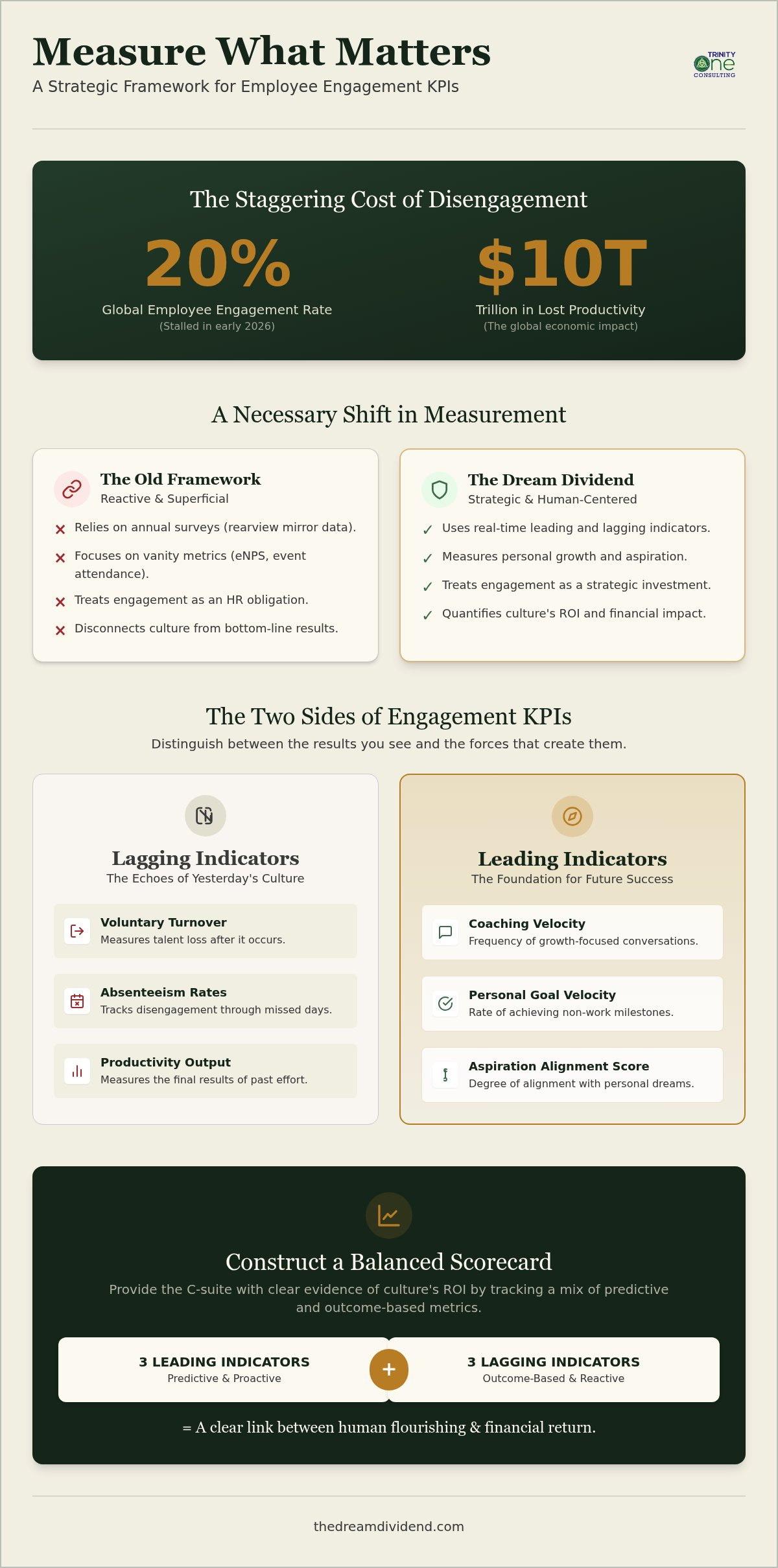
In early 2026, the global employee engagement rate stalled at 20%, leaving a staggering $10 trillion in lost productivity in its wake. You've likely felt this friction in your own halls. You see "satisfactory" survey scores on your desk, yet you still face high turnover and the silent drain of quiet quitting. It's difficult to prove the ROI of culture programs when your metrics feel disconnected from the bottom line. Learning how to measure employee engagement kpis requires moving beyond superficial sentiment to track the compounding value of human flourishing.
This strategic guide offers a sophisticated framework for quantifying engagement by aligning individual aspirations with organizational mission. You'll gain a clear dashboard of leading and lagging indicators that link personal growth to professional output. We'll examine how to transform your culture into a strategic asset, reduce turnover, and unlock discretionary effort. By the end, you'll have a roadmap to calculate your "Dream Dividend" and secure the long-term health of your enterprise through sustainable growth.
Key Takeaways
- Shift your perspective from reactive annual surveys to a framework that treats engagement as a strategic investment in human potential.
- Identify the critical difference between lagging indicators like turnover and leading metrics such as coaching frequency to learn how to measure employee engagement kpis effectively.
- Implement the DreamCompass tool to map the 12 Life Characteristics, allowing you to quantify personal growth and aspiration alignment within your team.
- Construct a balanced scorecard featuring three leading and three lagging indicators to provide the C-suite with clear evidence of culture's ROI.
- Bridge the gap between personal fulfillment and professional output to realize a measurable financial return on human flourishing.
Table of Contents
- Beyond the Survey: Why Measuring Employee Engagement Requires a New Framework
- Leading vs. Lagging Indicators: Categorizing Your Engagement KPIs
- The DreamCompass Framework: Quantifying Aspiration and Personal Growth
- Step-by-Step: Implementing an Engagement Measurement Strategy
- Realizing the Dream Dividend: Turning Metrics into Excellence
Beyond the Survey: Why Measuring Employee Engagement Requires a New Framework
Most organizations treat engagement as a temperature check rather than a fuel gauge. They wait for the annual survey to tell them how their people felt six months ago, effectively managing by looking in the rearview mirror. To understand what is employee engagement in a high-performance context, we must stop viewing it as a human resources obligation. Instead, we must view it as a strategic investment in human potential. When you master how to measure employee engagement kpis, you aren't just collecting data; you're auditing the structural integrity of your organization’s future.
Traditional metrics often fail because they capture lagging data. By the time a survey reveals a dip in morale, the talent has already checked out or the productivity has already vanished. We propose a shift toward "The Dream Dividend." This is the measurable financial return that occurs when an organization commits to human flourishing. It's the byproduct of a culture where every individual is encouraged to become the "Best Version of Yourself." This framework establishes a high-performance baseline by treating personal growth as the primary engine of professional output.
The Failure of Superficial Metrics
Relying on Employee Net Promoter Scores (eNPS) alone doesn't tell the full story of commitment. While a high score might suggest satisfaction, it doesn't guarantee the discretionary effort required for true innovation. Many leaders fall into the trap of tracking vanity metrics, such as internal newsletter open rates or attendance at optional social events. These numbers monitor behavior but ignore motivation. If a team member is present but not "becoming," their contribution will eventually plateau. You need to move beyond monitoring what people do and start understanding why they choose to do it.
The 2026 Shift: Human-Centered Data
The modern workforce has evolved beyond the era of superficial perks. Ping-pong tables and free snacks are no longer substitutes for meaning and purpose. In 2026, top talent prioritizes organizations that invest in their holistic well-being. This requires a shift toward human-centered data, utilizing the 12 Life Characteristics as a blueprint for measurement. When you measure "becoming" alongside "doing," you create a culture of excellence. This approach ensures that personal aspirations aren't sidelined but are instead the very foundation upon which professional success is built.
Leading vs. Lagging Indicators: Categorizing Your Engagement KPIs
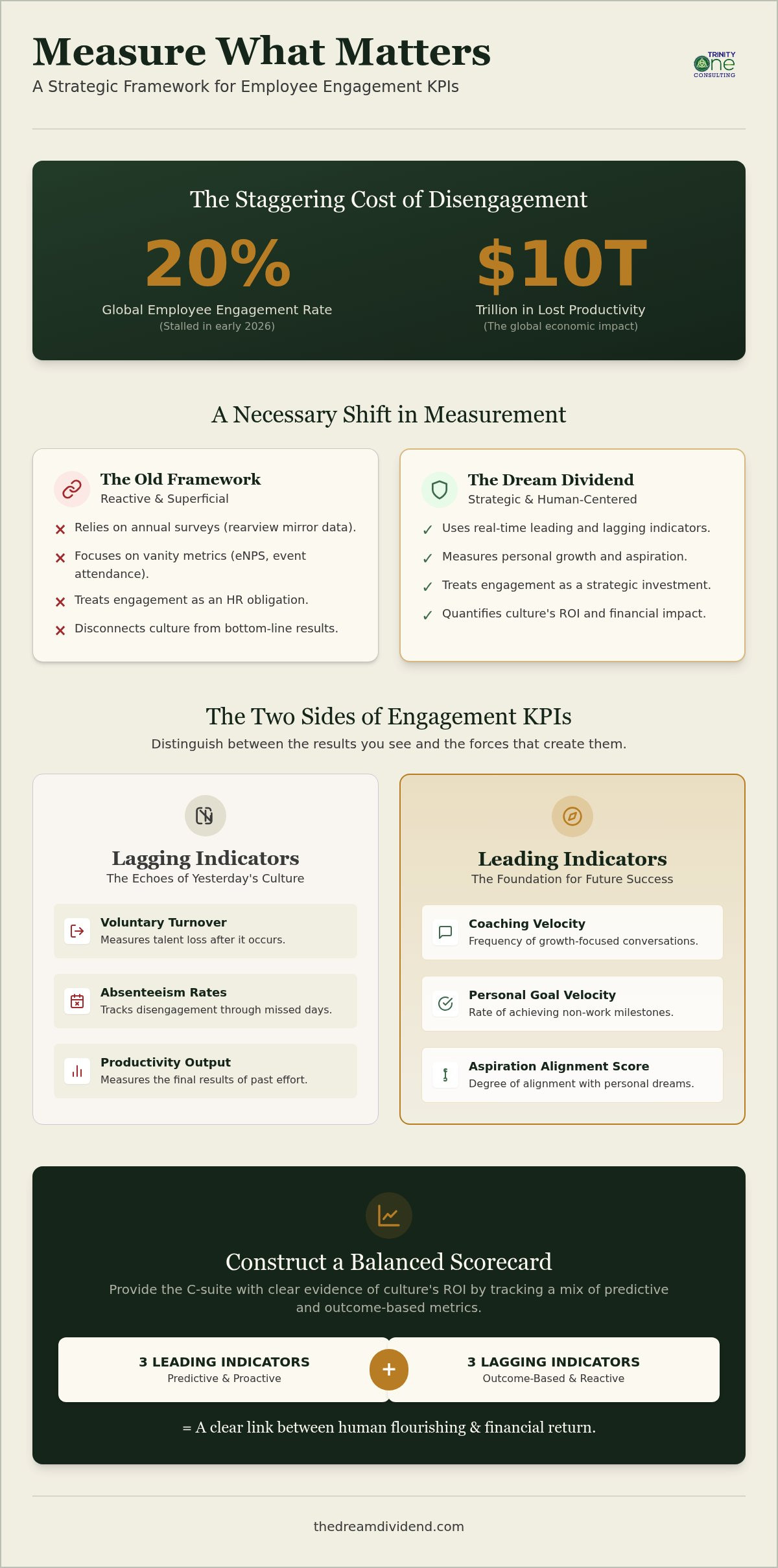
To master how to measure employee engagement kpis, you must distinguish between the results you see and the forces that create them. Lagging indicators like voluntary turnover, absenteeism, and productivity output are the echoes of yesterday's leadership. They tell you where you've been, but they offer little guidance on where you're going. Leading indicators, conversely, act as the structural foundation for future success. Metrics such as aspiration alignment, personal goal attainment, and coaching frequency allow you to predict organizational health before the cracks appear.
Think of engagement as a high-yield investment. Every conversation about an employee's personal growth is a deposit. Over time, these deposits compound, creating a reservoir of trust and commitment that traditional management styles cannot replicate. While many organizations focus on top employee engagement KPIs that reflect past performance, the visionary leader prioritizes the inputs that drive future returns. If you ignore the leading indicators, you're essentially trying to grow a garden by only measuring the height of the weeds.
Quantifying Aspiration: The Ultimate Leading Indicator
Real engagement begins when personal dreams intersect with corporate objectives. Measuring "Dream Alignment" involves identifying the "Aspiration Gap," the distance between an employee's current reality and their deepest desires. When you bridge this gap, you unlock a level of discretionary effort that no bonus structure can buy. Consider these leading metrics:
- Coaching Velocity: The frequency and quality of growth-focused one-on-one conversations.
- Personal Goal Velocity: The rate at which employees achieve non-work milestones.
- Alignment Score: The degree to which an employee sees their job as a vehicle for their personal dreams.
If you want to see a tangible shift in performance, start by consulting with experts who understand the architecture of human motivation.
Outcome-Based KPIs: Measuring the ROI of Engagement
The financial case for this approach is undeniable. By connecting engagement scores directly to Dream Manager ROI, leaders can quantify the impact of culture on the balance sheet. You'll see "Quiet Quitting" dissipate as performance spikes, driven by individuals who feel seen and supported. There is a direct, measurable correlation between personal fulfillment and customer satisfaction. When your people are becoming the best versions of themselves, they naturally provide better service, create better products, and build a better company. This isn't just about feeling good; it's about building a resilient, high-output organization that thrives in any market.
The DreamCompass Framework: Quantifying Aspiration and Personal Growth
Data points are useless if they don't lead to direction. While many leaders struggle with how to measure employee engagement kpis in a way that feels authentic, the DreamCompass tool provides a structured navigational path. It transforms the vague concept of "engagement" into a tangible, strategic asset. By focusing on the individual’s trajectory, managers can align personal aspirations with the organization's mission, creating a self-sustaining cycle of high performance. This isn't about monitoring hours; it's about measuring the velocity of a person's growth toward their potential.
The role of the manager is undergoing a profound evolution. We're moving away from the traditional supervisor model toward a "Manager as Life Coach" approach. This shift isn't just about soft skills; it's a rigorous method of data collection that bridges the gap between personal fulfillment and professional output. When a manager understands an employee's personal goals, they gain access to the most powerful driver of discretionary effort. This data becomes the foundation for a more resilient and innovative workforce, where every individual feels their work is a vehicle for their own flourishing.
Mapping the 12 Life Characteristics
To build a high-performance culture, you must first establish a baseline for human excellence. The DreamCompass allows you to map the 12 Life Characteristics directly to individual performance reviews. This involves identifying which characteristics, such as physical health, emotional intelligence, or intellectual curiosity, drive the most professional value for a specific role. By setting these baselines, you create a "Personal Excellence Score" that complements traditional output metrics. It's a holistic view of the person that ensures they aren't just "doing" their job, but "becoming" a more capable version of themselves. This investment in the person always yields a return in the work.
The Dream Management Audit
Every employee has untapped potential that remains hidden under the weight of daily tasks. A "Dream Audit" is the process of uncovering these aspirations to identify where they can be leveraged for organizational success. Using the Dream Manager Framework, leaders can categorize these dreams and turn qualitative conversations into quantitative trends. This audit allows you to see the aggregate "aspiration health" of your team. When you treat dreams as a primary data source, you don't just measure engagement; you architect it. This transformation of subjective data into objective milestones is the key to unlocking the Dream Dividend and securing long-term loyalty.
Step-by-Step: Implementing an Engagement Measurement Strategy
Constructing a measurement strategy is an architectural feat that requires both a vision for human flourishing and a rigorous eye for financial health. When you determine how to measure employee engagement kpis, you are essentially designing the operating system for your culture. This process must be intentional, steady, and deeply rooted in the belief that people are your most valuable asset. It avoids the superficiality of traditional consulting by focusing on the long-term compounding value of the individual.
Step 1: Define the "Why." Begin by identifying the specific business friction you aim to resolve. Are you battling high turnover, stagnant innovation, or the quiet drain of disengagement? Pinpointing the problem ensures your data collection serves a strategic purpose rather than becoming a hollow administrative exercise. Step 2: Select a Balanced Scorecard. Choose three leading indicators, such as coaching frequency and aspiration alignment, alongside three lagging indicators like voluntary turnover and productivity output. This balance provides a holistic view of current health and future potential.
Step 3: Empower Your Architects. A framework is only as strong as the leaders who implement it. Enroll your leadership team in a Certified Dream Manager Program to equip them with the tools needed to facilitate human growth. This training transforms managers into compassionate guides who understand how to link personal dreams to professional excellence. Step 4: Establish Aspiration Conversations. Create a safe space for regular dialogue regarding employee dreams. These sessions are the primary source of the leading data required to predict future performance. Step 5: Analyze the Dream Dividend. Synthesize your data to calculate the financial return on your human investment. Presenting these findings to the board demonstrates the tangible ROI of your culture programs. To begin this transformation, you can explore our consulting services to build your custom roadmap.
Aligning KPIs to Organizational Mission
For engagement to be sustainable, personal dreams must fuel corporate objectives. A "Shared Value" dashboard allows teams to see how their individual growth contributes to the collective success of the enterprise. Mission Alignment is the nexus where individual aspirations and corporate objectives converge to create a singular, unstoppable momentum. When employees see their job as a bridge to their dreams, their commitment becomes an unbreakable foundation for the company's mission.
The Rhythm of Measurement
Static data is dead data. You must move away from the sterile annual review toward a rhythmic cycle of monthly "Dream Sessions." These real-time feedback loops allow you to adjust engagement strategies with agility and precision. Transparency is the currency of this relationship. By sharing data openly, you build a foundation of trust that encourages employees to invest their full potential into the organization's future. It's a methodical flow that leads toward a logical and inspiring conclusion for the entire workforce.
Realizing the Dream Dividend: Turning Metrics into Excellence
The journey of understanding how to measure employee engagement kpis concludes not with a static spreadsheet, but with a transformed organization. When you move beyond the sterile collection of data and begin to treat your people as a portfolio of high-potential assets, you unlock the Dream Dividend. This is the tangible, measurable return on human flourishing that manifests as increased innovation, reduced turnover, and a culture that rivals any in the marketplace. It's a shift from monitoring behavior to architecting a future where the individual and the enterprise thrive in unison.
By adopting the principles of Dream Management Consulting, you create a structural bridge between the aspirations of the individual and the mission of the enterprise. This alignment ensures that every effort expended by your team is fueled by a personal sense of purpose. When your employees believe that the organization is the best vehicle for them to achieve their personal goals, their commitment becomes absolute. They aren't just working for a paycheck; they're working for their future, their growth, and their dreams.
The Compounding Effect of Engagement
Organizational excellence is rarely the result of a single grand gesture. Instead, it's the result of small, consistent wins in the lives of your people that compound into massive gains for the corporation. When a manager helps an employee achieve a personal milestone, they build a foundation of loyalty that no competitor can buy. "When you invest in the dreams of your people, they invest their best selves in your company." This dream-driven culture creates a structural resilience that allows your organization to navigate volatility with confidence and grace. It turns the workplace into a laboratory for personal and professional excellence.
Next Steps for Strategic Leaders
The path forward requires a bold rejection of the status quo and a commitment to long-term value. If you're ready to bridge the "Engagement Gap" in your own halls, start by requesting a comprehensive culture audit to identify the disconnect between your team's potential and their current output. This audit provides the baseline data needed to determine how to measure employee engagement kpis within your unique context. For those seeking to lead this change from the front, the journey toward becoming a Certified Dream Manager offers the framework and authority needed to architect a high-performance environment.
Continue your education by listening to The Dream Dividend Podcast, where we explore the intersection of humanistic leadership and pragmatic business strategy. The ultimate competitive advantage in 2026 isn't technology or capital; it's the collective commitment of a workforce that is actively becoming the best version of itself. Invest in their dreams, nurture their growth, and secure the future of your enterprise today.
Architecting Your Organization's Future
The transition from monitoring behavior to architecting aspiration represents the most significant strategic evolution for leaders in 2026. By distinguishing between lagging metrics and leading indicators, you gain the foresight needed to prevent turnover before it begins. We've explored how the DreamCompass tool provides a navigational foundation for this shift, turning personal growth into a measurable organizational asset. It's time to move beyond the sterile data of the past and embrace a framework that treats human potential as your most valuable compounding investment.
Mastering how to measure employee engagement kpis allows you to build a culture where every individual is becoming the best version of themselves. Our work is grounded in Floyd Consulting methodologies and the Certified Dream Manager program, featuring a proven track record of reducing turnover through aspiration-based management. This isn't just a cultural initiative; it's a pragmatic business strategy for long-term excellence. Transform your culture and unlock the Dream Dividend. Book a Consulting Session today. Your team is waiting for a leader who believes in their dreams as much as their output. Map their aspirations, track their progress, and realize the return on human flourishing.
Frequently Asked Questions
What are the most important employee engagement KPIs to track in 2026?
The most critical metrics in 2026 shift from passive sentiment to active growth. You should prioritize aspiration alignment, coaching frequency, and personal goal velocity. These leading indicators allow you to predict future performance rather than simply reacting to past failures. By tracking how well an individual's personal mission aligns with corporate objectives, you create a foundation for sustainable excellence and long-term organizational health.
How do you measure the ROI of employee engagement programs?
Measuring the ROI of engagement requires calculating the "Dream Dividend," which is the financial return on human flourishing. You compare the costs of engagement initiatives against the savings from reduced turnover and the revenue gains from increased discretionary effort. When employees are engaged, they produce higher quality work and stay longer; this compounds into significant bottom-line growth. It's a strategic investment that yields high-stakes returns for the entire enterprise.
Can you actually measure "dreams" and "aspirations" as business data?
Yes, you can quantify aspirations by using structured tools like the DreamCompass. This framework allows managers to categorize personal goals and track their progress as measurable milestones. By converting qualitative conversations into quantitative data, you gain a clear view of the aspiration health of your workforce. This process bridges the gap between personal fulfillment and professional performance, providing a rigorous roadmap for strategic human capital management.
What is the difference between a leading and a lagging engagement indicator?
Lagging indicators tell you where you've been, while leading indicators show you where you're going. Lagging metrics include voluntary turnover and absenteeism, which are results of past leadership. Leading indicators, such as coaching frequency and personal development scores, provide the real-time data needed to understand how to measure employee engagement kpis effectively. High-performance organizations focus on these inputs to ensure the structural integrity of their future growth.
How often should we measure employee engagement KPIs?
You should move away from the sterile annual survey toward a monthly rhythm of engagement measurement. Real-time feedback loops, such as monthly "Dream Sessions," allow for agile adjustments to your culture strategy. This consistent cadence builds trust, ensures data accuracy, and keeps the focus on long-term value. If you wait twelve months to check the pulse of your team, you're likely ignoring the early signs of disengagement and quiet quitting.
What tools are best for tracking personal development at work?
The most effective tools for tracking personal development are those that integrate human aspirations with professional reviews. The DreamCompass tool and the 12 Life Characteristics framework are designed to bridge this gap. These assets allow managers to act as mentors, guiding employees through a structured path toward becoming the best version of themselves. Using these proprietary tools ensures that personal growth remains a vital, strategic asset for the organization's health.
How do engagement KPIs help in reducing employee turnover?
Engagement KPIs help reduce turnover by identifying the "Aspiration Gap" before an employee decides to leave. When you understand how to measure employee engagement kpis through the lens of personal dreams, you can ensure that the job remains a vehicle for the individual's flourishing. Employees don't leave companies that are helping them achieve their life goals. This alignment creates an unbreakable bond of loyalty, securing your talent against competitor headhunting.
Is eNPS still a relevant metric for modern organizations?
While eNPS provides a basic pulse check, it remains a lagging vanity metric that often fails to capture the complexity of human motivation. In 2026, relying solely on eNPS is insufficient for high-stakes leadership. It monitors behavior but ignores the underlying "why" behind employee commitment. To achieve true organizational excellence, you must supplement eNPS with leading indicators that track personal growth, aspiration alignment, and the holistic well-being of your workforce.