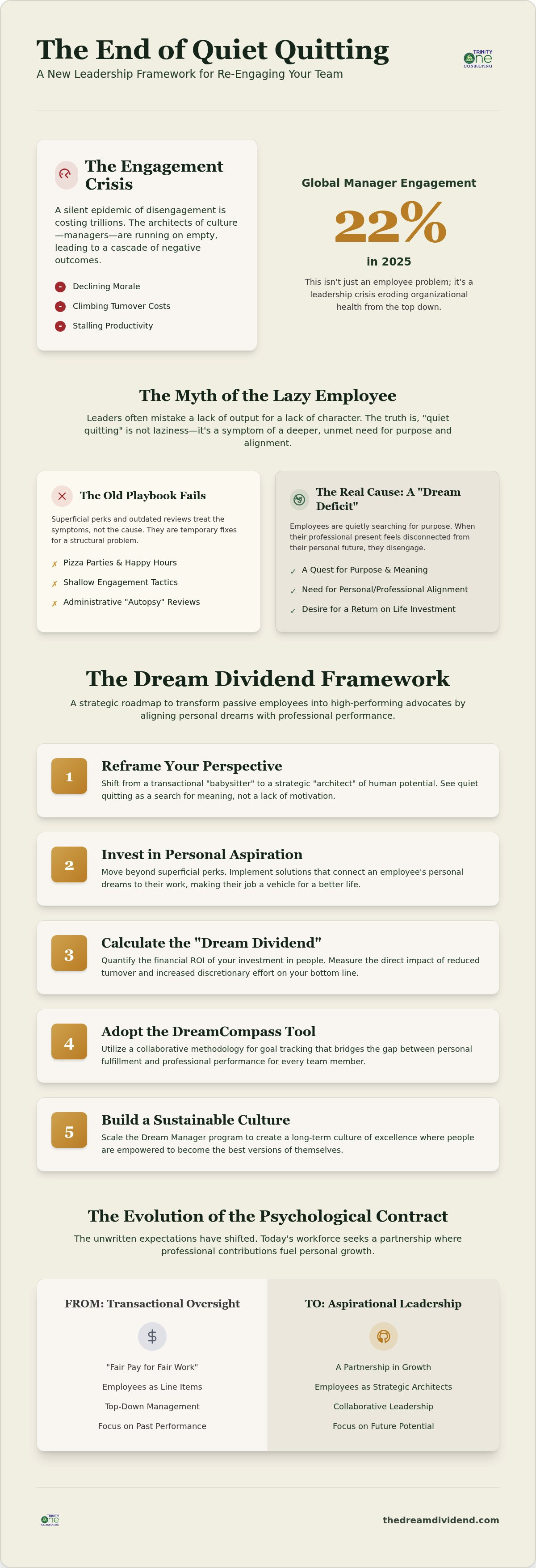
With global manager engagement plummeting to 22 percent in 2025, the real crisis isn't just that employees are pulling back; it's that the architects of culture are running on empty. You likely feel the weight of this every morning as you face a team doing the bare minimum while you act as a babysitter rather than a visionary leader. It's exhausting to watch morale decline, turnover costs climb, and productivity stall. You know that standard quiet quitting solutions for managers aren't working because they treat the symptoms of disengagement instead of the underlying dream deficit that erodes organizational health.
Investing in your people is no longer about superficial perks; it's about strategic human architecture. This article reveals why traditional engagement tactics fail and how a dream-centric leadership framework can transform passive employees into high-performing advocates. We will explore The Dream Dividend’s unique framework, examine its foundational principles for holistic development, and provide a roadmap to help your team become the best version of themselves. By aligning personal aspirations with professional performance, you can cultivate initiative, lower turnover, and build a team that feels personally invested in the work.
Key Takeaways
- Reframe quiet quitting as a quest for purpose rather than a lack of motivation. When you understand that employees are searching for meaning, you can pivot from a babysitter to a strategic architect of human potential.
- Discover why superficial perks fail to drive engagement and how to implement effective quiet quitting solutions for managers that focus on personal aspirations.
- Learn to calculate the Dream Dividend to quantify the financial impact of reduced turnover and increased discretionary effort. This approach transforms intangible human qualities into measurable organizational assets.
- Adopt the DreamCompass tool to facilitate collaborative goal tracking. This methodology bridges the gap between personal fulfillment and professional performance for every team member.
- Move beyond immediate fixes toward a sustainable culture of excellence. By scaling the Dream Manager program, you ensure that your organization becomes a place where people can become the best version of themselves.
Table of Contents
- The Myth of the "Lazy Employee": Redefining Quiet Quitting in 2026
- Why Traditional Engagement Tactics Fail (and What Actually Works)
- The Dream Dividend: Calculating the ROI of Personal Aspiration
- 5 Strategic Solutions to Re-Engage Your Team
- Implementing a Dream-Driven Culture for Long-Term Retention
The Myth of the "Lazy Employee": Redefining Quiet Quitting in 2026
Managers often mistake a lack of output for a lack of character. In the high-stakes environment of 2026, the prevailing narrative suggests that employees are simply lazy or unmotivated. This is The Myth of the 'Lazy Employee'. In reality, what we label as disengagement is often "quiet searching." It's a profound quest for purpose that the modern workplace fails to satisfy. When an individual's personal future feels disconnected from their professional present, they enter a state of "Dream Deficit." This isn't a failure of work ethic; it's a failure of alignment. You cannot expect a high-yield return from an individual who feels their time is a sunk cost rather than a strategic investment.
Today's workforce demands a transition from transactional oversight to aspirational leadership. If you treat your team as mere line items on a balance sheet, you'll receive the bare minimum return on your investment. Effective quiet quitting solutions for managers require viewing every employee as a strategic architect of their own life. You aren't just managing tasks. You are navigating the complex intersection of personal ambition, internal growth, and organizational health. Identify the deficit. Reframe the role. Invest in the dream.
The Evolution of the Psychological Contract
The unwritten expectations between employer and employee have fundamentally shifted. Post-2020, the ceiling of the psychological contract was "fair pay for fair work." That foundation has crumbled. Now, the "Whole Person" employee brings their personal dreams, health, and family aspirations to the office. They expect their labor to compound into something greater than a paycheck. They seek a partnership where their professional contributions fuel their personal becoming, support their family goals, and sharpen their internal growth. They want to know that by helping the company win, they're also winning in the game of life.
Recognizing the Signs of a Dream-Starved Team
Identifying a dream-starved team requires a discerning eye. When a high-potential contributor starts doing the bare minimum, it's rarely about a sudden loss of skill. It's a symptom of a lack of future-vision. You must distinguish between healthy boundaries, which protect sustainable performance, and disengaged withdrawal, which signals a loss of hope. A team that feels its dreams are being ignored will eventually stop dreaming for the company.
Quiet quitting is a psychological disconnection from personal aspiration that manifests as professional stagnation.
To resolve this, you must look beyond the surface. By implementing quiet quitting solutions for managers that prioritize human potential, you can bridge the gap between where an employee is and who they want to become. This is the foundation of becoming the best version of yourself within a professional context. When you help an employee navigate toward their personal goals, their professional engagement becomes a natural byproduct of that journey.
Why Traditional Engagement Tactics Fail (and What Actually Works)
Corporate leaders often default to the "Pizza Party" fallacy when faced with declining morale. It's a shallow attempt to fix a structural problem. If free snacks and occasional happy hours could solve disengagement, we wouldn't see a $10 trillion loss in global productivity. Even flexibility, while necessary, isn't a cure-all. Remote work can actually deepen the isolation if the underlying connection to the work is missing. Managers often seek immediate, superficial fixes for deep-seated cultural erosion. Real quiet quitting solutions for managers require a shift from managing tasks to managing dreams.
Forbes highlights several leadership strategies for quiet quitting, but most fail to address the structural failure of standard performance reviews. These reviews often function as administrative autopsies. They examine what went wrong in the past rather than building what could go right in the future. To drive long-term initiative, you must replace these sterile checklists with the Dream Manager Framework. It serves as the ultimate antidote to organizational apathy by creating a clear, structural path toward employee fulfillment.
The Limit of "Job-First" Management
When you focus solely on KPIs, you create a transactional trap. This approach tells your team that they are only as valuable as their last spreadsheet. It leads to a culture where people do just enough to avoid being fired. To break this cycle, you must evolve into a strategic mentor. You must understand what truly drives your people beyond the 9-to-5. If you invest in their growth, empower their decisions, and inspire their loyalty, you create a culture that transcends the clock.
Investing in the Aspiration Economy
Personal goals fuel professional performance. Whether an employee wants to buy their first home, run a marathon, or learn a new language, these aspirations are the fuel for their work. When a job becomes the vehicle for a dream, the work ceases to be a burden. It becomes a strategic investment in their own future. This is the core of Becoming the Best Version of Yourself. If you want to see the ROI of engagement, start by helping your people build the lives they've always wanted. You can begin this journey by exploring how Dream Management Consulting aligns personal growth with corporate success.
The Dream Dividend: Calculating the ROI of Personal Aspiration
Disengagement is a financial hemorrhage. While many leaders view morale as a "soft" metric, Gallup research on quiet quitting indicates that at least 50 percent of the U.S. workforce is currently doing the bare minimum. This widespread withdrawal isn't just a cultural hurdle; it's a massive drain on productivity that costs the global economy trillions. To stop the bleed, effective quiet quitting solutions for managers must move beyond the HR handbook and into the ledger. When you invest in an employee’s personal dreams, you aren't just being kind. You're securing a "Dream Dividend" that manifests as increased discretionary effort and radical loyalty.
The financial case for this shift is undeniable. High turnover costs companies roughly 1.5 to 2 times an employee’s annual salary. By contrast, the Dream Manager ROI is found in the drastic reduction of recruitment and training expenses. When an organization supports the 12 Life Characteristics, it creates a compounding interest of talent. A team that feels its personal life is improving because of its work will naturally protect the company’s interests with the same ferocity they apply to their own aspirations.
Transactional vs. Aspirational Management
Most management styles are built on a transactional trap. You pay; they perform. This creates "clock-watchers" who leave the moment a slightly better offer appears. Aspirational management, however, builds brand advocates. These are employees who stay because the company has become the primary engine for their personal success. They aren't just fulfilling a job description. They're building a life.
| Metric | Transactional Management | Aspirational Management |
|---|---|---|
| Retention | High churn; constant recruitment | Long-term loyalty; internal growth |
| Productivity | Compliance-based bare minimum | High-level discretionary effort |
| Culture | Fragmented and reactive | Unified brand advocacy |
Structural Foundations for Organizational Health
Think of your culture as a piece of architecture. A transactional culture is a temporary tent; it collapses under the first sign of market pressure. A dream-driven culture is a skyscraper built on deep, structural foundations. It acts as an insurance policy against future market disruptions because your people are anchored by more than just a paycheck. Employee dreams are the "undervalued assets" on a company’s balance sheet. By identifying and investing in these assets, you create a resilient organization that thrives while competitors struggle with quiet quitting solutions for managers that only scratch the surface. You're building a legacy of excellence that survives any storm.
5 Strategic Solutions to Re-Engage Your Team
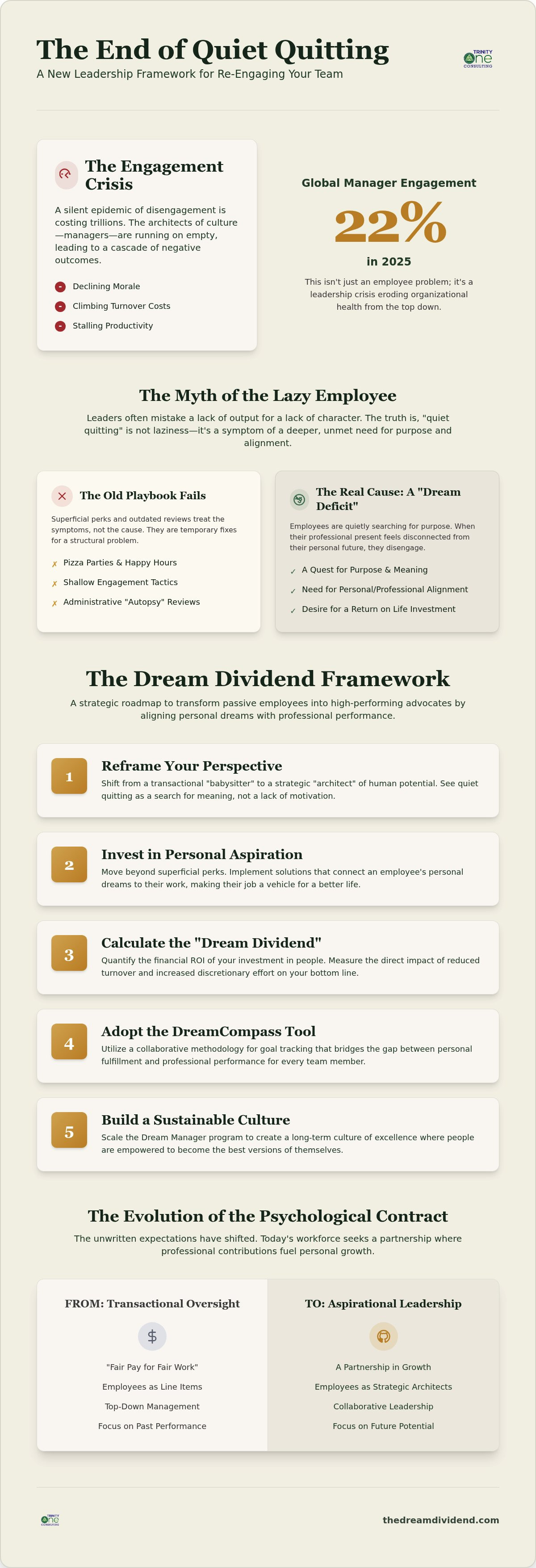
Transformative leadership isn't about better oversight; it's about better insight. To implement effective quiet quitting solutions for managers, you must pivot from managing output to cultivating potential. This requires a structural shift in how you view your role and your team. By following these five strategic steps, you can move from crisis management to a culture of high-stakes mentorship.
- Step 1: Shift the Conversation. Move beyond the standard "What do you do?" and ask "Who do you want to become?" This identifies the individual's trajectory and creates a roadmap for their personal evolution.
- Step 2: Implement the DreamCompass Tool. Use this practical framework for collaborative goal tracking. It bridges the gap between daily tasks and long-term aspirations.
- Step 3: Integrate the 12 Life Characteristics. Professional development must include physical, emotional, and spiritual health. A holistic approach ensures your team stays resilient and focused.
- Step 4: Evolve the "Manager as Life Coach" Mindset. Your job is to be a strategic architect of human potential. When you act as a mentor, you build a foundation of trust that transcends the 9-to-5.
- Step 5: Measure Success by Personal Milestones. Don't just track quarterly quotas. Celebrate when an employee buys a home, finishes a degree, or hits a fitness goal. These are the real indicators of a thriving culture.
By adopting these strategies, you ensure that every team member is moving toward Becoming the Best Version of Yourself. When you align their personal success with the company’s mission, engagement becomes a natural byproduct of growth. You can start this transformation today by engaging with Dream Management Consulting to build a custom roadmap for your leadership team.
The Power of the DreamCompass
The DreamCompass Tool is more than a tracking device; it is a structural foundation for mutual success. It allows you to map individual aspirations directly to team objectives, ensuring that every project feels like a step toward a personal dream. You must create a safe space where employees feel comfortable sharing non-work-related goals, such as saving for a first home or learning a new language. The psychological benefit is profound. When an employee knows their manager has their back outside the office, their loyalty to the organization compounds. They stop working for a paycheck and start working for a future they believe in.
Mastering the 12 Life Characteristics
A dream-driven culture recognizes that physical, emotional, and spiritual health are vital professional concerns. If an employee is struggling in their personal life, their professional performance will eventually suffer. A holistic approach to development is the ultimate insurance policy against burnout. You can support the "best version" of every team member by providing resources that address the 12 Life Characteristics. This might mean encouraging better sleep habits, supporting financial literacy, or fostering a sense of community within the team. When you invest in the whole person, you secure a workforce that is energized, focused, and deeply invested in the collective success of the organization.
Implementing a Dream-Driven Culture for Long-Term Retention
Moving from crisis management to a sustainable future requires more than a policy change. It demands an Organizational Culture Transformation. For mid-size or large organizations, scaling this framework involves embedding the principles of dream management into the very fabric of the company. This is where the role of a Certified Dream Manager becomes vital. They serve as the structural anchor, ensuring that the engagement dividends you've worked to build don't evaporate when the next market shift occurs. They provide the consistency, the coaching, and the long-term vision necessary to sustain a high-performance environment.
The future of work isn't about management. It's about mentorship. If you continue to rely on traditional quiet quitting solutions for managers that focus on enforcing boundaries, you'll remain stuck in a transactional cycle. Instead, choose to lead with purpose. When you shift your focus to the personal success of your people, you create a culture where turnover is low and initiative is high. You aren't just paying for labor; you're investing in a collective future.
Becoming a Strategic Architect of Human Potential
Leadership is an act of construction. You must pivot from monitoring tasks to empowering people as a daily practice. This shift creates a powerful ripple effect. When one manager begins to care about the dreams of their team, it transforms the entire department. It replaces suspicion with trust, apathy with energy, and compliance with commitment. In 2026, this approach makes your organization a talent magnet. High-performers don't want a boss. They want a guide who helps them reach their potential and reach their personal milestones.
Your Next Steps Toward the Dividend
Transforming your culture starts with a single, intentional step. You don't need to overhaul your entire enterprise overnight. Begin with a pilot program using the Dream Manager framework. Identify a specific team, secure leadership buy-in, and start having different conversations. Aspirational management requires courage, commitment, and a belief that your employees' dreams are worth the investment. Explore how Dream Management Consulting can transform your team into a powerhouse of purpose and performance. By implementing these quiet quitting solutions for managers, you aren't just fixing a problem. You are building a legacy of excellence.
Architecting a Future of Shared Success
The era of transactional management is over. If you continue to treat your team as a row on a spreadsheet, you'll continue to harvest the bare minimum. By reframing disengagement as a dream deficit, you transform the workplace into a launchpad for human potential. You've seen that superficial perks can't replace the deep, structural connection formed when a leader invests in an employee’s personal future. These quiet quitting solutions for managers aren't just about survival; they're about building a high-performance culture where initiative compounds over time.
Success in 2026 demands a strategic architect who can navigate the complex intersection of personal fulfillment, professional growth, and organizational health. You can Transform your culture with Dream Management Consulting to unlock this potential. Our Certified Dream Manager expertise and proprietary DreamCompass tool provide a proven ROI in employee retention by turning individual aspirations into collective momentum. Lead with vision. Invest in dreams. Watch your organization thrive as your people feel known, supported, and inspired to become the best versions of themselves.
Frequently Asked Questions
Is quiet quitting just a trend or a permanent shift in work culture?
Quiet quitting is a permanent evolution of the psychological contract between employer and employee. It's not a trend. This shift marks a transition from transactional labor to a demand for aspirational leadership. Modern workers now demand that their labor fuels their personal becoming, supports their family goals, and sharpens their internal growth. Success requires a strategic architect who embraces this new reality rather than waiting for a return to the past.
How can I tell if an employee is quiet quitting or just setting healthy boundaries?
Discerning between the two requires a focus on the spark of initiative. Quiet quitting is a psychological withdrawal from purpose, whereas healthy boundaries are a strategic tool for sustainable performance. An employee with boundaries protects their energy to maintain long-term excellence. A quiet quitter does the bare minimum because they've lost the connection between their work and their future. Boundaries safeguard your team’s spark; disengagement suggests it has faded.
What is the first step a manager should take to address disengagement?
The first step is to pivot the conversation from quarterly quotas to personal aspirations. Ask your team members what they hope to achieve in their lives outside the office over the next year. This simple shift signals that you are a mentor interested in their holistic growth rather than a taskmaster. By exploring these quiet quitting solutions for managers, you build a structural foundation of trust that transforms the daily work experience.
Can a manager really act as a life coach without overstepping?
Acting as a strategic mentor is possible by focusing on the 12 Life Characteristics as professional assets. This approach isn't about prying into personal secrets; it's about supporting the holistic well-being that drives performance. When you help an employee navigate financial literacy, physical health, or personal growth, you're acting as a strategic architect of their potential. You're protecting the human capital that is essential for long-term organizational success and resilience.
How does investing in personal dreams improve professional performance?
Personal dreams provide the essential "why" behind every professional "what." When an employee views their role as the vehicle for buying a home or finishing a degree, the work becomes a strategic investment in their own future. This alignment creates a compounding interest of motivation and loyalty. It transforms the job from a transactional burden into a vital asset for achieving their most significant personal milestones.
What is the Dream Manager framework and how does it work?
The Dream Manager framework is a strategic leadership methodology based on Matthew Kelly’s work. It utilizes tools like the DreamCompass to help leaders identify, track, and support the personal aspirations of their people. By integrating these dreams into the professional journey, the framework creates a culture of mutual investment. It moves the organization beyond crisis management toward a sustainable model where personal fulfillment and professional performance are inextricably linked together.
How do I handle a quiet quitter who refuses to engage in personal growth?
If an employee refuses to engage in growth, you must assess their alignment with the "Best Version of Yourself" framework. A dream-driven culture is a partnership that requires commitment from both sides. If an individual is unwilling to invest in their own becoming, they may not be the right fit for a high-performance team. You must clearly communicate that personal excellence is the foundation of professional success and determine if your trajectories still match.
What is the ROI of implementing a Dream Manager program?
The ROI manifests as a "Dream Dividend" through reduced turnover, lower recruitment costs, and increased discretionary effort. By implementing quiet quitting solutions for managers, you secure a workforce that is personally invested in the company’s success. The financial impact of keeping a high-performer is far greater than the cost of a replacement. Investing in dreams is a pragmatic business strategy that yields high-stakes returns in loyalty, innovation, and long-term organizational health.