What if the most dangerous threat to your organization’s growth isn't a competitor’s strategy, but a silent "dream deficit" compounding within your own walls? You see the symptoms every day: the sudden departure of your brightest talent, a pervasive sense of "quiet quitting," and a frustrating stagnation that persists despite high activity. It's exhausting to lead when the air feels heavy with unspoken discontent. You likely suspect that the subtle signs of a toxic work culture are already taking root, but you need more than just a gut feeling to spark a meaningful change.
We understand that a healthy culture is a vital, strategic asset, not a luxury. In this strategic audit for 2026, we'll help you move beyond surface-level frustration to identify the systemic red flags that are stifling your team's potential. You will discover a clear framework to diagnose toxicity, validate your observations with current data, and build a strategic roadmap for cultural transformation. By the end of this guide, you'll know how to pivot toward a high-performance, dream-driven culture that allows every individual to become the best version of themselves.
Key Takeaways
- Define the "Dream Deficit" and understand how a culture that extracts more value than it invests creates systemic stagnation.
- Identify the behavioral signs of a toxic work culture, including fear-based leadership and exclusive cliquishness that stifle innovation.
- Examine the structural rot within your organization to understand why high turnover is often a symptom of a missing "glass ceiling of purpose."
- Apply the "Dream Test" to evaluate the human health of your workplace; ensure your environment supports employees in becoming the best version of themselves.
- Discover the strategic roadmap to pivot toward a high-performance culture by adopting the Dream Manager mindset and resetting your foundational systems.
Table of Contents
What is a Toxic Work Culture in 2026?
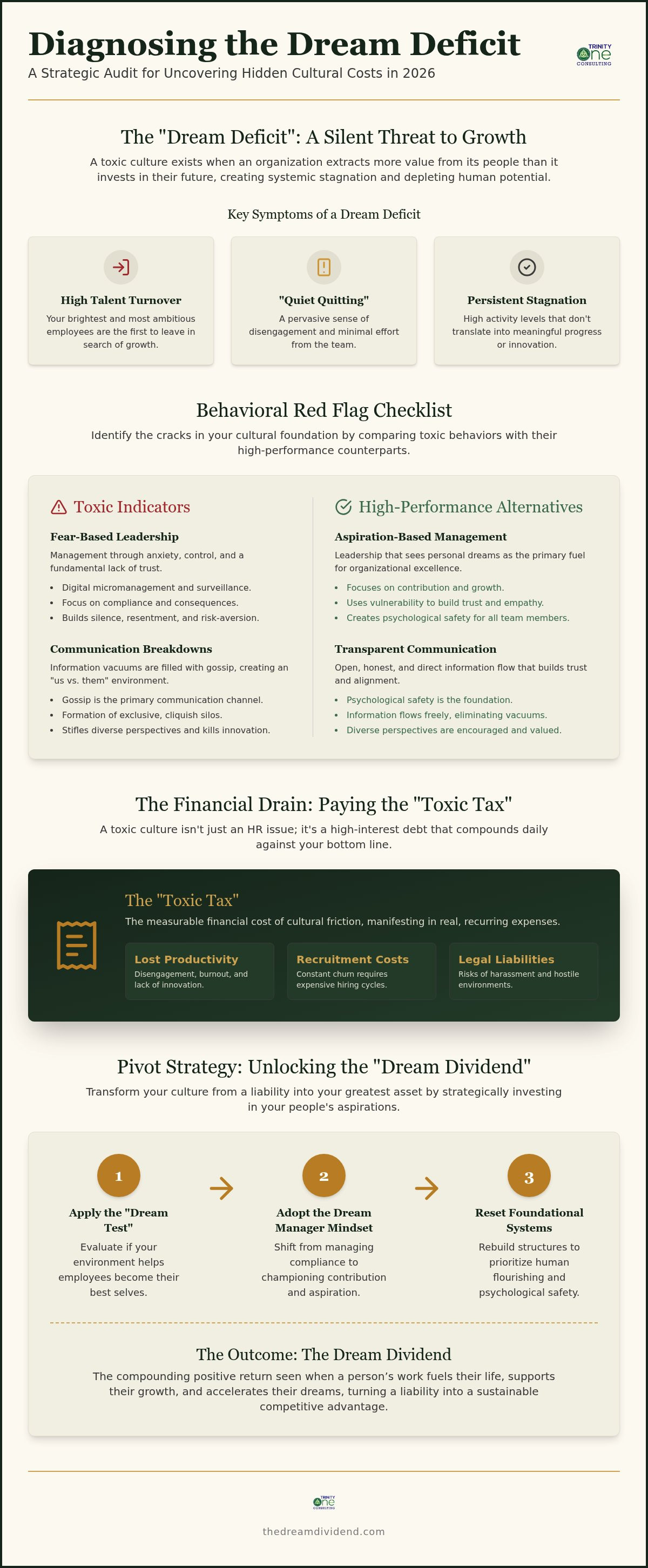
In 2026, a truly toxic culture isn't always marked by shouting, overt hostility, or obvious harassment. It's more accurately defined as an environment that actively depletes human potential and suppresses personal aspiration. We call this the "Dream Deficit." This occurs when a company extracts more from an employee's time, energy, and spirit than it invests in their personal future. While high-pressure performance environments can be exhilarating and growth-oriented, toxic dysfunction is different. It's the difference between a rigorous training program and a slow erosion of identity. Recognizing the signs of a toxic work culture requires looking past the quarterly reports to see the human spirit beneath. When you align organizational goals with individual aspirations, you unlock the Dream Dividend. This is the compounding positive return seen when a person’s work fuels their life, supports their growth, and accelerates their dreams.
The Evolution of Toxicity: From Burnout to Boredom
The 2026 landscape of hybrid work and AI integration has introduced subtle, digital forms of toxicity. Digital micromanagement, where every keystroke is monitored and every idle minute is questioned, creates a pervasive sense of surveillance that destroys trust. However, toxicity also stems from a profound lack of purpose. A job that offers no meaning or path toward self-actualization is just as damaging as an aggressive supervisor. To reverse these trends, leaders must commit to a comprehensive organizational culture transformation. This process isn't about superficial perks; it's about rebuilding the structural foundations of the workplace to prioritize human flourishing in a world that feels increasingly automated and impersonal.
The Financial Cost of a Toxic Culture
A toxic workplace acts like a high-interest debt that compounds against your bottom line. High turnover and pervasive disengagement aren't just HR headaches; they're massive financial drains that bleed capital every single day. When you ignore the signs of a toxic work culture, you're paying a heavy "Toxic Tax." The Toxic Tax is the measurable financial cost of cultural friction, manifesting in lost productivity, recruitment expenses, and legal liabilities. Organizations that fail to see this often miss the significant Dream Manager ROI that comes from investing in employee dreams. By treating human aspiration as a strategic asset, you turn a liability into a sustainable competitive advantage that attracts and retains the world's best talent.
The Behavioral Red Flag Checklist: Leadership and Interaction
Behavioral red flags are the leading indicators of a failing culture. They are the cracks in the foundation that appear long before the building starts to lean. To conduct a strategic audit, you must look closely at how your leaders interact with their teams. Are they building people up, or are they managing them through anxiety? Identifying the behavioral signs of a toxic work culture is the first step toward reclaiming your organization’s potential and protecting your human assets.
Fear-Based Leadership vs. Aspiration-Based Management
Fear is a poor architect. It builds structures of compliance, silence, and eventual resentment. When leadership prioritizes control, they often ignore the signs of a toxic work culture that manifest as digital micromanagement. This behavior signals a fundamental lack of trust in the "Best Version" of the employee. In contrast, adopting the Dream Manager framework shifts the focus from consequence to contribution. Healthy leaders use vulnerability to bridge the gap between authority, empathy, and strategic alignment. They don't see personal dreams as distractions; they see them as the primary fuel for organizational excellence.
Communication Breakdowns and Gossip Hubs
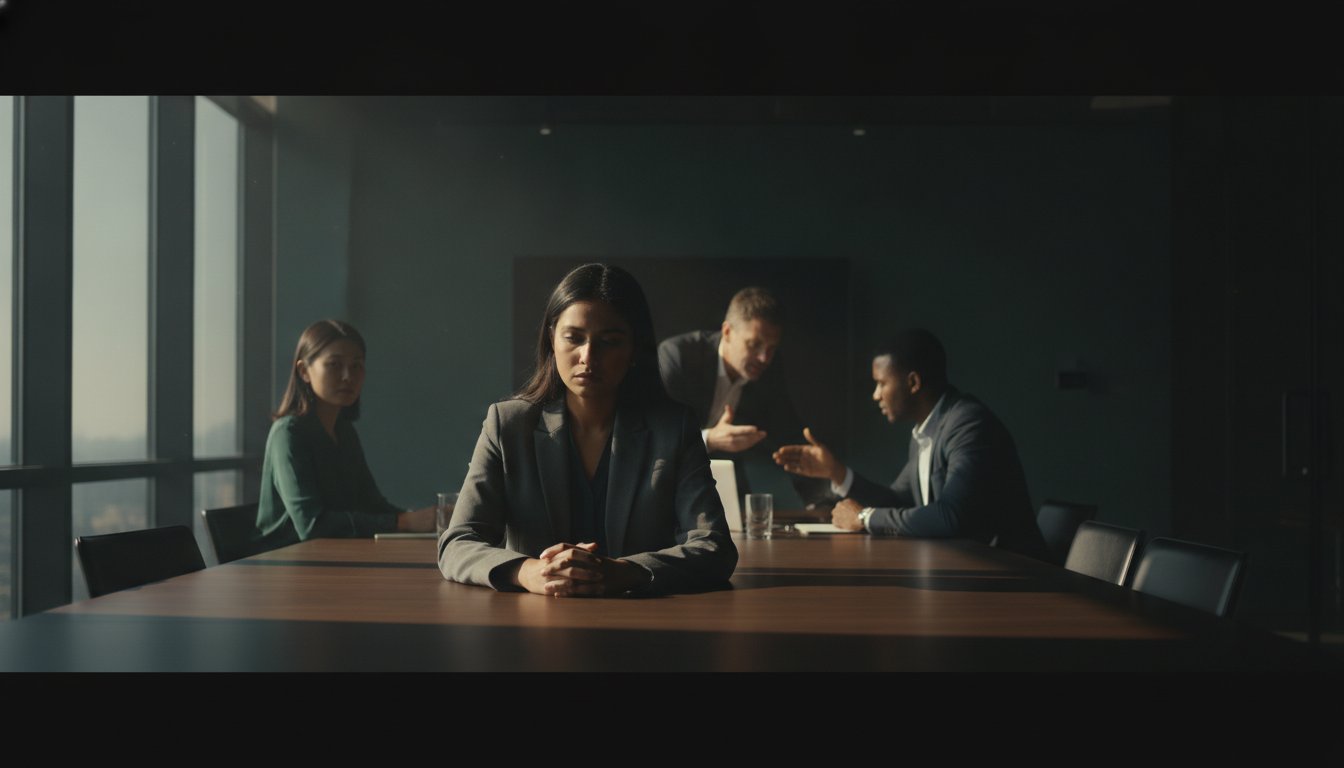
Transparency is the foundation of psychological safety. Without it, an information vacuum forms, and toxic gossip becomes the primary mode of communication. When spotting a toxic work environment, pay close attention to exclusive cliquishness. These internal silos create an "us versus them" mentality that erodes trust, stifles diverse perspectives, and kills innovation. True collaboration requires an open exchange of ideas across all levels of the hierarchy.
Perform a simple audit of your last team meeting. Is your team talking about solutions, or are they talking about people? If the conversation consistently revolves around blame, you're witnessing the "Gaslighting of Ambition." This occurs when individual growth and professional aspirations are framed as distractions from the "real work." It's a strategy of suppression that limits the long-term value of your team. To begin reversing this trend, you can find actionable tools at The Dream Dividend that help realign leadership with the genuine aspirations of your people.
The Structural Red Flag Checklist: Systems and Stagnation
Structural toxicity is often invisible until the foundation begins to crumble. It manifests as "The Revolving Door," where high turnover acts as a loud, expensive symptom of deeper systemic rot. MIT Sloan research on toxic cultures confirms that a toxic environment is the primary driver of employee attrition, proving far more influential than salary or benefits. When top talent leaves, they aren't just quitting a boss; they're escaping a system that fails to value their humanity, their time, and their future. If your recruitment costs are skyrocketing while your retention rates plummet, you're likely ignoring the structural signs of a toxic work culture.
Another subtle red flag is "The Glass Ceiling of Purpose." This occurs when promotions lead only to more work, more stress, and more meetings, without any increase in personal meaning or fulfillment. It's a hollow advancement. When employees realize that climbing the ladder only takes them further away from their aspirations, they stop climbing. This structural failure is often accompanied by the "Boundary Blur," the toxic expectation of 24/7 availability that treats human energy as an infinite resource rather than a finite investment. Organizations that fail to invest in "Whole Person" development essentially signal that their people are merely tools for profit rather than partners in progress.
Incentives That Corrode Culture
Systems that encourage cutthroat internal competition destroy the collaborative spirit essential for long-term health. If your incentives reward "the what" while ignoring "the how," you're inadvertently subsidizing toxicity. You might hit your quarterly targets, but you're doing so at the expense of your cultural capital. To correct this, leadership must align incentives with the Becoming the Best Version of Yourself philosophy. This ensures that success is measured by professional output, personal growth, and the collective health of the team. When incentives prioritize short-term wins over long-term human value, the resulting friction creates a deficit that eventually bankrupts the culture.
The Stagnation Audit
A healthy organization requires a clear path for employee personal dreams to coexist with corporate goals. Without this alignment, you face Structural Stagnation. Structural Stagnation is the point where organizational goals and individual dreams diverge, leading to a permanent state of disengagement. To audit your structure, consider these indicators:
- Does the company have a formalized system to track and support employee personal aspirations?
- Is professional coaching integrated into the standard management structure?
- Are individual development plans focused on the "Whole Person" or just job-specific skills?
If you can't answer "yes" to these questions, your system is designed for maintenance, not momentum. Professional coaching shouldn't be a luxury for the elite; it should be the foundation of how you manage. Recognizing these signs of a toxic work culture allows you to move from a system of extraction to one of mutual investment, where every employee's growth contributes to the organization’s overall return.
The Human Impact: Signs Your Culture is Killing Dreams
The most revealing diagnostic for any organization isn't found on a balance sheet, but in the hearts of its people. We call this the "Dream Test." Ask your team a simple question: can you name three of your personal dreams? In a flourishing environment, the answer is immediate and vibrant. In a dysfunctional one, you'll meet blank stares or hesitant silence. This silence is one of the most profound signs of a toxic work culture. When the workplace becomes a site of extraction rather than investment, employees stop dreaming because they no longer have the cognitive or emotional surplus to do so. This leads to the erosion of the "Best Version" of the individual. Work should be a catalyst that makes people healthier, happier, and more engaged. If your team is leaving your office less whole than when they arrived, your culture is failing its most valuable assets.
According to current 2026 data, 80% of U.S. workers report that their workplace is toxic, and a staggering 76% are experiencing burnout. These aren't just HR metrics; they're indicators of a systemic human crisis. "Quiet Quitting" is often mislabeled as a lack of work ethic, but it's actually a rational response to an irrational environment. When the return on emotional investment reaches zero, disengagement becomes a survival strategy. This disengagement is expensive, costing companies the equivalent of 34% of a disengaged employee's annual salary in lost productivity.
The 12 Life Characteristics Diagnostic
To measure the true health of your culture, you must look at the 12 Life Characteristics of your people. A toxic environment specifically degrades physical vitality, emotional stability, and spiritual clarity. When work-life boundaries dissolve, the resulting "Boundary Blur" attacks the physical and emotional health of the team. We use the DreamCompass tool to help individuals realign their personal lives with their professional performance. If your culture doesn't provide the space for intellectual growth or personal fulfillment, the "Dream Deficit" will eventually bankrupt your organizational energy. A strategic architect knows that corporate health is simply the sum of individual well-being.
Burnout vs. Moral Injury
We must distinguish between simple exhaustion and the deeper wound of moral injury. Burnout is a result of overwork; moral injury is the result of working in an environment that lacks integrity. It occurs when employees are forced to act against their own values to meet toxic demands or navigate exclusive cliquishness. This psychological toll is devastating and cannot be fixed with superficial "self-care" initiatives or a weekend off. Systemic toxicity requires a systemic cure. If you're ready to stop the erosion of your team's potential and start building a culture of high-stakes mentorship, you can begin the journey with Dream Management Consulting to reset your cultural foundation.
Pivot Strategy: From Toxicity to a Dream Dividend
Recognizing the signs of a toxic work culture is a vital diagnostic step, but awareness alone won't stop the compounding interest of organizational decay. To truly pivot, leadership must undergo a fundamental transition from a traditional management mindset to that of a Dream Manager. This shift recognizes that when you help your employees achieve their personal dreams, they naturally become more engaged, more loyal, and more productive. It’s a strategic investment in the human spirit that pays out in the form of a Dream Dividend. By implementing Dream Management Consulting, you gain the structured methodology needed to reset your cultural foundation, replacing a system of extraction with one of mutual investment and long-term growth.
The First 90 Days of Cultural Recovery
Cultural recovery is a methodical process that requires both visionary courage and pragmatic discipline. During the first 90 days of your pivot, your focus should move through three critical stages of development. First, conduct a deep Cultural Audit to identify the specific toxins, whether they are behavioral cliques or structural glass ceilings, that are currently suppressing your team’s potential. Second, initiate Aspiration Alignment by using the DreamCompass tool. This facilitates honest, high-stakes conversations that connect business goals directly to employee dreams, creating a shared roadmap for success. Finally, begin scaling the program by identifying internal leaders to become Certified Dream Managers. This creates a self-sustaining ecosystem of mentorship that ensures the signs of a toxic work culture never return to your halls.
Leading with Visionary Purpose
The modern leader must act as a Strategic Architect of human potential. This role requires you to look beyond immediate tactical needs to build a foundation where every individual has the opportunity to become the best version of themselves. To support this ongoing evolution, leverage resources like The Dream Dividend Podcast as a primary leadership development tool. These sessions provide the intellectual capital and strategic insights necessary to lead with purpose in a complex, 2026 landscape. When you lead with visionary purpose, you stop being a supervisor and start being a guide. This attracts top talent who are no longer satisfied with mere employment; they are seeking a partnership where their personal aspirations are treated as vital organizational assets. If you are ready to finalize your cultural transformation, discover how to certify a Dream Manager in your organization and start reaping the returns of a dream-driven workplace.
Building the Architecture of Aspiration
Identifying the behavioral and structural signs of a toxic work culture is a vital strategic audit, but it is only the beginning of your journey. To truly thrive in the 2026 landscape, you must move beyond simple damage control toward the intentional construction of a dream-driven environment. You've learned that toxicity is defined by the absence of aspiration, the erosion of trust, and the neglect of the human spirit. By shifting your focus from extracting output to investing in the "Whole Person," you stop the compounding interest of disengagement and start building lasting cultural capital.
The path to a high-performance culture is paved with purposeful leadership and pragmatic tools. You can transform your culture with the Certified Dream Manager Program today. This methodology is based on the transformative principles of Matthew Kelly’s "The Dream Manager," utilizes our proprietary DreamCompass tool, and features expert guidance from seasoned Floyd Consulting alumni. It’s time to stop paying the "Toxic Tax" and start reaping the Dream Dividend. Your people are your greatest asset; lead them with vision, support their dreams, and watch your organization become the best version of itself.
Frequently Asked Questions
What are the most common signs of a toxic work culture?
The most common signs of a toxic work culture include pervasive fear-based leadership, exclusive cliquishness, and a visible "dream deficit" where growth is suppressed. Research indicates that 80% of U.S. workers currently describe their environment as toxic. You might notice information vacuums filled by gossip, chronic burnout, and a lack of psychological safety. These indicators suggest a fundamental misalignment between corporate goals and the human spirit that sustains them.
Can a toxic work environment be fixed without firing management?
Transformation is possible through a fundamental shift in leadership mindset rather than wholesale termination. It requires managers to transition into the role of a Strategic Architect who prioritizes the "Whole Person" development of their team. By adopting the Dream Manager framework, existing leaders can learn to facilitate aspirational conversations. This process involves honest self-reflection, rigorous training, and a commitment to building a culture of high-stakes mentorship that replaces extraction with sustainable human investment.
How does a toxic culture impact employee retention and ROI?
Toxic culture acts as a high-interest debt that compounds through attrition and disengagement. Research shows culture-driven turnover has cost U.S. businesses $223 billion, with replacement costs reaching up to 200% of an annual salary. When you ignore the signs of a toxic work culture, you pay a heavy "Toxic Tax." Conversely, investing in human potential yields a significant Dream Dividend by reducing recruitment expenses and increasing the compounding value of top talent.
Is micromanagement always a sign of a toxic workplace?
While micromanagement is a primary red flag, it's specifically a symptom of a systemic lack of trust. In the 2026 hybrid landscape, this often manifests as "digital micromanagement" through surveillance software. It signals that leadership views employees as tools to be controlled rather than as partners to be empowered. Constant oversight destroys autonomy, stifles innovation, and prevents individuals from becoming the best version of themselves within the professional architecture of the company.
What is the difference between a high-stress job and a toxic culture?
High-stress environments often involve rigorous performance standards that can lead to growth, whereas toxic cultures actively deplete human potential. A high-stakes job might be demanding, but it remains healthy if it provides purpose, support, and clear rewards. Toxicity is different; it's marked by moral injury, gaslighting, and the devaluation of personal dreams. Stress is a byproduct of effort, but toxicity is a byproduct of structural rot and the systematic neglect of human needs.
How can I tell if I am the one contributing to a toxic culture?
Self-awareness is the first step in auditing your own impact on the organizational climate. Ask yourself if you're fostering transparency or participating in gossip hubs. Do you view your team’s personal dreams as assets or distractions? If your leadership style prioritizes compliance over contribution, you may be inadvertently fueling a "dream deficit." A healthy leader acts as a compassionate guide, ensuring their interactions leave others feeling more whole and energized by their work.
What is the first step in transforming a toxic organizational culture?
The first step is a comprehensive cultural audit to identify specific toxins, structural glass ceilings, and humanistic neglect. You must move from a reactive posture to a proactive strategy of Aspiration Alignment. This involves using tools like the DreamCompass to facilitate honest dialogue about what your people truly want for their lives. By acknowledging dysfunction, you create the necessary space to implement a strategic roadmap for long-term cultural recovery and health.
How do employee dreams relate to workplace productivity?
Employee dreams are the primary fuel for sustainable organizational momentum. When a person sees that their work directly supports their personal life characteristics, their engagement naturally compounds. This alignment creates a powerful incentive for high performance because the individual's success is inextricably linked to the company's success. Productivity isn't just about hours logged; it's about the energy, creativity, and commitment that only a dream-driven employee can provide to the organization.