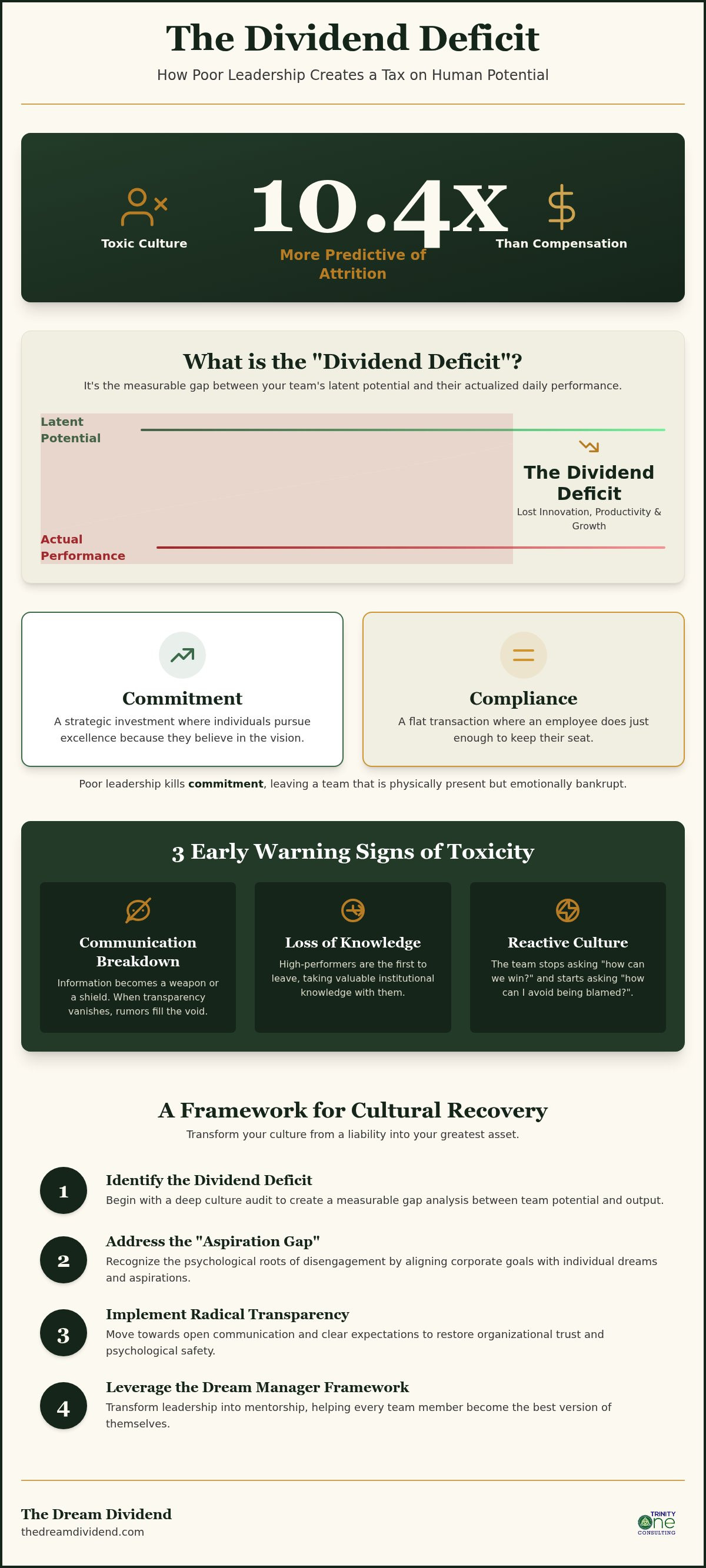
A toxic culture is 10.4 times more powerful than compensation in predicting whether your best people stay or walk out the door. You've likely seen the symptoms of this "invisible tax" in your own halls: the quiet quitting, the sudden resignations, and the heavy silence in meetings where there used to be fire. The corrosive impact of poor leadership on employee morale isn't just a HR headache; it's a structural failure that de-prioritizes the human future. When managers fail to engage, they don't just lose productivity. They bankrupt the very spirit of the organization.
It's time to stop treating these losses as inevitable costs of doing business and start seeing them as a "dividend deficit" you can actively reverse. In this article, you'll discover how ineffective leadership creates a ripple effect that stifles individual dreams and organizational growth alike. We'll explore the psychological mechanisms of disengagement and identify the early warning signs of toxicity before they become terminal. Finally, you'll learn a strategic framework that links personal aspirations to business ROI, helping you transform your culture into a powerful engine for collective success.
Key Takeaways
- Identify the "Dividend Deficit" as a structural tax on your organization that creates a measurable gap between your team's latent potential and their daily output.
- Recognize the psychological roots of disengagement, specifically how a lack of psychological safety and misaligned goals create a persistent "Aspiration Gap" for your talent.
- Examine the profound impact of poor leadership on employee morale and how workplace toxicity bleeds into an individual's health, family life, and long-term well-being.
- Implement a strategic recovery plan that begins with a deep culture audit and moves toward radical transparency to restore organizational trust.
- Leverage the Dream Manager framework to transform your leadership style into a form of mentorship that helps every team member become the best version of themselves.
Table of Contents
- Defining the Moral Cost: What Poor Leadership Actually Destroys
- The Psychology of Disengagement: Why Morale Crumbles Under Bad Management
- Beyond the Office: The Ripple Effect on Personal Dreams and Life Characteristics
- Turning the Tide: Strategic Frameworks for Cultural Recovery
- The Dream Manager Solution: Reinvesting in the Best Version of Your Team
Defining the Moral Cost: What Poor Leadership Actually Destroys
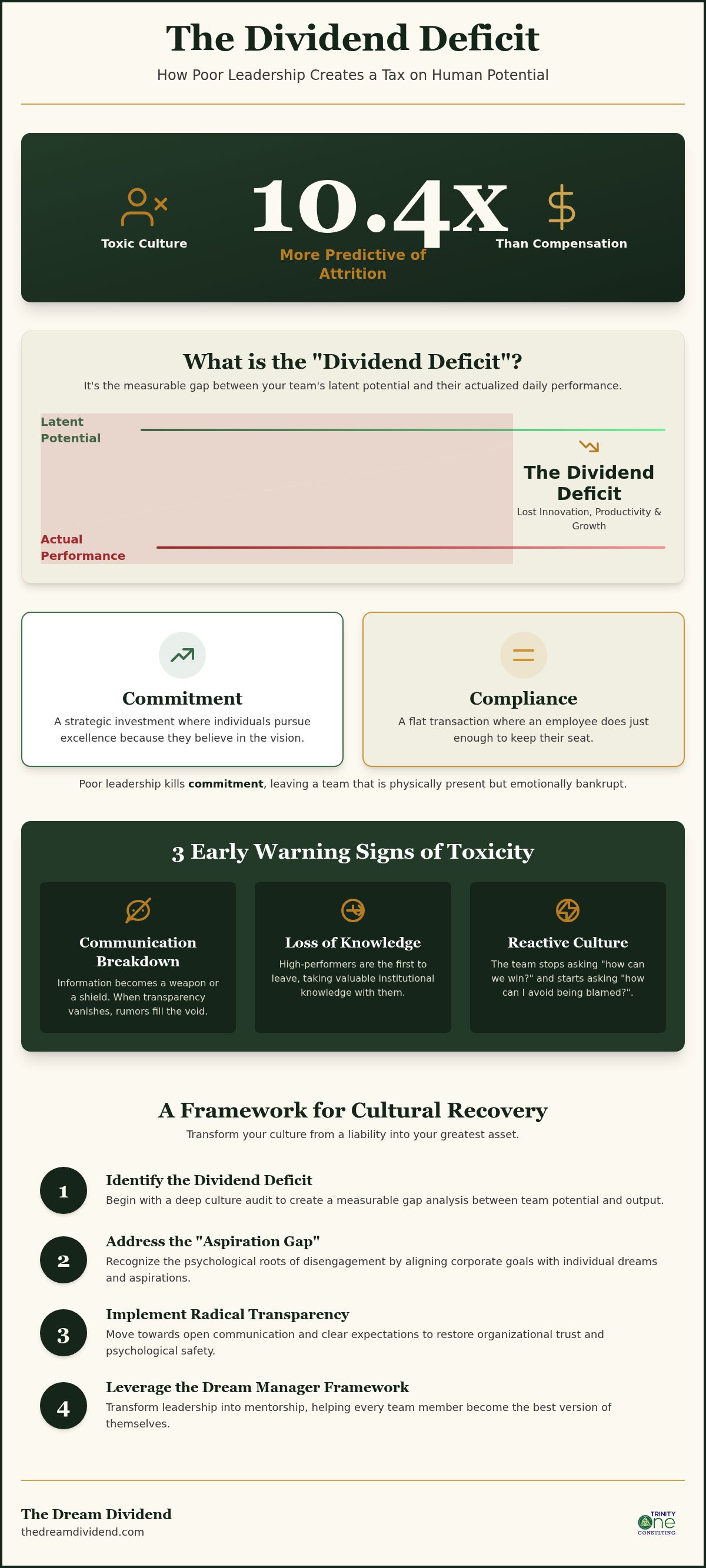
Poor leadership is not merely a localized management failure or a temporary dip in performance. It's a structural tax on organizational health that compounds over time, eroding the very foundations of your business. We call this the "Dividend Deficit." This deficit represents the widening gap between your team's latent potential and their actualized performance. While a healthy culture generates high returns on human effort, a toxic one forces you to pay a premium just to maintain basic operations. Morale acts as the internal currency of execution, determining the speed and quality of every transaction within your organization.
When leadership fails, the workforce shifts from commitment to mere compliance. Compliance is a flat transaction where an employee does just enough to keep their seat. Commitment, however, is a strategic investment where individuals pursue excellence because they believe in the vision. The impact of poor leadership on employee morale effectively kills this commitment, leaving you with a team that is physically present, emotionally bankrupt, and strategically misaligned. You aren't just losing hours; you're losing the future capacity of your people.
The Financial Metaphor of Employee Morale
Think of employee morale as a compounding asset. When nurtured, it builds trust, accelerates innovation, and strengthens your brand equity. Conversely, toxic management acts as a high-interest debt that eventually defaults. By 2026, the economic impact of "Quiet Quitting" and manager disengagement has become undeniable. With manager engagement falling to 22% in recent years, the rot often starts at the top. This erosion doesn't just hurt internal numbers. It damages your external reputation, making the recruitment of top-tier talent an uphill battle against your own history.
Symptoms of the Dividend Deficit
How do you spot the deficit before it becomes a crisis? Look for the shift from proactive problem-solving to reactive survivalism. In a healthy environment, people look for ways to build; in a toxic one, they look for ways to hide. The impact of poor leadership on employee morale manifests through specific, observable failures in the organizational structure:
- Communication Breakdown: Information becomes a weapon or a shield rather than a tool for growth. When transparency vanishes, rumors fill the void.
- Loss of Institutional Knowledge: Your high-performers, who value visionary environments, are the first to leave. Research shows that 50% of employees have left a job specifically to escape a bad manager.
- Reactive Culture: The team stops asking "how can we win?" and starts asking "how can I avoid being blamed?" This shift marks the transition from growth to survival.
When these symptoms appear, the leadership failure has already begun to structuralize. The result is an organization that is no longer navigating toward a goal, but merely trying to stay afloat in a sea of apathy. To reverse this, we must look deeper than management tactics and address the psychological foundations of the workplace.
The Psychology of Disengagement: Why Morale Crumbles Under Bad Management
Disengagement is rarely a sudden event; it's a defensive withdrawal. When a leader’s objectives conflict with an employee’s personal growth, an "Aspiration Gap" forms. This gap represents the distance between corporate output and individual fulfillment. If a team member feels their personal dreams are being sacrificed for a quarterly quota, they don't just work less. They protect themselves by mentally checking out. The impact of poor leadership on employee morale is most visible here, where the psychological contract between the individual and the organization begins to fray.
Psychological safety is the structural foundation of any high-performing team. Without it, the brain’s amygdala treats every piece of critical feedback or micromanagement as a direct threat. Micromanagement, in particular, signals a fundamental lack of trust. It triggers a "threat response" that shuts down the prefrontal cortex, the area of the brain responsible for creativity and complex problem-solving. Leaders must pass the "Mirror Test" daily, reflecting on how their own energy, anxiety, or dismissiveness dictates the emotional temperature of the room. If you project fear, you will harvest apathy.
The Erosion of Trust and Autonomy
In the 2026 workforce, autonomy has emerged as the primary driver of engagement. High-performers don't want to be managed; they want to be mentored toward becoming the best version of themselves. Transaction-based management, which relies on a "do this, get that" mentality, creates cognitive dissonance and chronic anxiety. It ignores the human need for purpose. Conversely, aspiration-based management aligns organizational goals with the 12 Life Characteristics of the individual. When leaders fail to bridge this gap, they create a culture of "Quiet Cracking," where managers and employees alike feel the weight of misaligned expectations. You can explore how to realign these interests by visiting The Dream Dividend to learn about modern cultural transformation.
The Death of Innovation in Toxic Climates
Innovation cannot survive in a climate of dismissiveness. When leadership punishes necessary experimentation, they effectively kill the future of the company. A "Safe-to-Fail" framework is essential for growth, yet poor leaders often view every mistake as a liability rather than a lesson. This creates a "checked-out" workforce that avoids risk at all costs. The long-term cost is a stagnant product pipeline and a team that has lost the ability to imagine what’s possible. To reverse this, leadership must shift from being a gatekeeper of tasks to being an architect of potential.
Beyond the Office: The Ripple Effect on Personal Dreams and Life Characteristics
The reach of a manager extends far deeper than the organizational chart. When leadership is toxic, the damage doesn't stay confined to the cubicle; it follows the employee home, sits at their dinner table, and disrupts their sleep. We must view leadership through the lens of the 12 Life Characteristics, a metric for whole-person excellence that measures everything from physical vitality to emotional stability. If an individual is suffering at work, their ability to excel in these other dimensions of life is fundamentally compromised. The negative impact of poor leadership on employee morale creates a ripple effect that turns a professional challenge into a personal crisis.
A soul-crushing job does more than lower productivity; it forces the abandonment of personal dreams. When people are stuck in a cycle of reactive survivalism, they lose the capacity to imagine a better future for themselves or their families. By 2026, the modern workforce has moved beyond the simple desire for a paycheck. Today’s talent demands "Whole Person Leadership Development." They seek mentors who recognize that professional success is hollow if it comes at the expense of one's humanity. If you aren't investing in the person, you are merely consuming their labor until they have nothing left to give.
Work-Life Integration vs. Work-Life Conflict
Poor leaders often manufacture artificial urgency to mask their own lack of strategic clarity. This constant state of high-alert destroys personal boundaries, turning what should be work-life integration into a state of permanent conflict. The data is clear: 55% of U.S. workers report experiencing burnout, a condition often driven by managers who prioritize short-term optics over long-term health. This stress manifests in chronic sleep deprivation, weakened immune systems, and strained family relationships. A leader’s influence is a silent guest at every family dinner and a heavy weight in every restless night. When you consider the impact of poor leadership on employee morale, you must look at the kitchen table, not just the conference table.
The Best Version of Yourself Framework
A leader’s primary responsibility is to help their team become the best version of themselves. This is the ultimate "Dream Dividend." When leadership is ineffective, it acts as a barrier to this evolution, causing professional stagnation that leads to deep personal disillusionment. If an employee feels their growth is being actively suppressed, they won't just leave your company; they may lose faith in their own potential. True leadership is architectural; it provides the structural support for individuals to build their highest aspirations. Without this foundation, the human spirit begins to default on its own dreams, creating a deficit that no amount of compensation can truly repay.
Turning the Tide: Strategic Frameworks for Cultural Recovery
Recovery requires more than a simple memo; it demands a fundamental redesign of your leadership architecture. To reverse the corrosive impact of poor leadership on employee morale, you must move from reactive damage control to proactive cultural investment. This process isn't about superficial "perks" or office renovations. It's about rebuilding the structural integrity of trust that has been taxed by years of ineffective management. When you fix the leadership, you fix the future capacity of the entire organization.
To begin this transformation, follow a structured recovery roadmap. Start with a comprehensive "Culture Audit" to identify exactly where the Dividend Deficit is most severe. Once the gaps are identified, implement radical transparency in all communications to dissolve the culture of fear. By shifting your focus from mere "Performance Tracking" to "Aspiration Mapping," you transform the workplace from a site of labor into a platform for personal evolution. Utilize the DreamCompass tool to align these individual dreams with professional milestones, ensuring that as the company grows, the individual prospers. Finally, invest in professional coaching through a certified leadership consulting program to ensure these changes are sustainable and systemic.
The Mirror Test: A Leadership Self-Audit
The Mirror Test is a daily discipline for the visionary leader. Ask yourself: "Would I want to be led by me today?" This isn't a question of ego, but one of strategic impact. To gauge trust, ask your team what they need to become the best version of themselves, then listen without defensiveness. Moving from management by fear to management by inspiration requires you to own your influence. If your behavior dictates the team's energy, ensure that energy is one of calculated optimism and relentless support. Listen, reflect, and act.
Implementing the Dream Manager Framework
The most effective antidote to toxic culture is a shift in the managerial role itself. By implementing a Dream Manager program, you position your leaders as life coaches who are invested in the whole person. This framework doesn't just improve the atmosphere; it delivers a tangible ROI through reduced turnover, increased engagement, and a more resilient workforce. In the 2026 business landscape, the impact of poor leadership on employee morale is a choice you no longer have to make. You can choose to be the architect of a culture where dreams and profits grow in tandem. If you are ready to stop the drain on your human capital and start building a culture of excellence, reach out to the experts at The Dream Dividend to begin your transformation.
The Dream Manager Solution: Reinvesting in the Best Version of Your Team
Traditional leadership training often fails because it treats the symptoms of disengagement rather than the root cause. Most programs focus on task delegation, conflict resolution, or personality typing. While these skills are useful, they don't address the fundamental reason morale collapses: the feeling that the company is a consumer of a person's life rather than a partner in it. To truly reverse the impact of poor leadership on employee morale, you must move beyond tactical management and embrace the role of a strategic mentor. You aren't just managing a workforce; you're stewarding human potential.
The Dream Manager Framework serves as the strategic differentiator in this pursuit. It shifts the organizational focus from mere output to the holistic development of the individual. When a leader takes a genuine interest in an employee's personal aspirations, the dynamic of the relationship changes from a transaction to an investment. This approach is explored deeply on The Dream Dividend Podcast, where visionary leaders share how they have successfully transitioned from being gatekeepers of productivity to architects of dreams. Your culture should be your most valuable asset, not a hidden liability that taxes every initiative you launch.
The Strategic Financial Case for Dreams
For those focused on the bottom line, the Dream Manager ROI provides a compelling financial argument for this human-centric approach. Investing in employee aspirations isn't "soft" management; it's a calculated strategy to protect your human capital. Organizations that implement these principles often see a significant reduction in turnover, with some benchmarks showing up to a 40% improvement in retention. This represents a massive shift from traditional "Human Resources" to a focus on "Human Aspirations." When people feel that their personal growth is the fuel for the company's success, they stop looking for the exit and start looking for ways to contribute to the collective mission.
Next Steps: Becoming a Certified Dream Manager
The journey toward cultural excellence requires a new set of competencies. The Certified Dream Manager program is designed to equip leaders with the tools needed to facilitate this transformation. It provides a structured methodology for using the 12 Life Characteristics to guide individuals toward becoming the best version of themselves. For organizations seeking a more tailored approach, Dream Management Consulting offers bespoke solutions to unlock a high-performance culture.
Leadership is the architecture of human potential. It's the foundation upon which every dream is built and every professional milestone is reached. By choosing to invest in your people's personal futures, you stop paying the "invisible tax" of a disengaged workforce. Instead, you begin to collect the Dream Dividend: a culture defined by loyalty, innovation, and an unwavering commitment to excellence. The impact of poor leadership on employee morale is a cycle you have the power to break today. Build something that lasts by building the people who make it possible.
Architecting a Culture of Aspiration
The journey toward organizational excellence begins with a fundamental shift in perspective. You've seen how the impact of poor leadership on employee morale acts as a persistent drain on your most valuable resources; yet, this deficit is entirely reversible. By moving from a culture of compliance to one of commitment, you transform the workplace into a strategic engine for growth. True leadership isn't about managing tasks; it's about stewarding the human potential within your halls.
Successful recovery relies on aligning individual aspirations with professional milestones. World-class organizations now use these principles to drive engagement and create sustainable value. Based on Matthew Kelly’s "The Dream Manager" principles, our methodology is proven to slash turnover by up to 40% while fostering a culture of relentless innovation. You don't have to navigate this cultural redesign alone.
It's time to stop paying the invisible tax and start collecting the dividends of a fully engaged team. Unlock your team’s potential with Dream Management Consulting and begin building the best version of your organization. Your people are your greatest asset; it's time to invest in their dreams and watch your collective vision take flight.
Frequently Asked Questions
How does poor leadership specifically affect employee morale?
Poor leadership erodes morale by creating an environment of fear, uncertainty, and stagnation. When leaders fail to provide clear direction or support, employees shift from proactive innovation to reactive survivalism. The impact of poor leadership on employee morale manifests as a loss of trust that shuts down the brain's creative centers. This psychological withdrawal leads to "quiet quitting" where the team does the bare minimum to avoid notice rather than pursuing excellence.
What are the early warning signs of a toxic leadership culture?
Early indicators include a 149% surge in "misalignment" mentions in internal reviews and a rise in defensive communication patterns. You might notice high-performers suddenly becoming silent in meetings or a noticeable lack of risk-taking across departments. A toxic culture is 10.4 times more powerful than compensation in predicting attrition, so watch for "quiet cracking" among managers. If information becomes a weapon rather than a shared tool, the structural integrity of your culture is failing.
Can a company recover from the impact of a bad manager?
Recovery is entirely possible through a structured architectural redesign of the leadership framework. It begins with a deep culture audit to identify the roots of distrust, followed by radical transparency in communication. Companies must shift their management focus from simple performance tracking to aspiration mapping. By reinvesting in the personal growth of the team, an organization can rebuild the trust that was previously taxed, turning a legacy of failure into a future of shared success.
What is the "Dividend Deficit" in workplace culture?
The Dividend Deficit is the measurable gap between a team’s latent potential and their actualized performance caused by ineffective leadership. It acts as an invisible tax on every initiative, slowing down execution and inflating operational costs. While a healthy culture compounds trust and innovation, a deficit culture forces the organization to pay a premium for basic compliance. Reversing this deficit requires a strategic shift toward investing in the whole person rather than just the professional output.
How does leadership impact employee retention in 2026?
In the 2026 workforce, leadership is the primary architect of retention. Statistics show that at least 50% of employees have left a job specifically to escape a bad manager. Today's talent prioritizes "Whole Person Leadership Development" over traditional compensation packages. If a leader fails to act as a mentor toward becoming the best version of yourself, high-performers will seek visionary environments where their personal aspirations are treated as vital strategic assets rather than afterthoughts.
Why is "Management by Aspiration" more effective than traditional management?
Traditional management relies on transaction-based interactions that focus on short-term quotas and compliance. Management by Aspiration is more effective because it aligns an employee's personal dreams with the company's professional goals. This alignment creates a natural momentum where the individual's pursuit of excellence fuels the organization's growth. By utilizing tools like the DreamCompass, leaders can foster a culture where employees feel their work is a bridge to their highest potential, not a barrier to it.
What is the role of a Dream Manager in improving morale?
A Dream Manager acts as a strategic architect of human potential within the organization. Their role is to help employees identify and achieve their personal dreams using the 12 Life Characteristics framework. By focusing on the whole person, a Dream Manager directly counteracts the impact of poor leadership on employee morale. This investment creates a "Dream Dividend," resulting in higher engagement, lower turnover, and a workforce that is emotionally invested in the collective success of the business.
How much does poor leadership cost a company annually?
While the full cost of the "invisible tax" is difficult to quantify, specific data points reveal the scale of the damage. Employee burnout alone is estimated to cost global businesses $322 billion annually in lost productivity. When you factor in that a toxic culture is the leading predictor of attrition, the financial drain becomes systemic. Companies lose institutional knowledge, recruitment fees, and brand equity every time a bad manager drives a high-performer out the door.