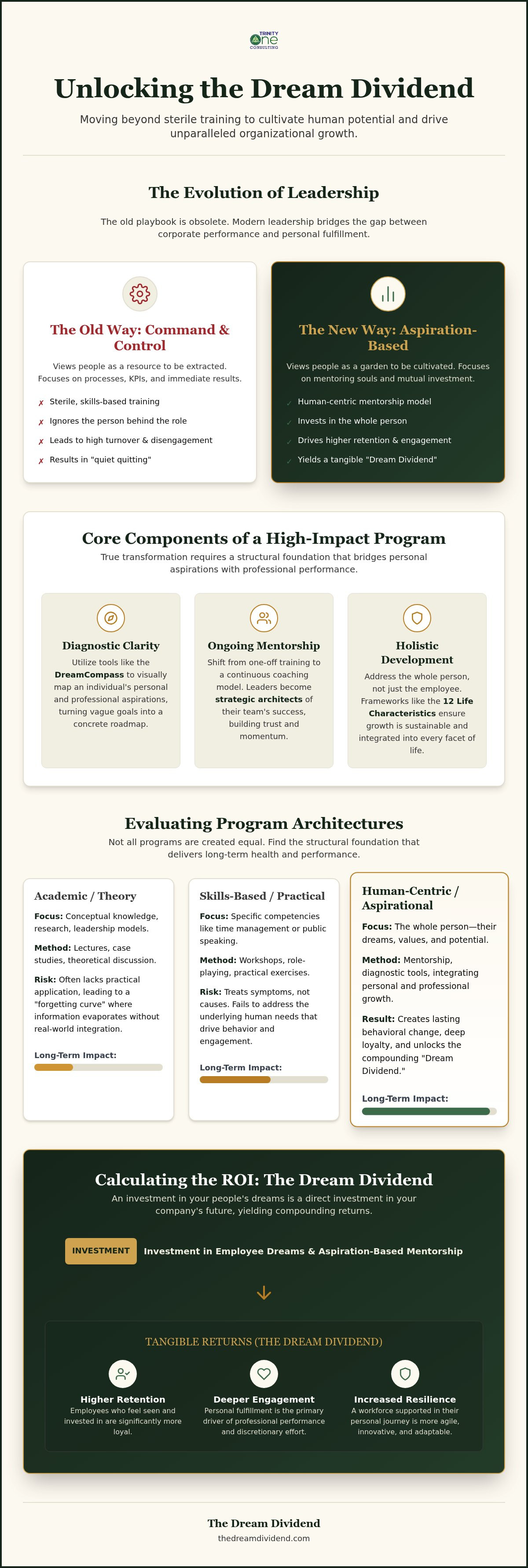
What if the most valuable asset on your balance sheet isn't your proprietary technology or your market share, but the unrealized dreams of your people? Most transformational leadership programs fail because they treat human potential as a resource to be extracted rather than a garden to be cultivated. You've likely seen the results of this sterile approach: high turnover, the quiet drain of disengagement, and training sessions that feel like temporary bandages on deep-seated cultural wounds.
It's clear that the old playbook of command and control is no longer solvent in a world that demands meaning, growth, and connection. You deserve a strategy that bridges the gap between corporate performance and personal fulfillment. This guide provides a clear framework to evaluate and select leadership development that yields a tangible Dream Dividend. We'll examine how to identify programs that build better humans, explore the architecture of mentorship, and leverage tools like the DreamCompass to create a culture where every individual feels seen, valued, and invested in the collective future.
Key Takeaways
- Learn why modern transformational leadership programs must move beyond sterile skill-building to embrace a mentorship model that honors the individual.
- Discover how to integrate personal aspirations with professional performance using diagnostic tools like the DreamCompass to drive holistic growth.
- Quantify the "Dream Dividend" by measuring how an investment in employee dreams compounds into higher retention and deeper engagement.
- Evaluate different program architectures, ranging from academic theory to skills-based training, to find the structural foundation your organization needs for long-term health.
- Transition from traditional management to a coaching model that positions leaders as strategic architects of their team's personal and professional success.
Table of Contents
Evaluating Transformational Leadership Programs in 2026
Leadership is no longer a mere checklist of professional competencies; it's the structural foundation for human flourishing. In 2026, the market for transformational leadership programs has shifted away from the sterile extraction of labor toward the strategic cultivation of people. While legacy models focused heavily on the "how" of business, modern frameworks prioritize the "who." This evolution is deeply rooted in transformational leadership theory, which posits that leaders who inspire individual growth create organizations that are more resilient, more innovative, and more profitable. It's the difference between managing a resource, overseeing a process, and mentoring a soul.
Why do so many corporate initiatives fail to move the needle on engagement? They treat employees like hardware requiring a software update rather than humans seeking a sense of purpose. When training ignores the person behind the desk, quiet quitting becomes the inevitable result of a spiritual vacuum. You can't fix a cultural crisis with a weekend seminar on time management. When evaluating transformational leadership programs, look for those that treat human potential as a strategic asset and bridge the gap between organizational KPIs and individual aspirations.
The Evolution from Manager to Life Coach
The modern leader acts as a strategic architect of human potential. Today's most effective managers don't just oversee tasks; they coach dreams. This shift toward aspiration-based management recognizes that personal growth is now the primary driver of workplace loyalty. When a leader acts as a "Dream Manager," they signal that the company's success is inextricably linked to the employee's success. It's a philosophy of mutual investment: you invest in their future, they reinvest their energy into your mission, and the entire organization realizes a compounding return on empathy. Leaders must learn to see, value, and challenge their people to reach heights they hadn't imagined for themselves.
Why Traditional Corporate Training Falls Short
Most workshops suffer from a steep "forgetting curve," where the majority of new information evaporates shortly after the session ends. This happens because the training lacks a structural foundation to support long-term behavioral change. Sterile corporate environments often prize immediate results over sustainable growth, leaving leaders with tools they don't know how to integrate into daily life. To bridge this gap, organizations are turning to frameworks like the 12 Life Characteristics. By addressing the whole person, these programs ensure that leadership isn't just a role you play at work, but a way of becoming the Best Version of Yourself in every facet of life. Agility isn't something you can mandate; it's a byproduct of an engaged workforce that feels supported in their personal journey.
Core Components of a High-Impact Leadership Curriculum
High-impact transformational leadership programs don't just teach management; they build a bridge between the individual's soul and the company's balance sheet. Traditional training often fails because it isolates professional skills from the human being performing them. If you want a team that performs at its peak, you must first ensure they're thriving as individuals. This is a people-focused approach to leadership that recognizes personal fulfillment as the primary driver of professional ROI. When leadership curriculum integrates personal development with professional KPIs, it creates a culture where growth isn't just a corporate mandate but a shared human journey.
True transformation requires more than a one-and-done seminar. It demands a structural foundation of ongoing mentorship and diagnostic clarity. By using the DreamCompass tool, organizations move beyond vague aspirations toward a concrete roadmap for excellence. This methodical approach ensures that the investment in your people doesn't evaporate after a few weeks; instead, it compounds over time, creating a high-performance culture built on trust, clarity, and momentum.
Mapping Aspirations with the DreamCompass
Visual tools like the DreamCompass allow leaders to see the trajectory of their people's lives. When a manager understands a team member's personal dreams, the relationship shifts from transactional to transformational. It creates a powerful psychological bond where the employee feels seen, valued, and supported. Goal-tracking for personal excellence ensures these dreams don't remain fantasies but become milestones in a well-architected life. This alignment between personal desire and professional duty is the secret to sustainable engagement. If you're curious about how these tools function in real-world scenarios, you might listen to The Dream Dividend Podcast to hear from leaders who've mastered this art.
The 12 Life Characteristics Framework
Holistic growth is anchored in the 12 Life Characteristics, which provide a blueprint for excellence across every dimension of existence. These pillars, ranging from physical health to emotional stability and intellectual growth, create a resilient workforce capable of navigating any market challenge. By focusing on these characteristics, organizations provide their people with the navigation tools needed to steer through both personal and professional storms. The "Best Version of Yourself" framework functions as a daily, intentional practice that empowers leaders to model the holistic growth they wish to see in their teams. It's a commitment to continuous improvement that transforms the office from a place of work into a laboratory for human potential.
The ROI of Aspiration: Calculating the Dream Dividend
Skeptics often dismiss human-centric initiatives as "soft" metrics better suited for a retreat than a boardroom. This is a fundamental misunderstanding of human capital. In reality, the most rigorous transformational leadership programs produce a financial surplus that far outweighs the initial capital outlay. We call this the Dream Dividend. It's the tangible profit generated when your people stop working for a paycheck, start working for a purpose, and begin investing their best selves into the mission.
Calculating dream manager ROI requires a shift in perspective. You must view leadership development not as a line-item expense to be minimized, but as a strategic investment to be compounded. When you fund the personal aspirations of your team, you aren't just being "nice." You're securing the structural integrity of your organization. It's a pragmatic business strategy that recognizes that a company can only reach its full potential if its people are reaching theirs.
Reducing Turnover Through Personal Growth
Every time a high-performer walks out the door, they take thousands of dollars in institutional knowledge and recruitment costs with them. Aspiration-based management creates an impenetrable culture by making the workplace the primary engine for personal fulfillment. By aligning corporate goals with individual desires, you turn your company into a destination rather than a pit stop. Mapping employee dreams can slash turnover rates by ensuring people feel their future is being built within your walls, not outside of them. This creates a sense of loyalty that no competitor's sign-on bonus can easily break.
Engagement as a Strategic Asset
The hidden tax of quiet quitting is a silent drain on your annual revenue. Disengaged employees don't just do less; they erode the momentum of those around them, stall innovation, and lower the bar for excellence. A dream management consulting approach revitalizes stagnant cultures by replacing apathy with ambition. It's a strategic architecture that converts disengagement into a competitive advantage. Over time, this investment in human potential compounds. You'll find that an organization fueled by individual dreams is more agile, more innovative, and more profitable than any transactional competitor could ever hope to be.
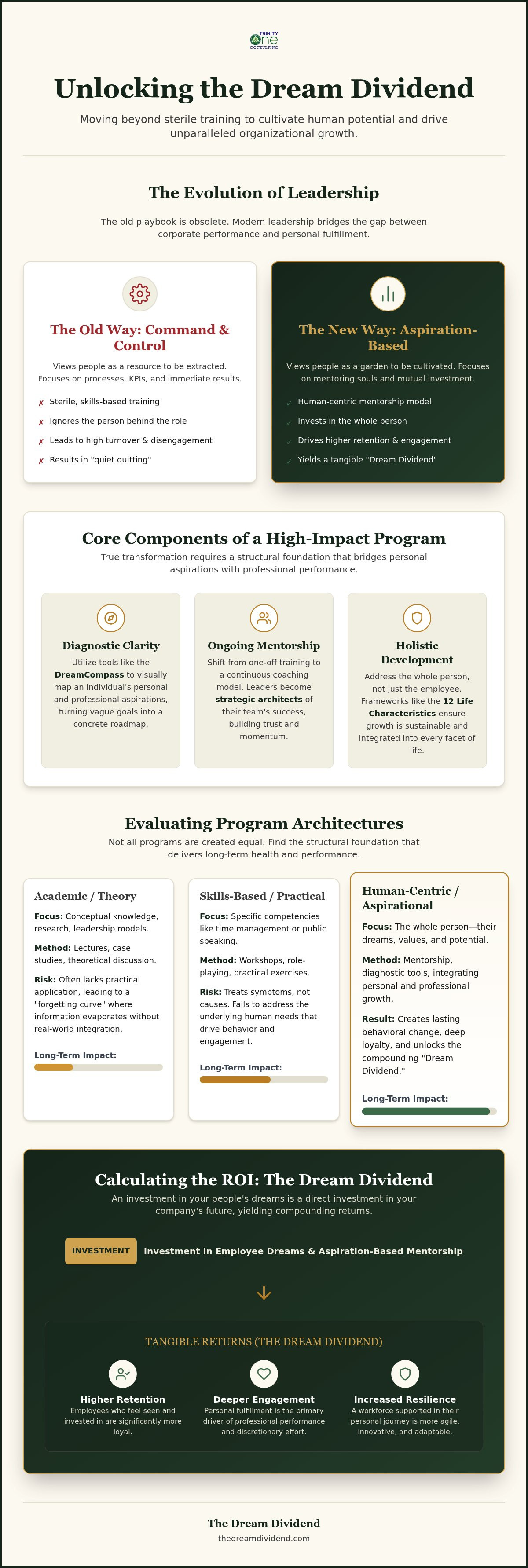
Comparing Program Formats: Academic vs. Practical vs. Human-Centric
Choosing between various transformational leadership programs requires an honest assessment of your organization's architectural needs. Academic certificates from prestigious universities offer undeniable authority, deep research, and high-level prestige. However, they often remain trapped in the ether of theory, making them difficult for busy managers to apply in the heat of daily operations. Standard skills-based corporate training provides immediate tactics, but it frequently lacks the soul required to inspire long-term loyalty or solve the root causes of disengagement. The human-centric model represents the logical evolution of leadership, focusing on the individual's growth as the primary driver of organizational health.
University programs are often too slow for the pace of modern business. They prioritize research over results. Conversely, standard corporate workshops are too shallow. They offer bandages where surgery is required. A human-centric approach, like the Dream Manager framework, bridges this gap by providing a pragmatic, repeatable methodology that honors the person behind the professional. It's about matching the program to your maturity level: do you need a theoretical foundation, a tactical toolkit, or a transformative culture?
The Case for Professional Certification
A certified dream manager program offers more than just a credential; it provides a structural foundation for mentorship. In the 2026 job market, "Manager as Coach" is no longer a luxury. It's a requirement for any firm that wishes to attract and keep top-tier talent. Certification ensures that your leadership team speaks a common language, utilizes validated tools, and follows a consistent process. While external consulting can provide a necessary spark, internal certification allows your culture to scale and sustain itself without permanent outside intervention. It turns your managers into strategic architects of human potential.
Implementation Speed and Cultural Integration
Speed of implementation is a vital metric for any strategic initiative. Academic paths can take years to yield results. Consulting can take months to design. A human-centric framework integrates into your existing organizational culture transformation by focusing on the immediate, personal aspirations of your team. To secure buy-in from upper management, focus on three pillars: the financial cost of turnover, the hidden drain of disengagement, and the compounding value of a purpose-driven workforce. When leadership training is personal, it becomes permanent.
Ready to build a leadership foundation that lasts? Explore our consulting services to see how we can help you architect a culture of excellence.
Building Your Dream-Driven Leadership Foundation
The old model of transactional management is bankrupt. It's a system that prioritizes short-term output over long-term human health, leading inevitably to the disengagement and turnover we see today. The most effective transformational leadership programs recognize that the Dream Manager framework is the only logical conclusion for modern leadership. If you desire a culture that resists turnover, radiates purpose, and compounds value, you must transition from merely managing people to actively coaching dreams. This shift represents the ultimate alignment between organizational health and individual flourishing.
The Dream Dividend stands as your strategic architect in this vital transition. We don't offer superficial fixes or sterile workshops that fade within a week. Instead, we provide the navigation tools and structural foundations necessary to build a high-performance culture from the ground up. Whether through deep-dive assessment, professional certification, or bespoke consulting, the path forward is clear. You're invited to stop overseeing labor and start investing in the potential of the human spirit.
Becoming a Certified Dream Manager
The journey toward becoming a Certified Dream Manager is one of profound professional and personal evolution. It's a process that moves beyond theory into the practical application of mentorship, accountability, and inspiration. Throughout the certification journey, leaders learn to utilize the proprietary tools that turn vague aspirations into concrete results. You won't walk this path alone. The program provides an enduring community of like-minded professionals and ongoing support to ensure your leadership remains sharp and impactful. To hear how this framework functions in diverse industries, listen to The Dream Dividend Podcast for real-world examples of leading with purpose.
The Future of Humanizing the Workplace
The workplace of the future is not a site of extraction; it's a center of cultivation. It is a space where individuals are seen, valued, and empowered to reach the Best Version of Themselves. This is the visionary promise of the Dream Dividend. When you invest in the dreams of your people, you secure the future of your organization. The financial returns are significant, but the human impact is immeasurable. Your journey toward a purpose-driven culture begins with a single, intentional step. Utilize the DreamCompass tool today to begin mapping the aspirations of your team and unlock the high-performance culture your organization deserves.
Architecting the Future of Leadership
The corporate landscape of 2026 demands a leadership model that recognizes the human being behind the professional KPI. We've explored how the most effective transformational leadership programs succeed by moving beyond sterile skill-building toward a mentorship model that honors individual aspirations. By calculating the Dream Dividend, organizations can finally quantify the massive financial return on personal fulfillment, turning engagement into a compounding strategic asset. True cultural transformation requires a structural foundation that addresses the whole person through validated tools and ongoing coaching.
It's time to stop managing labor and start architecting potential. Based on the transformative principles of Matthew Kelly’s "The Dream Manager", our framework utilizes the proprietary DreamCompass goal-tracking tool to bridge the gap between corporate goals and personal dreams. Led by Kevin Patrick, a veteran Certified Dream Manager, we provide the mentorship your organization needs to thrive. Transform your culture with the Certified Dream Manager Program and begin your journey toward a human-centric ROI. The future of your business is built on the dreams of your people; it's time to invest in them.
Frequently Asked Questions
What is the difference between a leadership consulting program and an MBA?
An MBA provides the technical architecture of business, whereas transformational leadership programs focus on the human navigation within that structure. While an MBA teaches you how to manage a balance sheet, our consulting teaches you how to inspire the people who drive those numbers. It's the difference between understanding the machine and empowering the operator. One is a degree in administration; the other is a mastery of mentorship and holistic growth.
How long does it typically take to see results from a transformational leadership program?
You'll often notice a shift in cultural momentum within the first ninety days as people feel seen and valued for the first time. Tangible financial results, such as reduced turnover and increased productivity, typically compound over six to twelve months. This is a strategic investment in human potential, not a superficial fix. Like any high-yield asset, the most significant returns accrue to those who commit to the long-term architecture of their culture.
Can a dream management approach work in highly technical or industrial fields?
A dream management approach is particularly effective in high-pressure technical or industrial environments where burnout is a constant threat. These fields often treat people as cogs in a machine, leading to the quiet drain of disengagement. By humanizing the workplace, you create a structural foundation of loyalty that technical skills alone cannot build. It transforms a sterile job site into a laboratory for personal excellence and professional mastery.
What are the specific 12 Life Characteristics used in your leadership framework?
Our framework utilizes twelve distinct pillars to ensure holistic growth for every leader and employee. These pillars are categorized into the following dimensions of life:
- Physical, Emotional, and Intellectual health
- Spiritual, Psychological, and Professional development
- Financial, Social, and Character foundations
- Creative, Family, and Adventure aspirations
Addressing these characteristics ensures that your team isn't just surviving the workday but is actively becoming the Best Version of Themselves in every dimension of life.
How do we measure the ROI of a leadership program focused on employee dreams?
We measure the ROI of transformational leadership programs by tracking three primary metrics: retention rates, recruitment costs, and engagement scores. When turnover drops, the savings in onboarding and lost institutional knowledge create a direct financial surplus. Additionally, purpose-driven teams consistently outperform disengaged ones in output and innovation. We view these metrics as the compounding interest of a well-placed investment in the dreams and aspirations of your workforce.
Is the Certified Dream Manager program available for individual leaders or just companies?
The Certified Dream Manager program is designed for both visionary individuals seeking to elevate their careers and organizations looking to scale their internal mentorship capacity. Individual leaders gain a powerful credential that is highly valued in the modern job market. Companies can certify their own managers to create a sustainable, self-driven culture of excellence. Whether you're a solo architect of change or a corporate leader, the framework provides a repeatable path to success.
How does the DreamCompass tool integrate with existing performance reviews?
The DreamCompass tool transforms traditional performance reviews from transactional critiques into aspirational dialogues. Instead of simply reviewing past output, managers use the tool to align future professional goals with personal dreams. This creates a powerful psychological bond between the employee's growth and the company's mission. It doesn't replace your current review system; it provides the human-centric navigation that makes those systems actually work to drive long-term engagement.
What is the "Dream Dividend" and how is it calculated?
The Dream Dividend is the financial surplus created when an organization successfully bridges the gap between corporate performance and personal fulfillment. It's calculated by totaling the savings from reduced turnover and the gains from increased employee productivity, then subtracting the initial program investment. This isn't just "feel-good" math. It's a pragmatic business strategy that treats human aspiration as a vital asset capable of generating a tangible, measurable return for the boardroom.