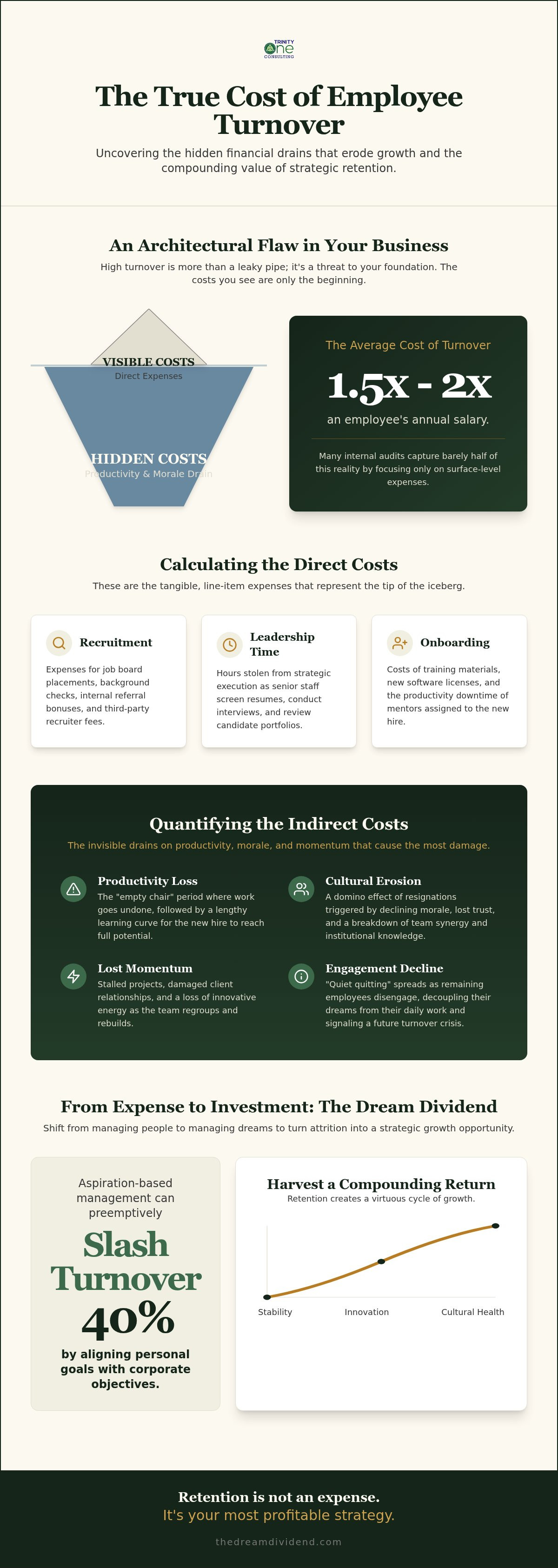
What if the most expensive line item on your balance sheet isn't your overhead, but the silent exodus of the talent you worked so hard to recruit? You already know that every time a key contributor walks out the door, they take more than just their laptop. They take institutional knowledge, client relationships, and team momentum. Yet, when you sit before the board, it's often difficult to move the needle beyond soft cultural concerns. You need a way to show that retention is a financial imperative. Learning how to calculate cost of employee turnover is the first step in shifting the conversation from a human resources headache to a strategic investment opportunity.
It's time to stop viewing attrition as an inevitable cost of doing business and start seeing it as a failure to harvest the Dream Dividend. We'll provide the concrete math and visionary frameworks required to quantify these losses with precision. This article delivers a pragmatic formula to present to leadership, a strategic argument for investing in employee aspirations, and the structural tools needed for long-term growth. You'll learn how to transform your culture into a compounding asset that helps every team member become the best version of themselves.
Key Takeaways
- Identify the architectural flaws that cause a single resignation to trigger a domino effect of declining morale and lost institutional knowledge.
- Master a precise framework for how to calculate cost of employee turnover by aggregating direct hiring expenses and the invisible drains on management time.
- Quantify the Dream Dividend to understand how long-term retention creates a compounding return on innovation, stability, and cultural health.
- Implement a step-by-step formula that translates abstract cultural data into a concrete financial argument for your board of directors.
- Discover how the Certified Dream Manager program helps you transition from managing people to managing dreams, turning attrition into a strategic opportunity for growth.
Table of Contents
- The Hidden Tax on Growth: Understanding the Strategic Impact of Employee Turnover
- The Pragmatic Math: Calculating Direct and Indirect Turnover Costs
- Beyond the Spreadsheet: Factoring in the Dream Dividend and Lost Potential
- The Step-by-Step Calculation Formula for 2026
- From Expense to Investment: Leveraging Dream Management to Slash Turnover
The Hidden Tax on Growth: Understanding the Strategic Impact of Employee Turnover
Think of your organization as a meticulously designed structure. High turnover isn't merely a leaky pipe; it's an architectural flaw that threatens the stability of the entire foundation. When a talented individual exits, they don't just vacate a physical space. They take with them the institutional intelligence, client trust, and team momentum that took years to cultivate. This departure often triggers a psychological contagion. It’s a quiet signal to the rest of the team that the organization’s mission might be faltering, which frequently leads to a domino effect of subsequent resignations.
Modern leaders must view these exits through the lens of human capital ROI. To understand how to calculate cost of employee turnover, you have to look beyond the surface-level recruitment fees. You're losing the "Dream Dividend," that compounding value generated when an employee’s personal aspirations align perfectly with your corporate objectives. When this alignment breaks, the financial loss isn't just a one-time expense. It's a recurring tax on your future growth, innovation, and stability.
The Cultural Erosion Factor
Every time a key player leaves, it forces an organizational culture transformation that is rarely positive. The "unwritten" synergy of a high-performing team is fragile. It relies on deep-seated trust and predictable collaboration. When that synergy vanishes, the remaining staff find it increasingly difficult to focus on becoming the best version of themselves. Instead of pursuing excellence, they spend their energy covering operational gaps, onboarding replacements, and managing the emotional fallout of lost colleagues. This erosion of morale is a silent killer of productivity that rarely shows up on a standard P&L statement.
The 2026 Talent Landscape
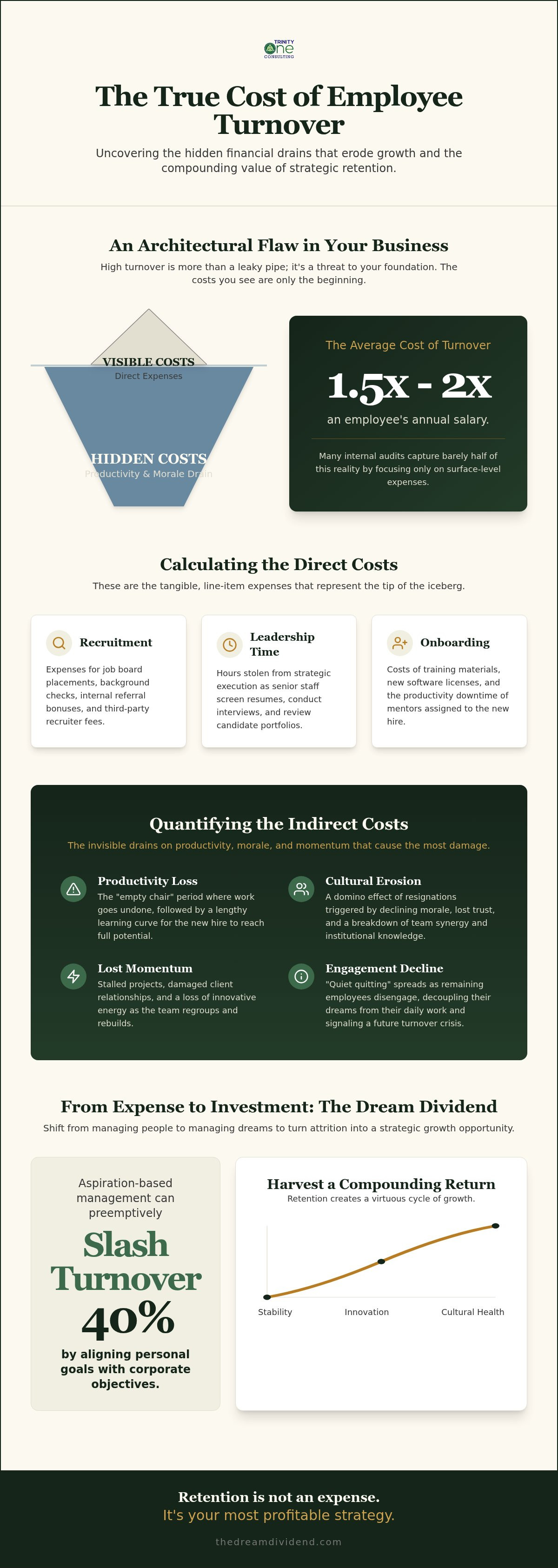
The relationship between employer and employee has undergone a fundamental shift. We've moved past the era of transactional employment into a period defined by aspiration-based management. Today, "quiet quitting" serves as the leading indicator of a coming turnover crisis. It’s the sound of an employee’s dreams being decoupled from their daily work. However, there's a significant opportunity here for visionary leaders. By utilizing tools to map individual dreams, organizations can preemptively slash turnover rates by as much as 40%. When you invest in the person rather than just the position, you transform the workplace from a revolving door into a destination for long-term growth. Learning how to calculate cost of employee turnover is simply the first step in realizing that retention is your most profitable strategy.
The Pragmatic Math: Calculating Direct and Indirect Turnover Costs
Standard HR models frequently miss the mark. They focus on the visible invoices while ignoring the structural erosion occurring beneath the surface. If you want to master how to calculate cost of employee turnover, you must account for both the explicit hard costs and the insidious soft costs that drain your organization's vitality. Industry research indicates that the average cost of turnover typically ranges from 1.5x to 2x an employee's annual salary. Despite this, many internal audits capture barely half of that reality because they fail to look beyond the basic recruitment budget.
Hard Costs: The Recruitment and Onboarding Phase
The recruitment phase is where the most obvious budget leakage occurs. You're paying for job board placements, background checks, and internal referral bonuses. These are the line items that are easy to track, yet they represent only the tip of the iceberg. The most significant hard cost is often the redirected time of your leadership. Every hour a senior executive spends screening resumes, conducting interviews, or reviewing portfolios is an hour stolen from strategic execution, market navigation, and long-term planning. Additionally, the onboarding phase requires new software licenses, training materials, and the inevitable downtime of the mentors assigned to guide the new hire. You're not just paying for a new employee; you're paying for the temporary paralysis of your existing talent.
Soft Costs: The Productivity and Morale Drain
The true financial impact lies in the "empty chair" period and the subsequent learning curve. During a vacancy, remaining team members often face burnout, which can lead to service errors, missed sales opportunities, and declining morale. Once a replacement is found, they aren't immediately profitable. You must calculate the "Ramp-Up ROI," which is the time it takes for a new hire to reach 100% productivity. This period of reduced output, combined with the potential for diminished customer experience, creates a significant productivity gap that standard accounting misses. To see how these variables interact at a deeper level, explore the Dream Manager ROI framework. It's not just about filling a seat; it's about restoring the momentum of your entire operation. If you're ready to move beyond basic spreadsheets, Dream Management Consulting can help you architect a culture that retains your most valuable assets.
Beyond the Spreadsheet: Factoring in the Dream Dividend and Lost Potential
Calculations that focus solely on replacement expenses are fundamentally incomplete. While it's vital to master how to calculate cost of employee turnover using direct and indirect data, the most profound losses exist in the realm of unrealized potential. When an employee leaves, they take their future innovations, their unique perspective, and their untapped creativity with them. This is the opportunity cost of turnover. You aren't just losing a set of current skills; you're losing the compounding value that individual would have contributed to your organization over the next five years.
This loss of momentum is what we call the "Dream Gap." It represents the financial drain caused by employees who are physically present but aspirationally absent. When an individual's personal goals are disconnected from their professional role, their output stagnates. By aligning organizational objectives with the 12 life characteristics, leaders can bridge this gap. This alignment ensures that the energy employees spend on their personal growth also fuels the organization's mission, creating a cycle of mutual success.
Investing in the Whole Person
The "best version of yourself" framework serves as the ultimate retention tool because it addresses the human being behind the job title. There's a massive financial difference between a "worker" who is merely fulfilling a contract and a "dreamer" who sees their job as a vehicle for their life's aspirations. The DreamCompass tool allows leaders to identify retention risks long before a resignation letter is drafted. It helps you navigate the complex relationship between personal fulfillment and professional performance. If you only manage the work, you'll eventually lose the person. If you manage the person's dreams, the work thrives naturally as a byproduct of their internal growth.
The ROI of Aspiration
The connection between personal fulfillment and professional excellence is a matter of strategic survival. In high-stress industries, mapping employee dreams has been shown to drastically reduce turnover by giving team members a reason to stay that transcends their paycheck. They stay because the organization has become a partner in their personal journey. The Dream Dividend is the surplus value generated when a company invests in an individual’s personal aspirations. When you understand how to calculate cost of employee turnover through this lens, you realize that the most expensive employee is the one who stops dreaming while still on your payroll. Retention isn't about keeping people in seats; it's about keeping their passion engaged with your vision.
The Step-by-Step Calculation Formula for 2026
Quantifying the financial impact of attrition requires a methodical approach that balances hard data with strategic insight. To understand how to calculate cost of employee turnover, you must move beyond simple arithmetic and embrace a framework that accounts for the full spectrum of organizational health. This process is about more than just filling gaps in a spreadsheet. It's about identifying the architectural weaknesses in your retention strategy and fortifying them for long-term stability.
- Step 1: Identify the average annual salary and comprehensive benefits package for the specific roles in question.
- Step 2: Aggregate all direct hiring expenses incurred over the past 12 months, including advertising, background checks, and administrative processing.
- Step 3: Estimate your "Productivity Multiplier." Industry research suggests that the true cost of turnover is often 1.5x to 2x the base salary of the departing employee.
- Step 4: Add a "Cultural Impact Tax." This accounts for the morale loss among remaining staff and the management time diverted from strategy to crisis control.
- Step 5: Apply the final formula to find your total turnover liability.
The Comprehensive Turnover Formula
Your total liability is the sum of visible and invisible drains on your resources. Use this formula: Total Cost = (Direct Hiring Costs + Onboarding Costs + Productivity Loss + Cultural Impact Tax). Consider a mid-level manager with a $100,000 salary. If direct hiring costs are $15,000 and onboarding expenses reach $10,000, your visible costs are $25,000. However, once you apply a productivity multiplier of 1.5x ($150,000) and add a conservative $25,000 Cultural Impact Tax, the total liability for that single departure surges to $200,000. By applying the dream manager framework, you can lower these variables by accelerating the ramp-up period and protecting your team's collective momentum.
Benchmarking Your Results
Compare your findings against 2026 industry averages to determine where your organization stands. Identifying "Red Zones," where turnover costs are cannibalizing your profits, is essential for sustainable growth. If your costs exceed 2x salary, your culture likely has a structural deficit that requires immediate attention. Set a strategic goal for reduction by adopting the Dream Dividend model, which focuses on retention through personal fulfillment and mutual growth. If you're ready to stop the budget leakage and start building a resilient workforce, schedule a strategy session with The Dream Dividend to begin your cultural transformation.
From Expense to Investment: Leveraging Dream Management to Slash Turnover
Once you understand how to calculate cost of employee turnover, the raw numbers usually provide a sobering wake-up call. However, data alone cannot repair a fractured culture or stop the silent drain of talent. You must transition from the sterile practice of managing people to the transformative art of managing dreams. This shift represents a move from viewing employees as replaceable units of labor to seeing them as vital, strategic partners in your organization's future. By investing in their personal aspirations, you create a bond that transcends the traditional employment contract, fostering innovation, stability, and growth.
Implementing the Certified Dream Manager program allows your organization to develop internal retention experts. These leaders are trained to navigate the complex intersection of personal fulfillment and professional performance. They don't just solve HR problems; they architect environments where individuals can thrive. Through dream management consulting, you can redesign your cultural foundations to ensure that your mission and your people's aspirations are in perfect alignment. This is how you turn a recurring expense into a compounding investment.
Implementing the Dream Manager Framework
The first 90 days of this transition focus on moving from calculation to cultural transformation. It is a period of discovery, alignment, and momentum. Use the DreamCompass tool to re-engage "quiet quitters" by showing them that their personal goals actually matter to the organization. When an employee realizes that their manager is an advocate for their dreams, their engagement levels skyrocket. You are building a workplace where people stay because they are growing, contributing, and evolving. This human-centric approach ensures that your team remains focused on becoming the best version of themselves while driving your business forward.
The Long-Term Dividend
After one year of implementation, the reduction in turnover costs becomes a tangible asset on your balance sheet. You'll see fewer "empty chairs," lower recruitment fees, and higher levels of internal innovation. This success ripples outward, strengthening your employer brand and attracting top-tier talent who are looking for more than just a paycheck. They want a partner in their personal journey. The best version of your organization is not a distant ideal; it's the natural result of investing in the best version of your people. It's time to stop paying the turnover tax and start harvesting the Dream Dividend. Turn your turnover liability into your greatest strategic dividend by choosing to manage the person, not just the position.
Architecting a Future of Compounding Value
Navigating the complexities of the 2026 talent market requires more than just reactive hiring; it demands a structural shift in how you value your people. The data confirms that the true financial impact of attrition extends far beyond job board fees. It reaches into the very heart of your organization's innovation, stability, and cultural health. Mastering how to calculate cost of employee turnover is the catalyst for this transformation. It allows you to move from a defensive stance of filling seats to a proactive strategy of building a resilient legacy. Dreams are assets. When you protect them, you protect your bottom line.
By integrating the Certified Dream Manager methodology and our architecture-based cultural frameworks, you can transform your turnover liability into a strategic advantage. This ROI-focused human capital strategy ensures that as your people become the best versions of themselves, your organization thrives in tandem. Don't let your most valuable assets walk out the door when you can architect a culture that keeps them engaged and inspired. Unlock your team’s potential with Dream Management Consulting. The path to long-term growth starts with a single, visionary decision. We're here to guide you toward a future where every dream fuels your collective success.
Frequently Asked Questions
What is the average cost of employee turnover in 2026?
The average cost of employee turnover typically ranges from 1.5x to 2x an individual's annual salary. For specialized or senior roles, this figure can climb even higher due to the scarcity of talent and the depth of institutional knowledge lost. These numbers represent a combination of visible recruitment fees and invisible productivity gaps. Understanding these figures is essential for any leader who wants to stop the silent erosion of their organization's profitability.
How do you calculate the indirect costs of turnover like lost productivity?
You calculate indirect costs by measuring the "Productivity Gap" between a departing expert and a new hire. This includes the time the position remains vacant, the reduced output of the new hire during their learning curve, and the diverted time of mentors. When you analyze how to calculate cost of employee turnover, you must account for the temporary paralysis of your existing team. This drain often accounts for over 70% of the total financial impact.
What is the "Dream Dividend" and how does it relate to retention?
The Dream Dividend is the surplus value generated when a company invests in an individual’s personal aspirations. It represents the compounding return on innovation, stability, and cultural health. When employees see their workplace as a vehicle for their own dreams, they become deeply committed to the organization's success. This alignment creates a powerful retention engine that transforms your workforce from a revolving door into a destination for long-term professional and personal growth.
Can a Dream Manager program actually reduce turnover costs?
A Dream Manager program reduces costs by addressing the root causes of disengagement and "quiet quitting." By shifting the focus from managing tasks to managing dreams, the program fosters a culture of loyalty and high performance. Case studies indicate that organizations using this framework see a significant reduction in attrition rates. This translates directly into lower recruitment expenses, stabilized team morale, and a more robust return on your human capital investment.
What are the three biggest hidden costs of losing a top performer?
The three most significant hidden costs are the loss of institutional knowledge, the psychological contagion among remaining staff, and the erosion of client trust. Top performers often hold "unwritten" synergy that keeps a team moving. When they exit, they trigger a domino effect of doubt that can lead to further resignations. Additionally, the time senior leadership spends in crisis control instead of strategic navigation represents a massive opportunity cost that rarely appears on a standard P&L statement.
How do I present turnover cost data to my executive board?
Present your data by framing turnover as a structural deficit rather than just a human resources issue. Use the comprehensive formula to show the total liability, including the "Cultural Impact Tax" and lost productivity multipliers. Boards respond to evidence of budget leakage and threats to long-term growth. When you show how to calculate cost of employee turnover with financial precision, you move the conversation from "soft" culture initiatives to vital, ROI-focused business strategy.
What is the difference between voluntary and involuntary turnover costs?
Voluntary turnover costs are typically higher because they are unplanned and often involve your most engaged talent. These exits cause immediate disruption, morale dips, and urgent recruitment needs. Involuntary turnover, while still costly, is often a strategic decision to remove a poor fit. Both types require you to account for severance, administrative processing, and the inevitable "learning curve" costs associated with finding and training a replacement to restore your team's momentum.
How does the DreamCompass tool help in calculating retention ROI?
The DreamCompass tool serves as a diagnostic instrument to identify retention risks before they result in a resignation. It measures the alignment between an employee's personal goals and the organization’s objectives. By quantifying these levels of engagement, the tool helps you calculate the potential ROI of retention initiatives. It allows you to navigate the complex relationship between personal fulfillment and professional performance, providing the data needed to justify a human-centric investment strategy.