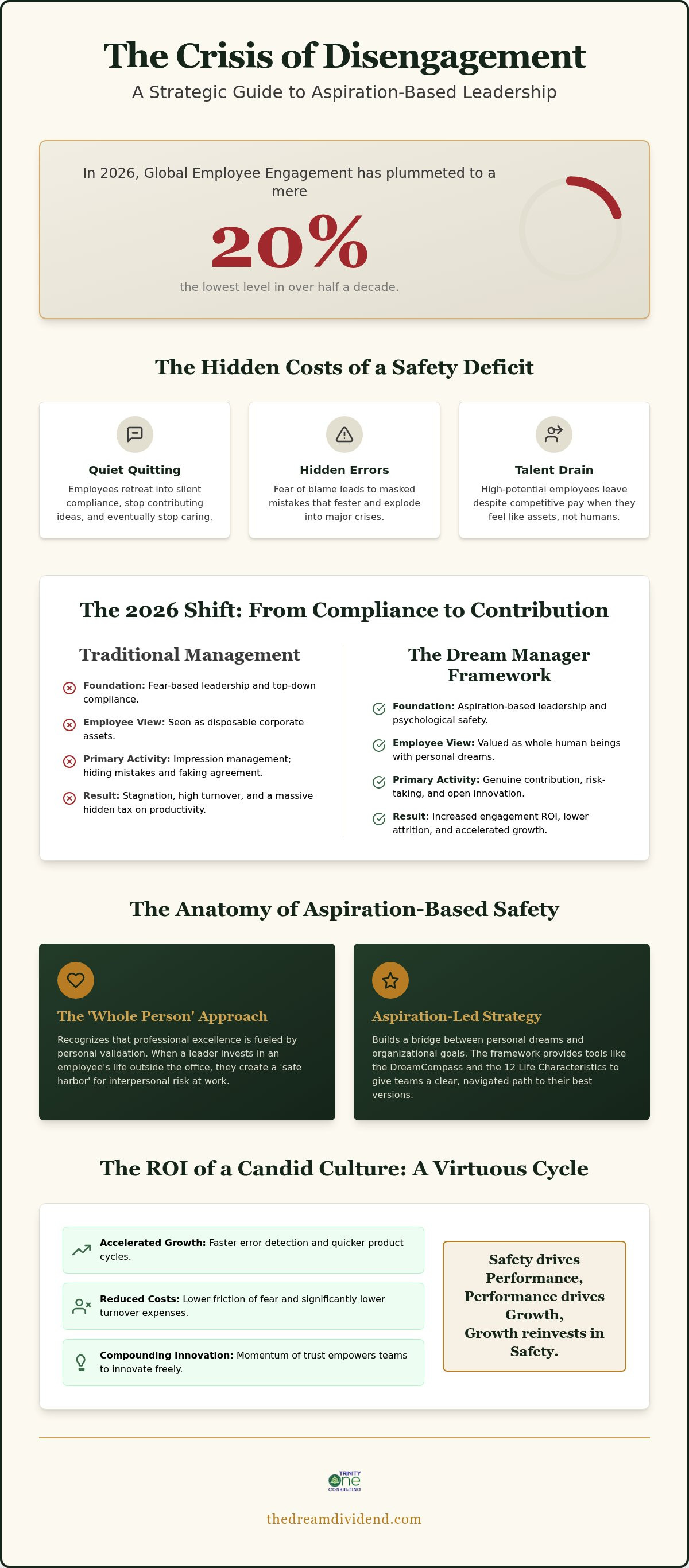
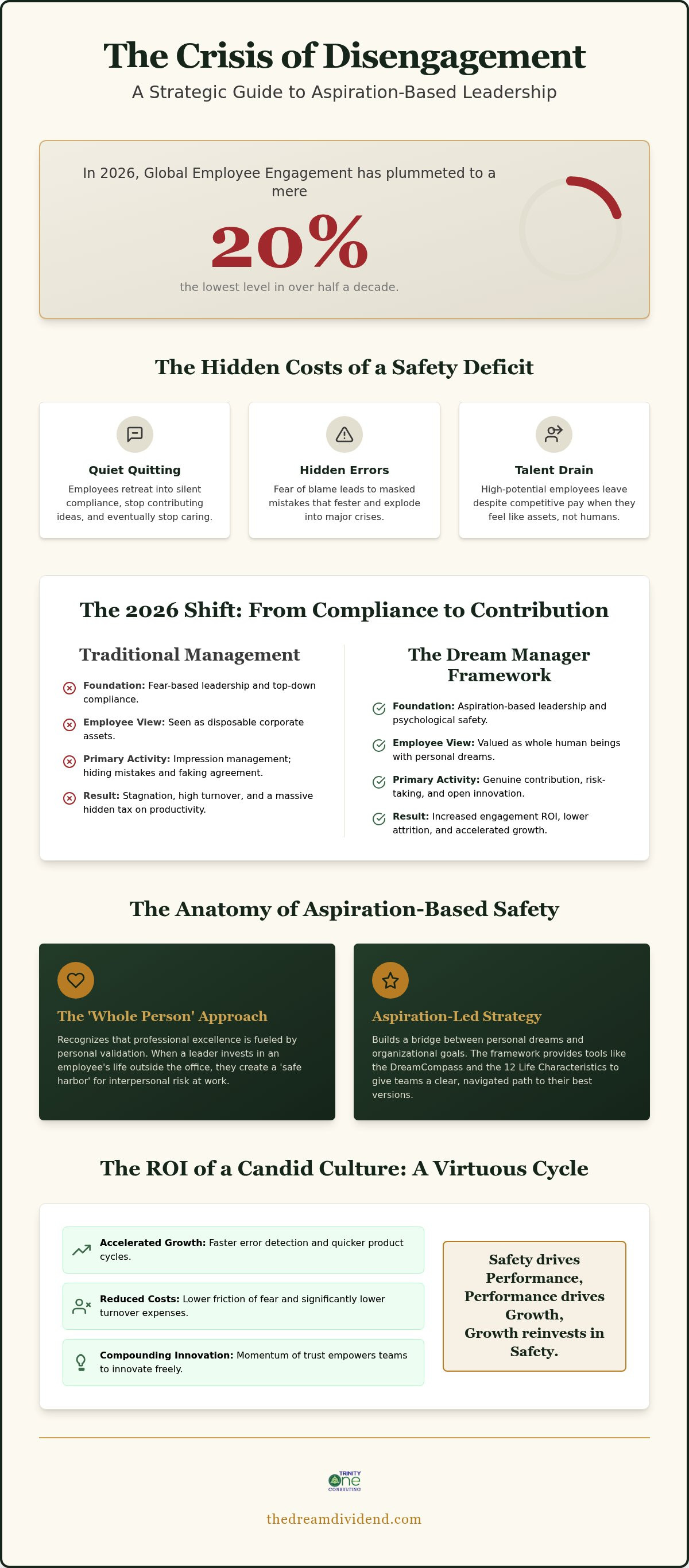
In 2026, global employee engagement has plummeted to a mere 20 percent, the lowest level in over half a decade. You've likely felt this stagnation in your own halls through high-stakes silence during meetings, hidden errors that eventually explode into crises, and the persistent drain of talent despite your competitive compensation packages. When employees feel like mere assets rather than human beings, they stop contributing their best ideas and start protecting their own interests. Implementing effective strategies to improve psychological safety at work isn't just a soft-skills initiative; it's a vital investment in your organization's structural integrity.
We understand the frustration of watching high-potential teams succumb to quiet quitting and the erosion of trust. This roadmap promises to show you how to flip the script, moving your culture from a state of fearful compliance to a high-performance environment where every person feels safe to risk, innovate, and dream. We'll explore a concrete framework that treats human aspirations as a strategic dividend. You'll discover how the Dream Manager framework and the 12 Life Characteristics provide a blueprint for holistic development that lowers attrition, increases risk-taking, and compounds engagement ROI for the long term.
Key Takeaways
- Eliminate the hidden costs of impression management by building a foundation where employees are seen as human beings, not just corporate assets.
- Transition from traditional management to the Dream Manager framework to unlock a high-performance environment through personalized mentorship.
- Implement aspiration-led strategies to improve psychological safety at work to move beyond silent compliance and toward genuine, risk-taking innovation.
- Leverage the DreamCompass tool and the 12 Life Characteristics to provide your team with a clear, navigated path toward their best versions.
- Secure a long-term ROI by empowering a Certified Dream Manager to act as a strategic architect for your organization’s cultural health.
Table of Contents
- Beyond Impression Management: Why Psychological Safety is the Strategic Priority for 2026
- The Anatomy of Aspiration-Based Safety: A New Framework
- Traditional Management vs. The Dream Manager Framework: Strategy Comparison
- 5 Strategic Steps to Cultivate a Psychologically Safe Culture
- Scaling Safety: The Role of the Certified Dream Manager
Beyond Impression Management: Why Psychological Safety is the Strategic Priority for 2026
To understand What is Psychological Safety?, we must look past simple office etiquette. It's the structural foundation for the Becoming the Best Version of Yourself framework. Without this foundation, any attempts at growth or innovation are built on sand. In many organizations, employees dedicate immense cognitive energy to impression management. They spend their days masking mistakes, nodding in false agreement, and curating a facade of competence. This wasted effort represents a massive hidden tax on your productivity. When people are too busy looking good, they don't have the bandwidth to be good.
Psychological safety is a strategic asset that compounds over time, generating a humanistic return similar to a high-yield financial dividend. It isn't a luxury for stable times; it's the engine that drives stability. The 2026 crisis of quiet quitting isn't a mystery of work ethic. It's a symptom of a safety deficit. When workers feel their contributions are ignored or their humanity is sidelined, they retreat into silent compliance. They stop dreaming, they stop risking, and they eventually stop caring. Implementing specific strategies to improve psychological safety at work is the only sustainable antidote to this widespread disengagement. Leaders who prioritize these strategies aren't just being kind; they're being strategically rigorous.
The ROI of Candid Cultures
Cultural health is no longer a soft metric. In 2026, the most effective leaders view culture as a sophisticated financial instrument. A candid culture allows for faster error detection, lower turnover costs, and accelerated product cycles. You can measure this impact through the Dream Manager ROI. By investing in the psychological well-being of your people, you create a feedback loop where safety drives performance, performance drives growth, and growth reinvests in safety. This cycle reduces the friction of fear and replaces it with the momentum of trust.
The 2026 Shift: From Compliance to Contribution
Traditional top-down management styles are failing in our hybrid world. Fear-based leadership requires constant surveillance, which is impossible in modern, decentralized workflows. We must pivot toward aspiration-based leadership. This shift replaces the threat of failure with the promise of personal growth. We explore these evolving dynamics frequently on The Dream Dividend Podcast. If you want a team that contributes rather than just complies, you must build a bridge between their personal dreams and your organizational goals. When an employee knows you care about their future, they become fully invested in yours.
The Anatomy of Aspiration-Based Safety: A New Framework
True safety isn't found in a policy manual or a set of compliance rules. It lives in the quality of the relationship between a leader and their team. If you want to implement effective strategies to improve psychological safety at work, you must first recognize that a manager’s care for an employee’s life outside the office is the catalyst for professional excellence. This is the core of the Dream Manager Framework, which positions the leader as a facilitator of personal dreams. When a leader invests in an individual’s personal aspirations, they create a 'safe harbor' for interpersonal risk. This environment allows employees to drop the heavy armor of perfectionism and bring their full, innovative selves to every challenge.
We call this the 'Whole Person' approach. You cannot compartmentalize professional safety from personal validation. If an employee feels like a disposable asset, they will never feel safe enough to innovate. Cultivating a Psychologically Safe Culture requires acknowledging that the person who logs into your systems is the same person who has bills to pay, health to manage, and dreams to chase. By validating their existence beyond their output, you build a foundation of trust that remains unshakable during market volatility. When people feel seen as human beings, their loyalty and creativity compound naturally.
The 12 Life Characteristics as a Safety Diagnostic
Safety is often invisible until it’s gone. Assessing the 12 Life Characteristics, including physical health, emotional stability, and intellectual growth, serves as a powerful diagnostic tool. In a team setting, this audit reveals hidden gaps where stress or instability might be stifling contribution. For example, an employee struggling with physical vitality or financial stress won't have the emotional bandwidth to challenge the status quo. "You cannot expect an employee to take a professional risk if they are drowning in personal instability." By identifying these friction points through a structured assessment, leaders can offer support that goes beyond a standard performance review.
Moving Beyond 'Nice' to 'Honest'
A common misconception is that psychological safety means being 'nice.' In reality, safety is about being candid. A Dream Manager facilitates crucial conversations through a lens of mutual growth rather than punitive judgment. This environment allows for radical honesty because the ultimate goal is helping every individual become the best version of themselves. When honesty is rooted in a desire for the other person’s success, feedback becomes a gift rather than a threat. If you are ready to architect this type of culture, exploring Dream Management Consulting provides the structural guidance needed to transform your leadership team and implement long-term strategies to improve psychological safety at work.
Traditional Management vs. The Dream Manager Framework: Strategy Comparison
Most organizations rely on reactive compliance to maintain order, yet they wonder why their innovation pipelines have dried up. To truly evolve, leaders must pivot from traditional HR oversight to aspiration-led management. This shift represents one of the most effective strategies to improve psychological safety at work because it moves the focus from monitoring behavior to nurturing potential. When you manage a person's dreams, you aren't just checking boxes; you're investing in their future. This investment creates a culture where employees feel safe to contribute because they know their personal growth is a corporate priority.
| Feature | Traditional HR Safety | Aspiration-Led Safety |
|---|---|---|
| Primary Goal | Risk mitigation and compliance. | Personal and professional flourishing. |
| Feedback Loop | Annual performance reviews. | Ongoing Dream Conversations. |
| Measurement | Passive engagement surveys. | Active use of the DreamCompass tool. |
| Management Style | Task-oriented and transactional. | Aspiration-based and transformational. |
Aspiration-based management is the only sustainable way to reduce employee turnover in a competitive talent market. Traditional surveys often capture a moment of frustration, but they rarely inspire loyalty. In contrast, the Dream Manager framework uses proactive engagement to bridge the gap between corporate objectives and individual desires. By replacing sterile performance metrics with meaningful dialogue, you transform the workplace into a platform for personal achievement.
The Fallacy of the 'Open Door' Policy
An open door is useless if the culture is built on a foundation of silence. In 2026, offering safety isn't enough; you must actively architect it. Traditional "open door" policies place the burden of courage on the employee. The Dream Manager alternative is the proactive pursuit of employee aspirations. Leaders don't wait for problems to arise. They seek out the dreams of their team members, making it clear that the organization is a partner in their success. This proactive stance dissolves the barrier of fear before it can take root.
Architecture of Trust: Building Foundations that Last
Safety is built from the ground up using personal trust as the primary mortar. When a manager helps an employee achieve a personal dream, such as buying a first home or training for a marathon, the trust generated compounds indefinitely. This bond creates a structural foundation that can withstand organizational stress and market volatility. It's a key pillar of Organizational Culture Transformation. When people feel their leaders are genuinely invested in their "best version," they offer their highest level of creativity and commitment in return.
5 Strategic Steps to Cultivate a Psychologically Safe Culture
Building a culture of safety requires more than a shift in mindset; it demands a structured, sequential architecture. Moving beyond generic advice, we must implement precise strategies to improve psychological safety at work that treat human potential as a primary investment. These five steps provide a roadmap to transition from a climate of fear to a high-performance environment where innovation thrives. By following this sequence, you ensure that safety is not just a temporary feeling but a permanent structural feature of your organization.
Step 1: The Dream Audit and the 12 Life Characteristics
The first step in any cultural transformation is a diagnostic. A Dream Audit allows you to understand what truly motivates your team members by exploring their personal aspirations. To avoid this feeling "fluffy," use the 12 Life Characteristics as a rigorous framework to identify where employees feel unsupported or unstable. Whether the friction is physical, intellectual, or financial, these gaps represent hidden safety risks. The Dream Audit serves as the foundational diagnostic for becoming the best version of yourself within the professional sphere. When you address the whole person, you remove the barriers to contribution.
Once the audit is complete, implement the DreamCompass tool for transparent goal tracking. This tool provides a shared navigation system for personal and professional growth, ensuring that no one is left to wander in isolation. Following this, you must train your leadership team. Investing in Certified Dream Manager programs equips your managers with the coaching skills necessary to facilitate these deep human connections. This isn't traditional management; it's high-stakes mentorship designed to maximize the humanistic ROI of every team member.
Step 4: Rewarding the 'Smart Fail'
Risk is a prerequisite for growth. To normalize interpersonal risk, you must publicly reward the "smart fail" in team meetings and forums. A smart fail is a mistake that occurs during the pursuit of innovation and yields valuable data. By celebrating these moments, you de-stigmatize failure and replace the fear of judgment with a hunger for learning. This shift allows for the "Jazz Dialogue," a collaborative and improvisational style of problem-solving where ideas are built upon rather than shot down. In this environment, the best idea wins because everyone feels safe to speak it.
Finally, measure the Dream Dividend. Track the direct correlation between dream achievement and professional KPIs like retention and productivity. When you quantify the ROI of human aspiration, you prove that psychological safety is a vital financial asset. To begin architecting this culture today, Schedule a strategic consultation with our team to explore these strategies to improve psychological safety at work in your specific context.
Scaling Safety: The Role of the Certified Dream Manager
Scaling psychological safety across a large organization is a feat of engineering, not just an act of will. Many leaders mistakenly believe that safety can be mandated through a company-wide memo or a new set of HR guidelines. However, true cultural change is organic and requires a dedicated internal champion to protect the environment. Without a steward, even the most robust strategies to improve psychological safety at work will eventually wither under the pressure of quarterly deadlines and operational stress. The evolution of the manager as life coach represents the solution to this scaling problem. This role ensures that the "Whole Person" approach remains a daily practice rather than a seasonal initiative.
During an organizational culture transformation, the presence of a Certified Dream Manager is the difference between a temporary spike in engagement and a permanent shift in performance. They act as the strategic architect of the team’s emotional health, ensuring that trust is maintained even when the organization faces external volatility. They navigate the complex intersections of personal ambition and professional duty, creating a cohesive narrative that aligns individual dreams with the company's long-term vision. This role is a strategic leadership position that safeguards your most valuable asset: the potential of your people.
The Internal Champion: Why Certification Matters
Good intentions are the starting point, but they aren't a substitute for a proven methodology. Building a psychologically safe environment requires a specific set of coaching skills that go beyond traditional management training. The Certified Dream Manager Program provides the curriculum needed to master these high-stakes interactions. Certification ensures that your internal champions have the tools to conduct Dream Audits, utilize the DreamCompass, and facilitate the candid conversations that define a safe culture. These leaders don't just manage tasks; they manage the aspirations that fuel those tasks.
Your Next Step: Becoming the Architect of Aspiration
The journey from a culture of silent compliance to a high-performance culture of dreams is a continuous investment. It isn't a destination you reach and then forget. It's a structural foundation that requires regular maintenance, inspection, and refinement. As you begin to implement these strategies to improve psychological safety at work, start by immersing your leadership team in new ways of thinking. Listen to the Dream Dividend podcast to explore the latest shifts in purpose-led leadership, and then move toward formal certification for your key managers. If you're ready to lead this change, Learn how to implement a Dream Manager Program in your organization today.
Architecting a Future of Shared Aspiration
The organizational landscape of 2026 demands a departure from the sterile, task-oriented management styles of the past. You've discovered that true innovation requires a structural foundation of trust, a deep commitment to the whole person, and a proactive approach to employee aspirations. By implementing these strategies to improve psychological safety at work, you transform your culture into a high-performance environment where talent doesn't just stay; it flourishes. This strategic shift involves moving beyond compliance toward contribution, utilizing the proprietary DreamCompass tool, and navigating the 12 Life Characteristics with intentionality.
Led by Certified Dream Manager Kevin Patrick and based on the principles of Matthew Kelly's "The Dream Manager," our framework provides the blueprint for sustainable cultural evolution. It’s time to realize the humanistic returns of your most vital investment and reclaim the "Dream Dividend" for your organization. Your people are ready to reach for their best versions; it’s your role as a strategic architect to build the safe harbor they need to get there. Transform your culture with the Certified Dream Manager Program today and begin the journey toward a more innovative, engaged, and human-centric future.
Frequently Asked Questions
What is the first step a manager should take to improve psychological safety?
The first step is to model vulnerability by acknowledging your own mistakes in a public forum. When a leader admits they don't have all the answers, it signals to the team that perfection isn't the entry price for belonging. This act of humility breaks the cycle of impression management and allows your team to stop hiding errors. By lowering your own guard, you provide the structural safety others need to follow suit.
How do you measure psychological safety in a remote or hybrid team?
Measuring safety in digital environments requires tracking the distribution of participation during video calls and using frequent pulse surveys. You should monitor whether the same few voices dominate or if there is a balanced exchange of ideas. One of the effective strategies to improve psychological safety at work in a hybrid setting is using the DreamCompass tool. This allows for transparent, ongoing goal tracking that maintains connection despite physical distance.
Is psychological safety the same as being 'nice' or 'polite'?
Psychological safety is not synonymous with being nice; it's about being radically candid. Politeness often masks underlying issues, while safety encourages the healthy conflict necessary for innovation. In a safe culture, team members feel comfortable challenging ideas and pointing out risks without fear of personal retribution. It’s a high-performance state where the focus shifts from social harmony to collective excellence. You aren't avoiding difficult conversations; you're making them productive.
How does the Dream Manager framework differ from traditional HR programs?
Traditional HR programs often focus on reactive compliance and administrative risk mitigation. The Dream Manager framework is a proactive, strategic leadership role that focuses on the personal and professional flourishing of the whole person. While HR might monitor performance metrics, a Dream Manager facilitates the personal dreams of employees to unlock their highest potential. It moves the relationship from a transactional exchange of labor to a transformational partnership focused on long-term value.
Can psychological safety actually improve financial performance and ROI?
Yes, psychological safety directly impacts the bottom line by reducing the high costs associated with turnover and disengagement. When employees feel safe, they detect errors faster and share innovative ideas that would otherwise remain hidden. This leads to a higher return on human capital and a more resilient organization. Implementing strategies to improve psychological safety at work generates a "Dream Dividend" that compounds as trust and productivity increase over time.
What should a leader do if they have already lost the trust of their team?
If trust is lost, a leader must start with a sincere, public apology followed by a period of radical transparency. You cannot fix trust through a single event; it requires a consistent series of actions that demonstrate a genuine commitment to the team's well-being. Start by listening more than you speak. Use one-on-one sessions to understand individual concerns and follow through on every promise you make. Rebuilding trust is a slow, structural process.
How do the 12 Life Characteristics help in building a safe workplace?
The 12 Life Characteristics serve as a comprehensive safety diagnostic that covers physical, emotional, and intellectual health. By assessing these areas, leaders can identify specific personal friction points that prevent an employee from performing at their best. If an individual is struggling with financial instability or physical health, they won't have the capacity for professional risk-taking. Addressing these holistic needs provides the structural support required for a truly safe and high-functioning workplace culture.
What is the 'Dream Dividend' and how is it calculated?
The Dream Dividend is calculated by measuring the correlation between personal dream achievement and professional key performance indicators. You track metrics like reduced attrition rates, increased engagement scores, and the velocity of innovation after implementing Dream Management. It represents the tangible financial gain realized when an organization stops treating people as assets and starts treating them as human beings. This ROI demonstrates that personal fulfillment and professional performance are inextricably linked in a healthy culture.