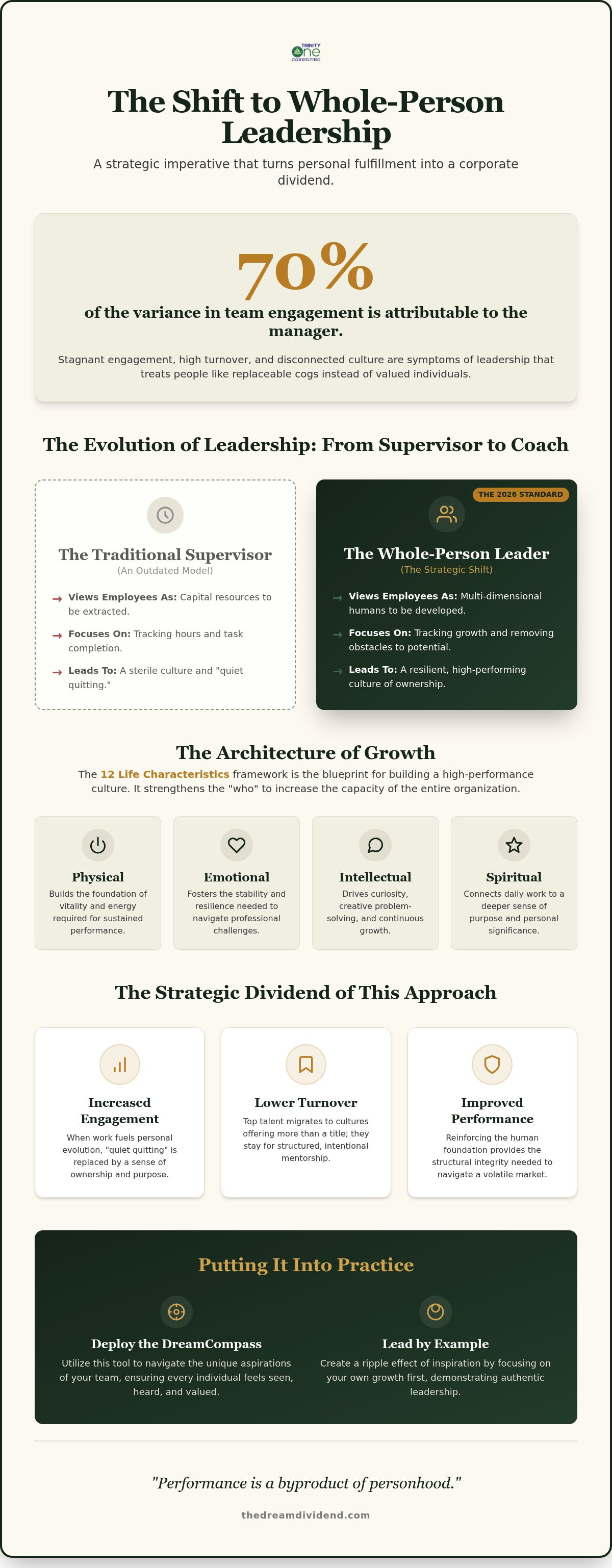
What if the most profitable investment you could make this year has nothing to do with software or market share? Many organizations treat talent like a line item to be optimized, yet they wonder why engagement scores remain stagnant, turnover rates climb, and corporate culture feels disconnected. The reality is that performance is a byproduct of personhood. You cannot effectively lead a professional without first leading the human. This shift toward whole person leadership development isn't just a soft skill trend; it's a strategic imperative for 2026 that turns personal fulfillment into a corporate dividend.
You likely recognize the fatigue of a sterile culture where employees feel like replaceable cogs rather than valued individuals. With 70% of the variance in team engagement attributable to the manager, the stakes for your leadership style have never been higher. Discover how to transform your organizational culture by leading the human through the Dream Manager framework. In this guide, we'll map the architecture of holistic leadership, utilize the DreamCompass tool to align aspirations, and examine how the 12 Life Characteristics foster sustainable growth.
Key Takeaways
- Transition from a traditional supervisor to a mentor by embracing whole person leadership development as your primary strategy for organizational health.
- Utilize the 12 Life Characteristics to build a robust framework for personal excellence, professional growth, and collective success.
- View human potential as a strategic asset that yields a significant dividend through increased engagement, lower turnover, and improved performance.
- Deploy the DreamCompass tool to navigate the unique aspirations of your team, ensuring every individual feels seen and valued as a multi-dimensional person.
- Lead by example by focusing on your own growth first to create a ripple effect of inspiration throughout the entire organization.
Table of Contents
What is Whole Person Leadership Development?
Traditional management is a relic of an industrial age that no longer exists. It views employees as capital resources to be extracted rather than human beings to be developed. Whole person leadership development flips this script by acknowledging that an individual's personal life and professional performance are inextricably linked. Traditional leadership development often fails in the modern, hybrid 2026 workplace because it ignores the blurred lines between home and office. This philosophy treats every team member as a multi-dimensional human with unique dreams, personal fears, and distinct aspirations. When you invest in the person, professional excellence follows as a natural byproduct.
The shift is profound and necessary. We're witnessing the evolution from the "Manager as Supervisor" to the "Manager as Life Coach." While a supervisor focuses on tracking hours and task completion, a life coach focuses on tracking growth and removing obstacles to potential. This isn't about hand-holding or lowering standards. It's about strategic alignment. If an employee’s personal life is in chaos, their professional output will eventually reflect that internal friction. By reinforcing the human foundation, you provide the structural integrity needed to navigate a volatile market.
The Evolution of the Human-Centered Workplace
By 2026, the labor market has become a battleground for meaning and purpose. A paycheck is now merely the entry fee, not the closing argument for talent retention. Employees demand work-life integration where their professional roles actively support their personal identities. This environment requires Authentic leadership that prioritizes self-awareness, balanced processing, and relational transparency. Organizations that fail to adapt find that their top talent migrates toward cultures offering more than just a title. They seek environments where they are encouraged to become the best version of themselves through intentional, structured mentorship.
Why "Whole Person" is the New Standard
Stagnant engagement scores are rarely about the work itself; they are a symptom of a deeper spiritual hunger for significance. People don't just want to "do" work anymore. They want their labor to contribute to their personal evolution. Holistic leadership addresses this by connecting daily tasks to the individual's larger life goals. This approach effectively eliminates the friction of "quiet quitting" because the employee is no longer just working for the company. They are working for their own future, fueled by a sense of ownership that traditional management cannot replicate. Whole person leadership is a strategic investment in human potential that compounds over time to produce a resilient, high-performing culture.
The Architecture of Growth: The 12 Life Characteristics
To build a structure that lasts, you need a blueprint. In the context of whole person leadership development, that blueprint is the 12 Life Characteristics. These aren't just abstract traits; they are the structural pillars of a high-performance culture. Most corporate training focuses exclusively on the "what" of a job. This framework focuses on the "who." When you strengthen the individual characteristics of your team members, you increase the load-bearing capacity of your entire organization. It's a strategic investment that pays dividends in resilience and innovation.
Mapping the 12 Life Characteristics
The framework categorizes human potential into physical, emotional, intellectual, and spiritual dimensions. Think of these as the primary coordinates for personal excellence. Physical vitality ensures energy, emotional stability fosters resilience, and intellectual growth drives creative problem-solving. By mapping these characteristics, a leader can identify specific gaps that hinder professional performance. This holistic approach is essential for becoming the best version of yourself, transforming leadership from a series of tasks into a meaningful journey of mentorship.
Measuring Holistic Progress
Sterile performance reviews often feel like post-mortem examinations. They look at what went wrong in the past rather than what could go right in the future. By using the 12 Life Characteristics, you shift the narrative from critique to curiosity. These traits serve as a diagnostic tool for team health, allowing you to spot burnout before it leads to turnover. Industry experts emphasize that developing the whole person is the only way to build the "muscle memory" required for modern leadership. You aren't just checking boxes; you're creating a shared language of excellence.
This methodology requires a delicate balance. You must still hit your professional KPIs, but you treat those metrics as the harvest, not the seed. The seed is the person. If you only focus on the output without tending to the individual, the soil of your culture eventually becomes depleted. Facilitating growth across these 12 dimensions ensures that your team remains engaged and productive. To see how these principles translate into a tangible ROI for your organization, explore the strategies offered at The Dream Dividend. This is how you move beyond management toward a legacy of impact.
Beyond Soft Skills: The Strategic Case for Holistic Leadership
Skeptics often dismiss human-centric initiatives as "fluffy" or "soft." This is a strategic error that ignores the fundamental mechanics of organizational health. In a marketplace where talent is the primary differentiator, whole person leadership development is the highest-yielding asset in your portfolio. It isn't about being nice; it's about being effective. When you lead the human, you unlock a level of discretionary effort that traditional management styles can't touch. This shift transforms your culture from a cost center into a value-generating engine.
The ROI of Aspiration
Business leaders must look at the bottom-line reality of engagement. Since 70% of team engagement variance is tied directly to the manager, the financial stakes of your leadership style are immense. By analyzing Dream Manager ROI, organizations discover that investing in employee aspirations leads to a significant reduction in turnover costs. High turnover is an expensive leak in your balance sheet, often costing thousands in recruitment and training for every mid-level departure. A purpose-driven culture compounds over time, creating a "Dream Dividend" where personal fulfillment and corporate profitability grow in tandem. You don't just lower your expenses; you increase your capacity for innovation.
The Dream Manager Framework as a Competitive Edge
Implementing the dream manager framework provides a distinct competitive advantage in the 2026 labor market. Top talent no longer settles for standard benefits packages or sterile office environments. They want to know that their employer will help them achieve their personal dreams, navigate life's challenges, and become the best version of themselves. This level of commitment differentiates your employer brand from the sea of generic corporate competition. It builds a resilient organization through empowered individuals who feel truly seen. When an employee knows you are invested in their life, they become deeply invested in your mission. This is the foundation of whole person leadership development, where loyalty is earned through mutual growth and shared success.
Implementing Whole Person Growth with the DreamCompass
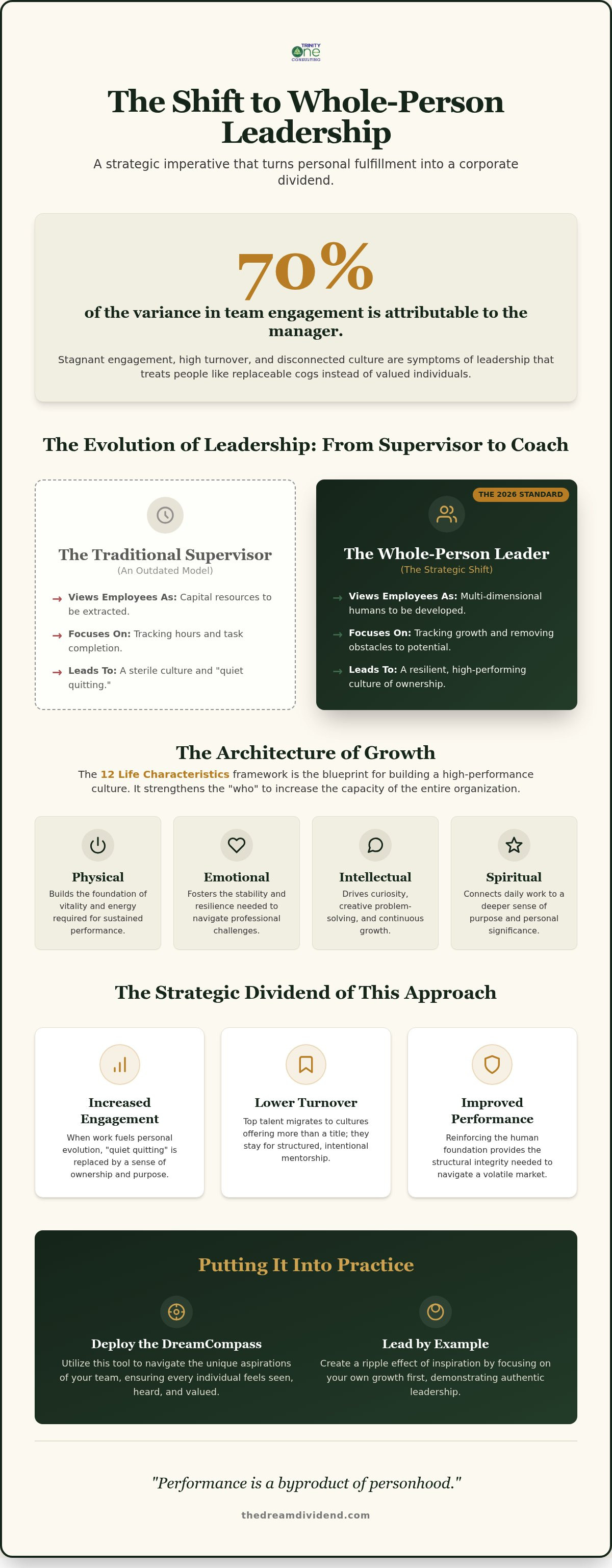
Theory alone won't transform a culture. To move whole person leadership development from a high-level philosophy to an operational standard, you need a repeatable, structural methodology. It begins with a radical shift in perspective. You must identify the dreams and aspirations of every team member. Most managers understand their employees' professional KPIs, yet they remain blind to their personal ambitions. You cannot lead a person you don't truly know. Once these aspirations are surfaced, utilize the DreamCompass tool to provide a clear roadmap for tracking and alignment. This process ensures that personal growth isn't a side project; it's integrated into the very fabric of the organization's mission.
Execution requires consistency. You must create a cadence of accountability where personal and professional milestones are discussed with equal rigor. This isn't about micromanagement. It's about mentorship. When a leader treats a team member's personal dream as a valid priority, they build a bridge of loyalty that no salary increase can replicate. Finally, celebrate the achievement of personal dreams as corporate wins. Whether an employee finishes a degree or saves for their first home, these are victories for the culture. They signal that the organization values the human, not just the output.
Navigating Personal Growth with the DreamCompass
The DreamCompass acts as a navigational instrument for the "Best Version of Yourself" framework. It provides the visual tracking necessary for long-term aspirations that often get buried under the weight of daily deadlines. By mapping out these goals, employees gain a sense of agency and direction. This tool encourages transparency between leaders and their teams, fostering a level of trust that traditional reporting structures simply lack. It transforms the manager-employee relationship from one of oversight to one of shared investment in a better future.
Training Managers to be Dream Managers
Scaling this human-centric culture requires a specific set of coaching skills. You must train managers through a certified dream manager program to ensure they can facilitate these conversations effectively. Many busy leaders object that they don't have time for "life coaching." However, dream management consulting reveals that these human-focused conversations actually save time by reducing friction, improving clarity, and boosting employee autonomy. If you're ready to lead this transformation in your organization, you can become a Certified Dream Manager today. Investing in your leaders' ability to coach the whole person is the most strategic move you can make for long-term organizational health.
Cultivating Your Own Dream Dividend
Whole person leadership development is not a program you merely implement for your subordinates; it's a philosophy you must first embody. Authentic transformation is a top-down phenomenon. If you aren't actively pursuing your own dreams, you can't expect your team to believe in the framework you're presenting. This is where the ripple effect begins. When a leader models personal excellence, they create a permission structure for everyone else to do the same. This movement from a standard management style to organizational culture transformation is ultimately about your personal legacy as a strategic architect of human potential. It requires courage, clarity, and commitment.
The Best Version of Yourself as a Leader
True leadership requires a rigorous self-assessment. Are you currently pursuing your own dreams? Modeling the 12 Life Characteristics isn't about achieving perfection. It's about demonstrating the process of growth. Vulnerability is a vital tool here. When you share your own aspirations and setbacks, you bridge the gap between executive authority and human connection. This transparency builds the trust necessary for a dream-driven culture to thrive. You become a guide who leads by example, showing that becoming the best version of yourself is a continuous, rewarding investment. Inspire your people, protect your culture, and grow your bottom line.
Your Next Strategic Move
Transformation doesn't have to happen overnight. Start small. You can pilot a Dream Manager initiative in a single department to observe the immediate impact on engagement and retention. This allows you to gather data, refine your approach, and prove the ROI before scaling across the entire organization. For ongoing inspiration and tactical advice, listen to The Dream Dividend Podcast. It provides a steady stream of insights for leaders committed to purpose-driven growth. The transition to this model is the most significant strategic move you can make for your organization's future health. If you're ready to secure your own dream dividend, schedule a consultation to begin your Dream Management journey today. Invest in the human. Reap the results. Secure the legacy.
Securing the Future of Your Human Capital
The 2026 labor market doesn't reward sterile management; it demands a culture where individuals are seen, valued, and developed. By adopting whole person leadership development, you transition from a mere supervisor to a strategic mentor who understands that personal aspirations fuel professional results. We've explored how the 12 Life Characteristics provide a structural foundation for excellence, how the Dream Manager framework creates a competitive edge, and how identifying personal dreams builds an unbreakable bond of loyalty. You're no longer just managing tasks. You're architecting potential.
Performance is the harvest, but the person is the seed. When you invest in the human, you secure a dividend that compounds through increased engagement, lower turnover, and sustainable innovation. If you're ready to move beyond traditional consulting toward a legacy of impact, transform your leadership culture with Dream Management Consulting. Our approach utilizes Certified Dream Manager expertise, the proprietary DreamCompass tool, and the world-renowned principles of Matthew Kelly’s "The Dream Manager." The path to becoming the best version of your organization starts with a single, human-centric conversation. Lead with purpose, inspire with vision, and build for the long term.
Frequently Asked Questions
What is the difference between whole person leadership and traditional coaching?
Traditional coaching often stops at the office door, focusing strictly on professional competencies and task-oriented output. Whole person leadership development expands this scope by addressing the individual's physical, emotional, and spiritual well-being. It treats personal aspirations as the engine for professional success. While traditional coaching fixes performance gaps, this model cultivates the human foundation. By helping employees become the best version of themselves, you resolve the underlying issues that cause poor performance in the first place.
How does the Dream Manager framework help with employee retention?
The Dream Manager framework reduces turnover by proving to employees that the organization is invested in their personal future. When a leader helps a team member achieve a personal dream, such as buying a home, it creates a bond of loyalty that salary alone cannot match. This approach transforms the workplace from a mere transaction into a meaningful partnership. Employees stay because they feel seen, valued, and supported in their life journey.
Can whole person leadership be applied in a remote or hybrid work environment?
Whole person leadership is actually more critical in hybrid settings where the physical boundaries between work and life have vanished. Leading the human requires intentional connection that transcends digital screens. Managers use tools like the DreamCompass to facilitate deep conversations about well-being and personal progress, preventing the isolation often felt by remote workers. By focusing on the individual's total life experience, you maintain a cohesive culture regardless of where your team members are physically located.
What are the 12 Life Characteristics used in this leadership model?
The 12 Life Characteristics serve as a comprehensive roadmap for personal excellence across four primary pillars:
- Physical: Your health, energy, and vitality.
- Emotional: Your stability, resilience, and relationships.
- Intellectual: Your curiosity, learning, and mental growth.
- Spiritual: Your purpose, meaning, and character.
This framework provides a common language for growth. It allows leaders to identify specific areas where a team member might need support to reach their full potential and perform at their highest level.
Is a Certified Dream Manager program necessary for small businesses?
While small business owners can begin with simple human-centric conversations, a Certified Dream Manager program provides the methodology needed to scale a culture of excellence. Certification ensures that your leadership team has the specific coaching skills required to navigate delicate personal aspirations without overstepping professional boundaries. It offers a repeatable system that prevents the initiative from fading when the business gets busy. For small teams, this structure is often the difference between a temporary trend and a permanent legacy.
How do you measure the ROI of investing in employee dreams?
You measure the ROI by tracking tangible metrics like turnover rates, recruitment costs, and engagement scores. When you invest in whole person leadership development, you typically see a decrease in absenteeism and a rise in discretionary effort. These financial dividends are the result of a more resilient workforce. By comparing the cost of the program against the savings from reduced talent attrition, organizations can calculate a clear strategic return on their human investment.
What happens if an employee’s dream is to leave the company?
If an employee's dream is to pursue a different path, a whole person leader supports that transition with transparency and grace. While this seems counterintuitive, it fosters a culture of radical honesty where people don't hide their intentions. Often, an employee who feels supported in their eventual exit will perform at their highest level during their tenure. These individuals become powerful brand ambassadors who attract new, high-quality talent to your human-centric organization.
How do I start implementing whole person development without a large budget?
Implementation can begin immediately through the simple act of listening to your team members' aspirations. You don't need a massive budget to ask, "What is one personal goal you want to achieve this year?" and "How can I support you?" Start by integrating these questions into your regular meetings. As you build trust and see the results, you can gradually invest in more formal tools like the DreamCompass to deepen the impact.